Posted August 9, 2013 by Anna Claussen
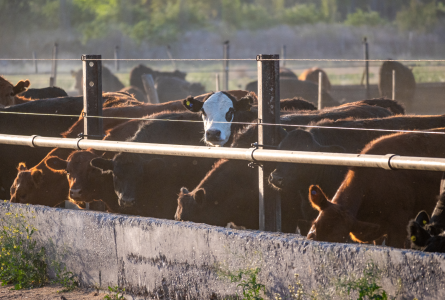
Farmfest is the largest farm show in Minnesota, bringing farmers together to talk about and see the latest in tractors, seeds, and other farm-related equipment. But Farmfest also brings out the politicians to talk about what is happening with agricultural policies and markets. With no farm bill in place, the question understandably on everyone’s minds at this year’s policy panel was “What’s next?” While the policymakers in attendance did a pretty good job of explaining how we got where we are today, the future of farm policy was left unclear.
Representatives Colin Peterson and Tim Walz, both of whom are on the House Agricultural Committee and participated in the policy discussion, gave their perspectives on why Congress still hasn’t passed a Farm Bill. Peterson and Walz pointed to the relatively speedy and nonpartisan work of the House and Senate agricultural committees, as well as the ongoing support of both parties’ leadership; they made clear that the fault didn’t lie there. Instead, the blame was leveled squarely at Eric Cantor and his fellow right-wing Republicans, who broke with their party’s leadership and scuttled the deal that the agricultural committee had developed. Both representatives were quite pessimistic of the possibility of passing a Farm Bill in the remaining months of 2013; Representative Peterson suggested that a 2-year extension was the most likely outcome, followed by many questions about whether we would actually have a Farm Bill (as we know it today) ever again.
Posted August 8, 2013 by Andrew Ranallo
Ask anyone who's been working on policy-change or advocacy efforts in any arena long enough and they’ll tell you: Change takes time. Except in very rare cases, big, noticeable shifts take years—often decades—of work by countless people, working on all levels and in different ways to achieve change. On one hand, this glacial pace makes sense. After all, it took years to get where we are—a climate on the fritz, food for some while others go hungry, a financial system that is more akin to an online casino—why should getting somewhere else be any quicker? On the other hand, if we aren’t able to think big about the changes we want, and get caught up in little victories, we risk losing sight of our real goals.
It is in this spirit that Oxfam held an online discussion last year calling on experts from across the food and development policy world to write a series of essays focused on four “big picture” questions:
Posted August 7, 2013 by Dr. Steve Suppan
The launch of the Transatlantic Trade and Investment Partnership (TTIP) negotiations presents a new challenge to commodity and financial market reform. Those reforms, codified in the U.S. in rules authorized by the Dodd-Frank Wall Street Reform and Consumer Financial Protection Act of 2010, are intended to prevent a reoccurrence of the big bank bankruptcies that were avoided only by the nearly $30 trillion bailout of mostly U.S. and European financial institutions from 2007 to 2010. The U.S. Department of Treasury has announced its opposition to the inclusion of financial services in the TTIP. However, according to Inside U.S. Trade (subscription required), the Office of the U.S. Trade Representative (USTR) said that it was evaluating the benefits of including financial services, and U.S. Trade Representative Michael Froman said that financial services would be included.
Posted August 1, 2013 by Dale Wiehoff
Earlier this week, Andrew Pollack reported in the New York Times that biotech companies like Monsanto, Dupont and Dow Chemical announced through an industry association that they would be more transparent with the public about the chemicals and genetically modified seeds they sell. According to Cathleen Enright, executive vice president at the Council for Biotechnology Information (BIO), “We have not done a very good job communicating about GMOs. We want to get into the conversation.”
To move that conversation along, they’ve opened a new web site, GMOAnswers.com. Any move toward greater transparency from companies who have spent decades suing farmers, spending millions to prevent the labeling of food containing GMOs, hiring private security firms to break into their critics offices and steal information—not to mention generally bullying anybody who questions the safety and value of their products—should be good news. But like with most news from chemical and seed companies, it is another reason to worry that the public will be misled and the issues will be futher obfuscated.
Posted July 19, 2013 by Colleen Borgendale
In late June, alumni from the past eight classes of the IATP Food and Community Fellows program met for the last time against the backdrop of the Snoqualmie Falls outside of Seattle. Almost every class was represented at the event heldand its alumni and to discuss the future of the network within the context of the larger food movement.
Launched in 2001 as the Food and Society Policy Fellows, the program was originally envisioned as a “public policy education team” that would work in support of the vision and goals of this new program at the W.K. Kellogg Foundation and hosted by IATP. The Fellows were innovative changemakers who advocated for food and farming systems that would be just and healthy for all people. The program nurtured the development of 86 alumni, many leaders in their fields, and helped make major contributions to the growing food movement. In late 2012, the W.K. Kellogg Foundation announced that it would no longer be funding the Fellows’ program.
A reception featuring local fruits and beverages and a dinner highlighting Washington cuisine kicked off the event allowing Fellows to share stories, meet alumni from other classes, reconnect and discuss the latest news and ideas in their fields. Discussions included the challenges of modern fishing, mushroom foraging and the finer details of what was served for dinner that evening.
Posted July 17, 2013 by Dale Wiehoff
In the early morning hours Monday, on a remote road near the Texas-Mexico border, Mexican marines picked a deadly and rotten piece of fruit when it captured Miguel Angel Treviño Morales, the sadistic boss of Los Zetas criminal cartel. Los Zetas appeared on the scene in 1999, an elite unit of the Mexican military that went rogue, working at first for the Gulf drug cartel and eventually breaking off to form their own criminal organization known for employing extremely brutal methods of torture, terror and mass murder. Los Zetas quickly became a major force in Mexican drug trafficking.
Drug cartels existed long before the passage of the North American Free Trade Agreement (NAFTA) in 1994, but not drug cartels as we know them today. As we approach the 20th anniversary of NAFTA, we can no longer ignore its contribution to building a powerful and violent criminal enterprise that has brought Mexico close to being labeled a failed state and made the Mexican-U.S. border into a war zone.
Most often when we analyze trade agreements, the focus is on trade volumes, jobs and manufacturing statistics, poverty levels and immigration—all extremely important ways to understand the impact of neoliberal policies bequeathed to us from Ronald Reagan and Bill Clinton. But to fully appreciate how devastating free trade has been, we need to look more closely at the aftermath of free trade on the bonds that hold communities together. It starts out small, a single thread that eventually leads to unraveling the whole cloth.
Posted July 17, 2013 by Dr. Steve Suppan
In September 2009, the Group of 20 Leaders, including President Barack Obama, announced their commitment to regulate the over-the-counter (OTC) commodity and financial derivatives market. Since then, however, ferocious industry resistance, abetted by sympathetic lawmakers, has frustrated realization of this commitment. Substantive differences in law and market infrastructure, combined with this resistance, have made the reform process a long and winding road without a comprehensive agreement on how to prevent another OTC-triggered global financial crisis.
It would be hard to overstate the impacts of the 2008 financial meltdown. Losses among major players in the global OTC market threatened to bankrupt the global financial system. Taxpayer-funded bailouts of the world’s largest banks and nearly $30 trillion of U.S. Federal Reserve Bank emergency ultra-low interest rate loans saved the banks from losses for which they had woefully inadequate reserves to pay up. The General Accountability Office (GAO) has estimated the financial damage to the U.S. economy from the OTC market meltdown at about $13 trillion, to say nothing of untold costs of human suffering.
Posted July 9, 2013 by Kathleen Schuler, MPH
We are all hearing a lot about obesity these days and more people are obese than ever; one-third of American children and two-thirds of adults are overweight or obese. The American Medical Association has declared that obesity is a disease.
While some disagree with the designation of obesity as a disease, there is strong evidence that obesity is linked with diseases—specifically Type II diabetes and heart disease. There is also general agreement that obesity is a major public health problem. Preventing obesity would contribute to a healthier, happier population and save an estimated $190 billion per year in direct health care costs.
But how do we prevent obesity? We all know that we should eat healthier and exercise more to maintain a healthy weight, but few people are aware that avoiding exposure to certain chemicals could reduce their risk of obesity, especially during prenatal life and in childhood. An emerging body of science links chemicals that disrupt hormones to increased risk for obesity.
Fetuses and children are the most vulnerable to adverse health effects from hormone-disrupting chemicals. Like hormones themselves, these chemicals exert health impacts even at minute levels of exposure and exposures in the womb can have lifelong impacts.
Posted July 3, 2013 by Karen Hansen-Kuhn
Transparency and trade negotiations don’t seem to go together these days. Recent revelations in Spiegel disclosed that the U.S. government had been spying on its EU “partners” connected to negotiations on the Transatlantic Trade and Investment Partnership (TTIP, probably better stated as the Trans Atlantic Free Trade agreement, or TAFTA, which very much rhymes with NAFTA). The French and German governments are outraged, with some parliamentarians calling for a suspension of the talks, slated to start next week in Washington, D.C.
Unfortunately, the only way civil society groups find out about the negotiations are through basically one-way conversations, where we express our concerns to trade officials, or through leaked negotiating documents. One such text came our way over the weekend, a set of position papers summarizing some of the EU’s initial goals on regulatory harmonization, which would be sent to the U.S. ahead of the talks. It includes initial proposals on regulatory issues involving the automotive sector, chemicals, pharmaceuticals, Sanitary and Phytosanitary issues (SPS), competition policy, a proposal for a chapter on trade and sustainable development, trade in raw materials and energy, and an ambitious proposal for cross-cutting disciplines on regulatory issues. It starts out by asserting that, “the TTIP offers a unique chance to give new momentum to the development and implementation of international regulations and standards (multilateral or otherwise plurilateral). This should reduce the risk of countries resorting to unilateral and purely national solutions, leading to regulatory segmentation that could have an adverse effect on international trade and investment.”
Posted June 24, 2013 by Dr. Steve Suppan
A recent announcement by the European Commission has consequences for anyone affected by an interest rate, the price of oil or the price of wheat [read: everyone].
On June 15, Reuters reported that the European Commission had decided to extend the deadline for U.S. financial firms to comply with European Securities Market Authority (ESMA) regulatory deadlines. However, the compliance concession is deceptive since ESMA has yet to finish issuing rules that would apply to EU and non-EU financial firms. Rules to implement the Dodd-Frank Wall Street Reform and Consumer Protection Act require that most trades be “cleared” on a central platform, to protect other market participants from the consequences of default by one or more counterparties to a trade.
Indeed, the U.S. and EU are among the Group of 20 members that committed to centralize clearing in 2009. ESMA is still trying to decide which commodity and financial contracts will have to be cleared. Other European market reform legislation has yet to be passed, much less implemented. In addition to extending its own deadline, the European Commission is hoping to use the “concession” as a bargaining chip to push the Commodity Futures Trading Commission (CFTC) into extending its July 12 compliance deadline for European financial firms on rules it has finalized. This proposed exchange for a European deadline extension to comply with rules it has yet to finalize, is disingenuous. Perfect synchronicity and harmonization in transatlantic rulemaking is not achievable. The CFTC should not, yet again, extend its compliance deadline beyond July 12 in response to the Commission’s gambit.