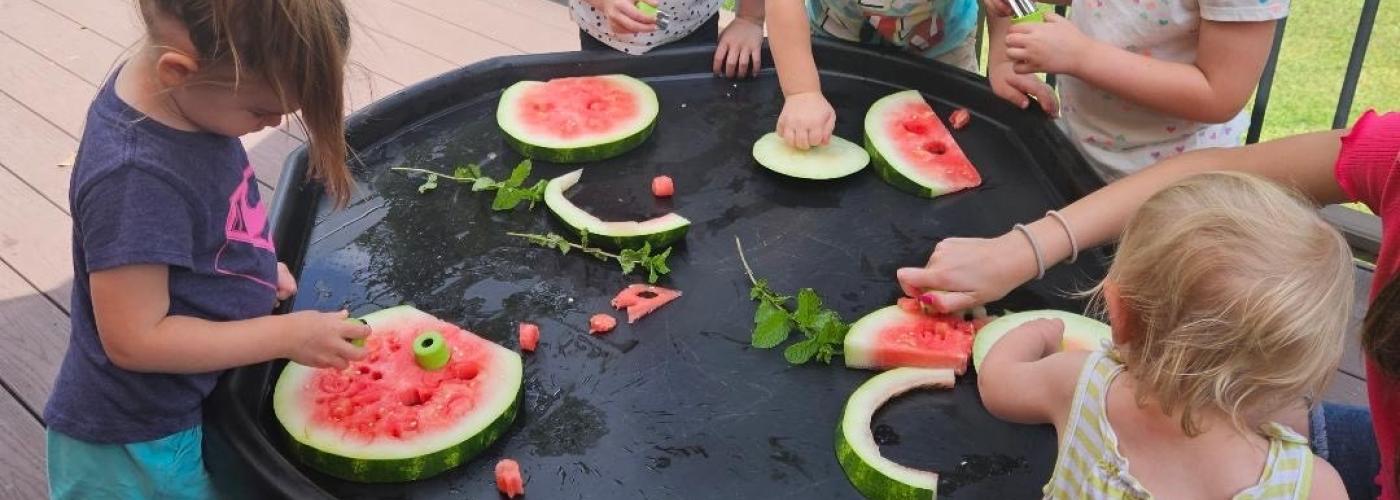
Farm to Early Care programs have been growing across Minnesota, with increasing numbers of early care providers talking about and sourcing local food for the kids they care for. Early care centers and now home-based providers are eligible recipients for the Minnesota Department of Agriculture’s (MDA) Farm to School and Early Care grant dollars. Our partners have made strides delivering CSA (Community Supported Agriculture) boxes, implementing school gardens, and so much more.
IATP, together with the University of Minnesota Extension, was excited to contribute to the expansion of resources by adapting Minnesota’s Harvest of the Month materials to include Minnesota Harvest of the Month for Early Care, a set of early care-specific resources and recipes inspired by the foods grown here in Minnesota.
The resources were pilot-tested by a group of providers around the state, including a larger place-based pilot in Hutchinson, Minnesota. Hutchinson is a community of approximately 15,000 residents, just over an hour west of Minneapolis. We were able to integrate Harvest of the Month for Early Care draft resources with Hutchinson’s larger project that included delivering local produce weekly to early care sites.
Hutchinson Place-Based Pilot
“Wait, you’re the one delivering peppers to daycare? My kids came home raving!”
The buzz about veggies is one great benefit of Hutchinson’s effort to distribute locally grown fruits and vegetables to early care providers around the city. The pilot enrolled 20 providers, including four childcare centers, and 16 home-based providers. In total, the pilot reached about 600 children, representing nearly 75% of children in licensed care settings in Hutchinson. Providers received a weekly delivery of a local produce item, along with Harvest of the Month resources and activities to explore, and recipe ideas for serving.
The pilot was an initiative bringing together a variety of local partners including the Hutchinson Childcare Coalition, and logistical support from Aimee Haag, the Farm to School coordinator for Hutchinson-Dassel-Cokato public schools. The local health foundation and Statewide Health Improvement Partnership (SHIP) also supported pilot efforts. Communication and promotion from partners such as their county licensor, local health foundation, and others ensured this was truly a community effort.
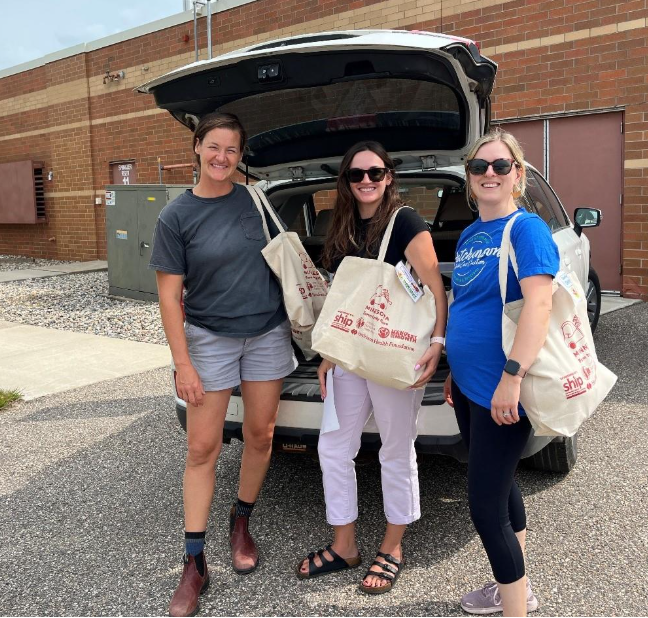
L-R: Aimee Haag, Liz Danielson and Ari Zaske load watermelons for delivery to providers.
Harvest of the Month Products
Integrating drafted early care versions of Harvest of the Month resources as part of this pilot allowed many more providers to review and provide feedback on the resources to ensure that the activities and recipes included are age-appropriate, engaging, and feasible for early care settings. Feedback from Hutchinson providers, other cohorts of providers around the state, and expertise from the Hmong Early Childhood Coalition (HECC) all informed the adaptation of draft materials. Feedback from early care providers was directly incorporated into the final products, including coloring sheets, easy crafts, toddler-oriented engagement, and more.
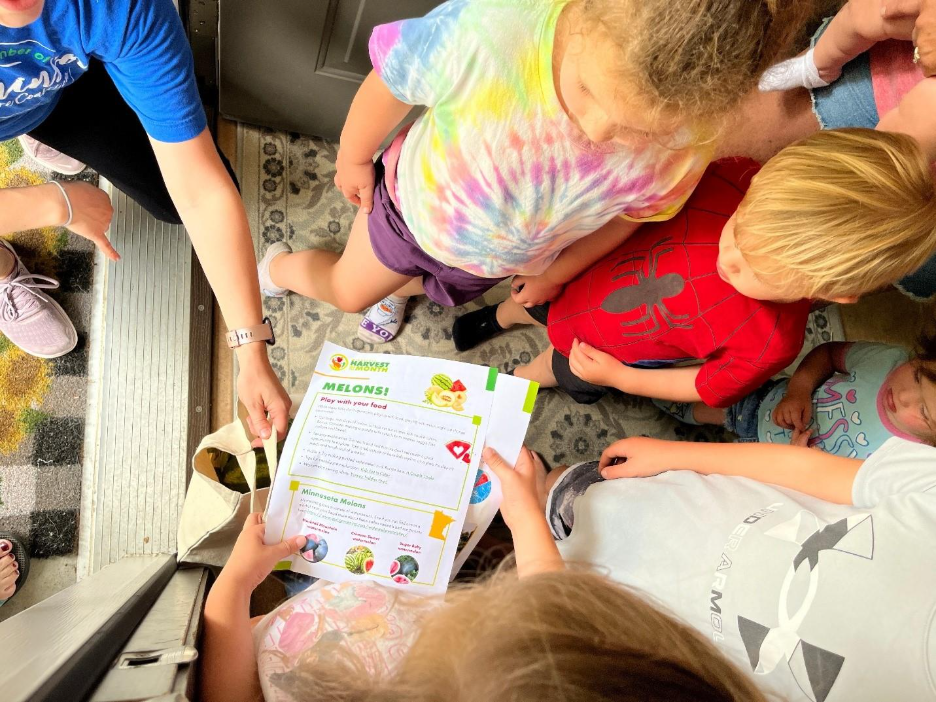
Kids at a Hutchinson daycare explore their bag!
Suggestions for Starting your own Farm to Early Care Project
For others wanting to kick-start a local effort, Haag recommends the following:
Let things marinate: It took time to identify people able to support the effort and build relationships.
Leverage local abundance: Haag’s Farm to School role means she started out already knowing local farmers and what products they have. Identifying a local grower, farmers’ market manager, or other local resident who can learn what your community grows is a great place to start.
Scale: The Hutchinson project was able to scale the amount of product each week, so each provider received amounts appropriate for the recipe of the week (see Table 1 for estimate amounts used during the Hutchinson pilot). In addition to scaling product amounts, Haag noted the importance of adjusting your plan based on what local products are available and your own capacity. Start with just one activity or product if that’s what you have in abundance!
Use tools to simplify: Haag stated what she appreciated about the Harvest of the Month resources is providing a frame. She says, “It’s such a good framework to build a system and to build inspiration...it takes a little bit of the mental energy out. Here’s something turnkey, let’s use that!”
We are pleased to share the final early care Harvest of the Month resources, including audio files and a mustard greens resource created by HECC, and written English, Somali and Spanish resources available online.
Early care providers in Minnesota can apply for Farm to School and Early Care grants to be reimbursed for local food purchases. The application deadline is October 23, 2025. Learn more and apply here: www.mda.state.mn.us/farm-school-early-care-programs