Minnesota has supported schools in purchasing local foods and equipment for more than a decade through the state’s Agricultural Growth, Research, and Innovation (AGRI) Farm to School Grant Program, administered by the Minnesota Department of Agriculture (MDA). This state-funded grant program, which started in 2013, originally provided funding to K-12 schools for planning projects and kitchen equipment and then shifted in 2019 to reimburse grantees for purchases of Minnesota grown and raised foods. For further history of the grant program, see the 2023 survey report of grantees and the fiscal year 2021 (FY21) evaluation report.
This report specifically focuses on Fiscal Year 2023 (FY23) grants, which were unique due their support from federal funding received by MDA from the USDA’s Local Food for Schools (LFS) Cooperative Agreement Program. This report includes the purchasing patterns of grantees, including methods, products, successes, and challenges. It also documents the overall economic impact of this infusion of funds on the local economy.
Minnesota’s Local Food for Schools Funding
MDA was able to award significantly more Farm to School grants in FY23 due to federal funding received from the U.S. Department of Agriculture (USDA) Local Food for Schools (LFS) Cooperative Agreement Program. These LFS funds, received and administered by the MDA, aimed to “strengthen the food system for schools by helping to build a fair, competitive, and resilient local food chain, and expand local and regional markets with an emphasis on purchasing from historically underserved producers and processors.” The MDA sub-awarded LFS funds through their existing Farm to School competitive grant structure to reimburse school districts for local food purchases.
MDA received grant requests for more than $5.3 million in FY23 and awarded $3.46 million in LFS funding for Farm to School local food purchase reimbursement grants. This represented approximately four-times the funding administered in previous years. The MDA also awarded $769,714 in Farm to School kitchen equipment grants using state funding. With funding from a 2023 USDA Patrick Leahy Farm to School grant, the MDA contracted The Institute for Agriculture and Trade Policy (IATP) to conduct evaluation on the FY23 grants. IATP, working with the University of Minnesota Extension, extracted line-item data provided by MDA staff from school reimbursements, including invoices from wholesalers, individual farmers, and food hubs. We analyzed purchasing patterns and economic impact.
MDA has reimbursed $3.37 million (95%) as of the time of this report, spanning purchases made between February 2023 through January 2025. The small portion of the remaining LFS funds will be awarded and spent by June 30, 2026. Purchasing records by grantees sometimes included a small amount of purchasing beyond grant funds, as final invoices may have reflected more eligible expenditures than remaining funds.
Grant Type
As in previous years, MDA offered two types of Farm to School grants in FY23: “First Bite” and “Full Tray” awards. First Bite Grants offered $2,500 to $10,000 to school districts with little to no experience with local procurement. The Full Tray Grant, for schools with some local procurement experience, offered funding based on the number of meals the school served, with a minimum award of $2,500 and a maximum award of $100,000. Full Tray applicants could also request up to $50,000 in Second Helping Funds, beyond their formula-based amount.
Schools can only be awarded First Bite grants once, then they must apply for the Full Tray grant, which typically requires a 1:1 cash match — but due to the federal infusion of funds, Full Tray awards did not require matching funds for FY23.
A total of 111 schools utilized Farm to School grants, with an approximately even breakdown of First Bite (55) and Full Tray (56) grants. However, most funds (87%) were distributed as Full Tray awards due to the higher funding amount through those grants.
Eligible Food Purchases
FY23 (LFS) grant funding reimbursed schools for purchases of Minnesota-grown or produced food served as part of the school’s or school district’s participation in the National School Lunch Program (NSLP) and School Breakfast Program (SBP). Food needed to be unprocessed or minimally processed, in accordance with USDA definitions, and be grown or raised in Minnesota. In alignment with original LFS programmatic priorities, grantees were encouraged to buy food from small businesses and socially disadvantaged producers.
Purchasing Methods
Most food purchases (63%) were direct from Minnesota farmers or food businesses (including food hubs). Purchases were made from a total of 501 producers and businesses, a significant increase from the FY21 analysis that identified 58 vendors. As part of this funding, grantees asked producers if they identified as small businesses, and whether they identified as socially disadvantaged producers, an umbrella term defined by the USDA including veterans, women, people of color, and others. Over 75% of purchases using FY23 funds went to vendors identified as small businesses (78.6%), and nearly 20% of the total funds went to those identified as socially disadvantaged (19.8%).
Food hubs were another important source of purchases. These ranged in structure, from operators aggregating food for a small group, to farmers market food hubs, to traditional brick-and-mortar businesses. Finally, wholesale distributors encompassed nearly one fourth of purchases (24%).
Sourcing varied across grant types, with a higher proportion of First Bite grant funds using direct sales (77.6% vs. 60.6% for Full Tray), while a greater portion of Full Tray funds went through wholesalers (25.3% vs. 14.4% for First Bite).
Product Mix
Proteins were the largest category of purchases, at 48% of sales. Beef was the single largest category within the protein category, including a wide variety of types from ground beef to stew meat to whole steers. But bison, chicken, pork, turkey, and yak were all reflected in purchasing, along with dried beans, eggs, fish, and tofu.
Fruit and vegetables, the mainstays of Farm to School purchasing, together reflected 40% of sales. Apples were the most popular fruit, and one of the most popular items of any kind. Vegetables reflected a much wider variety, with lettuce as the single largest vegetable purchase followed by carrots and tomatoes.
Finally, schools purchased a variety of other types of unprocessed and minimally processed products. Oats, flour with local grains, maple syrup, wild rice, and honey were just a few of the wide variety of local products schools purchased.
Economic Impact Analysis
As part of the evaluation process, University of Minnesota Extension completed an analysis to measure how farm-to-school funding impacted the state’s economy.
About economic impact analysis
Economic impact includes direct, indirect, and induced effects. Direct effect is spending directly for the project or activity. In this analysis, it is the spending by schools for local foods spurred by the grant funding. To quantify the direct effects, MDA provided the University of Minnesota Extension with school district receipts detailing what food item was purchased and spending for those items.
Economic impact terms
Direct effect: initial change
Indirect effect: business-to-business impacts
Induced effect: consumer-to-business impacts
Indirect and induced effects are also known as “ripple” effects. Spending on goods and services in the supply chain generates indirect effects. For example, a school district purchases cheese produced by a local company. To produce the cheese, the local company will in turn purchase goods and services from its suppliers, creating an increase in the supply chain. Spending by the company’s employees — spurred by their paychecks — generates induced effects. Workers are paid and then purchase items, such as health care, housing, and groceries.
Extension used the input-output model IMPLAN to measure the economic impact of the farm-to-school funding. Input-output models capture the flow of goods and services within an economy. Once the pattern is established, the model can show how a change in one area of the economy (say, food purchases) affects other parts of the economy (such as manufacturing and health care).
Farm-to-school economic analysis
The $3.37 million in farm-to-school funding generated an additional $3.16 million in economic activity in Minnesota through increased demand for products. These additional sales generated an equivalent of 16 new full-time jobs in the state ($1.1 million in labor income) in businesses through an increased demand of suppliers (indirect effect) and spending by employees (induced effects).
Extension generated these impacts in IMPLAN by measuring the impact of sales through wholesalers and direct from farmers, then combining the two for total economic impact in the state considering the importance of local foods sourced through wholesalers and food hubs (24%).
Certainly, the largest impact of farm-to-school was the direct impact with Minnesota farms. A total of $2.2 million was sourced directly from farms, whereas Extension estimated that an additional $1 million landed in Minnesota farmers’ pockets from sales through wholesalers (assuming a 20% margin going to wholesale businesses).
Income received by Minnesota Farms
Direct
$2,204,138
Wholesale*
$1,038,729
*Includes sales to schools through traditional wholesalers and food hubs
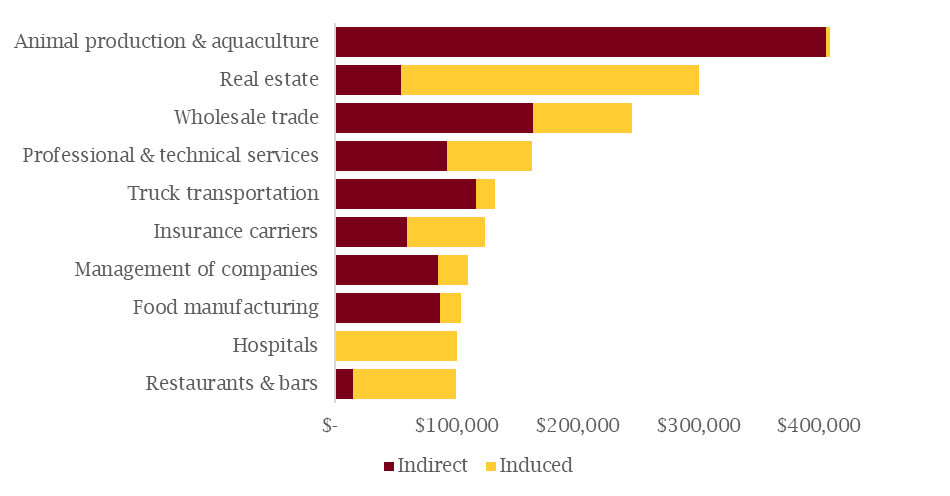
Spurred by this direct effect, an increase in sales for farm-to-school also rippled through other industries throughout Minnesota as measured by indirect (demand for additional supplies) and induced impacts (demand from employee spending).
Top ten industries impacted by output (does not include direct impact)
Final Report Theming
Final reports submitted to date at the end of the report period were analyzed for themes across submitted responses. There were several noted successes and barriers to grantees’ experience with grant funds. Special thanks to Amanda Nelson, who supported the theming and analysis of final reports.
As with any program, grantees did note a variety of challenges. Sourcing, regulations, and documentation were noted as key challenges. Sourcing was one of the most common challenges, including identifying farmers, handling ordering, and coordinating delivery. Processing and storage were another challenge, including the availability of USDA or MN Equal To inspected facilities for meat processing. In addition to these operational obstacles, tracking invoices and providing proof of purchases and submitting reports were noted as challenges for utilizing grant funds.
Schools noted significant benefits to this program — staff appreciated the ability to source high quality, locally grown and raised products. Students and staff noted the high quality of locally grown products, and both students and staff noted appreciation for supporting local farmers through school meals. One school noted, “The products were amazing, taste, quality everything about the products. We could tell by the increase in serving that the students ate more.” Several indicated how related signage, corresponding field trips, and classroom learning augmented the educational opportunity afforded by local sourcing.
Conclusion
The MDA’s FY23 Farm to School grants, funded by the USDA Local Food for Schools (LFS) program, supported over $3 million in local food purchasing by local districts and generated over $3 million in additional economic activity. Over 100 school districts supported over 500 farmers and food businesses using funds from this grant program. Schools purchased a wide variety of products, with proteins occupying a significant portion of purchases, but fruits and vegetables remained popular choices. Schools are thinking about purchases around the plate, including dairy, grains, and other local items like honey and maple syrup.
Schools noted a variety of benefits to the program and continue to request support in building connections with local growers, and ways to streamline purchasing and distribution. Most purchases are still direct from farmers, but wholesalers and food hubs are important resources for districts, particularly for larger districts and those in the metro area.