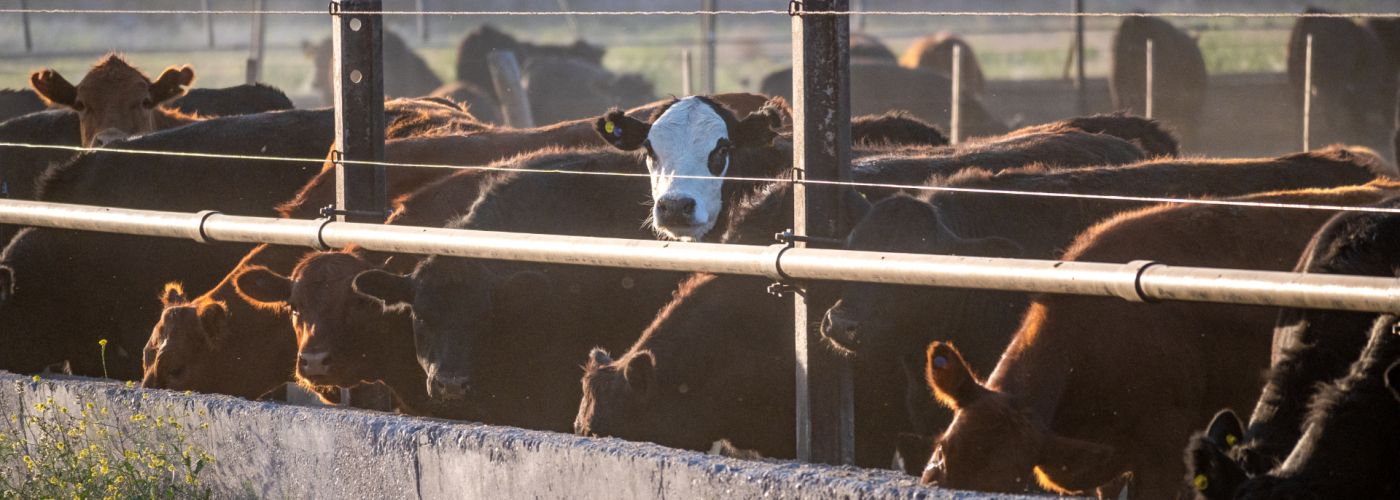
As limited climate gains from technical methane interventions are outpaced by growth in livestock production and associated emissions, we need to reframe technical interventions as complementary tools, not substitutes, for systemic reform.
The meat and dairy sector is feeling the effects of climate change. Livestock comprises almost half of global agricultural losses from climate events, and major meat and dairy producers could collectively lose nearly $24 billion in earnings by 2030 under high-impact climate scenarios. Because of their exposure to climate risk, meat and dairy companies are facing increasing scrutiny from investors to reduce their emissions. Livestock production is the leading source of methane, a greenhouse gas (GHG) more potent than carbon dioxide but shorter-lived in the atmosphere, making rapid cuts in methane emissions one of the most effective near-term strategies for addressing climate change. Meanwhile, a wave of climate-related disclosure requirements are making reporting emissions and climate risk mandatory for a large swath of the global economy, including major meat and dairy companies.
As pressure mounts on the meat and dairy sector to reduce methane emissions from livestock, a growing set of technical interventions have emerged that promise to curb emissions without fundamentally altering how industrial livestock systems operate. These approaches are increasingly positioned as scalable, science-driven solutions to a complex problem. Yet the reality is more complicated. This article outlines the three major categories of technical methane interventions and the ways that they fall short of delivering the systemic change needed to reduce the meat and dairy sector’s methane emissions at the scale required to meet current climate targets.
The 3 categories of technical methane interventions
Feed-based interventions
The most common livestock-based methane intervention is feed additives. Synthetic inhibitors like 3-Nitrooxypropanol (3-NOP, commercialized as Bovaer), seaweed-based additives (Asparagopsis), essential oils, and nitrates that suppress the production of methane in the rumen are all examples of feed additives that can result in lower ruminant methane production. There are also precision feeding strategies — which optimize protein, digestibility, and timing of meals to reduce methane — and early-life rumen interventions, which aim to shift microbial communities before they stabilize.
Among these feed-based interventions, Bovaer is considered the most promising and widely used, having received regulatory approval in more than 65 countries and promising to cut methane emissions by approximately 30% in dairy cattle and up to 45% in beef cattle. It works by feeding each cow up to one tablespoon each day and costs about $100-$150 per cow every year. Bovaer is best suited for use in feedlots or in dairy farms where cattle are housed most of the year, where feed intake is more controlled. Grazing systems pose significant challenges for administering Bovaer or similar additives, and there is no commercial development of a specialized delivery method for these types of operations.
The methane reduction potential of feed additives is highly variable, according to the testing done so far. Variability in methane reduction from feed additives can result from differences in how feed additives are administered, breed or species of the animal, health of the animal, and other factors or the interaction of multiple factors. There are also concerns with how feed additives affect animal health over time. In some studies of animals supplemented with seaweed-based additives, the animals developed inflammation and ulceration in the rumen. There are also concerns that the efficacy of feed additives for methane reduction may decline over an animal’s lifetime.
The animal itself
Another category of technical intervention deals with changes to the genetic makeup and immune response of the animals themselves. Selective breeding has emerged as a central focus of this category, where heritable differences in methane emittance are leveraged to create low-methane-emitting cattle. In a Scottish breeding program launched in 2025, calves that were selectively bred emitted 2% less methane than their parents. Methane reductions are also cumulative, meaning that future generations should emit even less.
The most efficient way to select low-methane-emitting cows would be through a genetic test, but genetically identifying low-emitting cows can be complex given that methane emittance is controlled by multiple genes spread across the animal’s DNA in difficult-to-find places. Therefore, widespread selective breeding depends on improved phenotyping tools for measuring methane emissions. Such tools being researched include “sniffers” which measure methane concentration as a cow stands alone in a stall (perhaps during automatic milking or feeding), rumen sensors like the proprietary SCOUT sensor which sit in the rumen, and permanent gas masks that measure methane exhaled by grazing cattle. None of these tools are being used at scale, and if selective breeding was to become common, practical on-farm methods would need further research.
Methane vaccines seek to trigger immune responses against methanogenic archaebacteria in the rumen responsible for methane production. Vaccines are often framed as the “next frontier” of livestock methane mitigation — but in practice, they remain one of the most speculative tools despite having been researched for almost three decades. Early research and development suggest that vaccines are biologically feasible and could be a low-cost, easy to administer option that would piggyback on routine vaccination schedules already used globally. But vaccines are still firmly in the testing phase, and progress has been slow. The narrative of methane vaccines has outpaced the science — industry actors increasingly describe vaccines as a silver bullet that could be used in grazing systems and developing countries in ways that feed additives cannot.1 This narrative prematurely positions vaccines as a low-friction way to achieve methane reductions globally without having to alter the industrial livestock system or production volumes.
Systems and infrastructure
The final category of livestock methane intervention shifts the focus from enteric fermentation to the physical and operational structure of livestock production, namely manure management systems. The most prominent technical intervention in this category is anaerobic digesters, which capture methane from liquid manure in large dairy operations and “digest” it into biogas that can be sold as “renewable natural gas.” Companies have invested heavily in this approach, often with public subsidies and carbon market incentives.
But recent developments are beginning to expose the limitations of digesters both economically and politically. In early 2026, the U.S. Department of Agriculture (USDA) paused funding and loan guarantees for anaerobic digesters under its Rural Energy for America Program (REAP), citing concerns about “underperformance, loan delinquency, and operational failure.” Furthermore, critics of digesters point to a growing body of evidence that digesters do not deliver the climate benefits promised — methane leaks, system failures, and water contamination undermine their effectiveness. Digesters also reinforce the industrial system of livestock production by incentivizing larger herd sizes.
Who is backing tech interventions — and who isn’t
Companies across the meat and dairy supply chain are already piloting and investing heavily in these technical fixes, positioning them as central to corporate climate strategies. Feed additives are the clearest example of this. Products like Bovaer are being integrated into corporate Scope 3 reduction plans, often financed through carbon markets or insetting schemes where companies reward producers within their supply chain for adopting practices that reduce emissions intensity. Danone is funding early-stage research and development through the $200 million Enteric Fermentation R&D Accelerator — supporting feed additives, genetic innovations, and methane vaccines. Danone is also deploying digesters across its global supply chain (targeting 6,500 smallholder dairy farmers by 2030) and tying procurement contracts to emissions reductions, effectively requiring suppliers to adopt these tools. Companies like Saputo, Lactalis, and Friesland Campina are adopting similar practices, though with less transparency on outcomes and investment levels.
What distinguishes this corporate approach is how tightly these technologies are integrated into supply chain governance and financing that they control. The result is a vertically integrated model of climate mitigation where emissions reductions often lack transparency and integrity. This system also results in a new layer of corporate control over production practices, as the biggest companies in the sector spend millions to scale solutions that align with their existing supply chains and shift the burden of implementation onto farmers.
Concerns of growing corporate control in the meat and dairy sector contributed to the controversy surrounding Danish dairy giant Arla’s adoption of Bovaer in 2024. Within hours of announcing a “trial” of Bovaer across 30 UK farms, Arla was hit with a storm of online misinformation that the additive was unsafe for human and animal consumption. The following year, when conventional farmers in Denmark with more than 50 cows were required to start administering Bovaer to their herds, some farmers reported that the additive was causing health issues. These reports, paired with social media posts about farmer concerns over using Bovaer, ultimately led to Denmark’s Veterinary and Food Administration issuing new guidance that allowed farmers to opt out of administering the additive. These incidents demonstrate the lack of trust between livestock corporations and rural communities, which is exacerbated by increasing corporate control over farm-level practices.
Public-private partnerships are also channeling capital to startups — methane vaccine developer ArkeaBio has raised over $26 million, and seaweed-based additive company CH4 Global has secured nearly $47 million. Yet measurable reductions at the animal level are mediated by limited uptake of the technology due to high costs, infrastructure constraints, and uncertain incentives for farmers. Even where uptake is growing, there are questions about whether these investments are delivering real climate gains or primarily servicing corporate net-zero narratives.
The international context
Internationally, the rise of technical methane interventions exposes a deep divide. In high-income countries, where productivity of livestock is already near-maximized, technical fixes are layered into highly industrialized and concentrated systems. In developing countries, the “efficiency problem” looks fundamentally different. Lower yields and high methane emissions from herds in these contexts are often tied to structural constraints like limited access to quality feed, land, credit, and veterinary services — not a lack of high-tech inputs. As a result, many technical methane interventions are impractical in these contexts. Relatively low-cost measures like improving feed quality and animal health deliver more immediate benefits. However, the narrative of the “developing world farmer” is increasingly mobilized to justify and globalize these technical pathways.2 This narrative suggests that climate mitigation can be achieved by “closing yield gaps” through technical solutions in low-income livestock producing countries — framing which sidesteps harder truths about overproduction and overconsumption of meat and dairy in a handful of countries.
Why tech fixes can’t deliver
Efficiency gains don’t result in absolute reductions
Most technical interventions target emissions intensity (methane per animal or per unit of product), not total emissions. Feed additives, selective breeding, and vaccines can reduce methane per cow, but they do not reduce herd size or production levels. In an export-oriented sector driven by continual growth, gains from methane interventions are offset by expansion. Global meat production has increased by more than 50% since 2000 and is projected to rise another 14-20% by 2030. In the U.S., the dairy sector has reduced emissions intensity by roughly 13% since 2005, but total milk production and associated emissions have continued to climb.
Technical interventions reinforce industrial production models
The most scalable and commercially viable technologies are best suited to large, industrial operations. For example, most methane digesters are located on large dairies with over 1,000 cows, where the volume of liquid manure makes methane capture economically viable. Similarly, feed additives like Bovaer must be delivered through controlled daily rations, making them incompatible with grazing systems. These technologies also require significant upfront capital and ongoing costs, which supports a system of production that favors scale, consolidation, and vertical integration.
Technical progress must be paired with systemic change
As major meat and dairy companies face growing pressure from investors to reduce methane emissions in light of new climate-related disclosure requirements, it is necessary for them to move beyond new technologies. Technical methane interventions can offer measurable, and in some cases impressive, reductions in methane emissions at the animal or farm level. But their overall climate impact is constrained by the system in which they operate.
To meet stronger climate targets, we should pair scientific innovation with structural change that addresses the core issues with the livestock system. For example, selective breeding practices could be combined with policies that stop subsidizing industrial livestock systems and incentivize smaller-scale, agroecological farming. In this framing, technical solutions are not dismissed, but are repositioned as complementary tools, not substitutes for systemic reform. Without that shift, the meat and dairy industry risks investing heavily in technologies that make an unsustainable system slightly more efficient — and only in specific contexts — while continuing to add fuel to the climate crisis.
1 Based on my experience attending the FAO Global Conference on Sustainable Livestock Transformation and the UC Davis State of the Science Summit on reducing agricultural methane in 2025, where many industry actors spoke about the promise of methane vaccines.
2 Based on my experience attending the FAO Global Conference on Sustainable Livestock Transformation and the UC Davis State of the Science Summit on reducing agricultural methane in 2025, where many industry and government actors employed this narrative.