Ireland is finalizing its climate protection targets to the year 2040. There is no way to meet its EU and international commitments without early, deep, and sustained cuts to its agricultural methane, the country’s largest source of climate pollution.
Rather than face that challenge directly, the Irish government is considering moving the goal posts and embracing a “no additional warming” approach to avoid having to fully address this pollution source. Beyond the climate harm, that approach only wastes precious time that farmers and farming communities will need to diversify their farm systems and puts them at risk of significant losses as global warming increases the frequency and severity of extreme climate events.
IATP, along with 33 other organizations from Ireland and across the rest of Europe, have written to Ireland’s government urging them to face the question of methane pollution head-on and focus on supporting farmers through this transition (Read the full letter here.)
The decision could set a new precedent in Europe for how agriculture methane is addressed (or not) and put Europe’s climate leadership at risk.
This blog unpacks what’s going on and what’s really needed to support farmers and farm communities.
Stroll by a supermarket cheese counter and there’s a good chance you’ll find some Irish cheddar. The country is a major dairy producer and exporter, churning out almost twice as much as it consumes.
Combining some apple slices with aged cheddar can make for a tasty afternoon snack. But the sizable industry also has a much less savory pairing: a notable contribution to global warming.
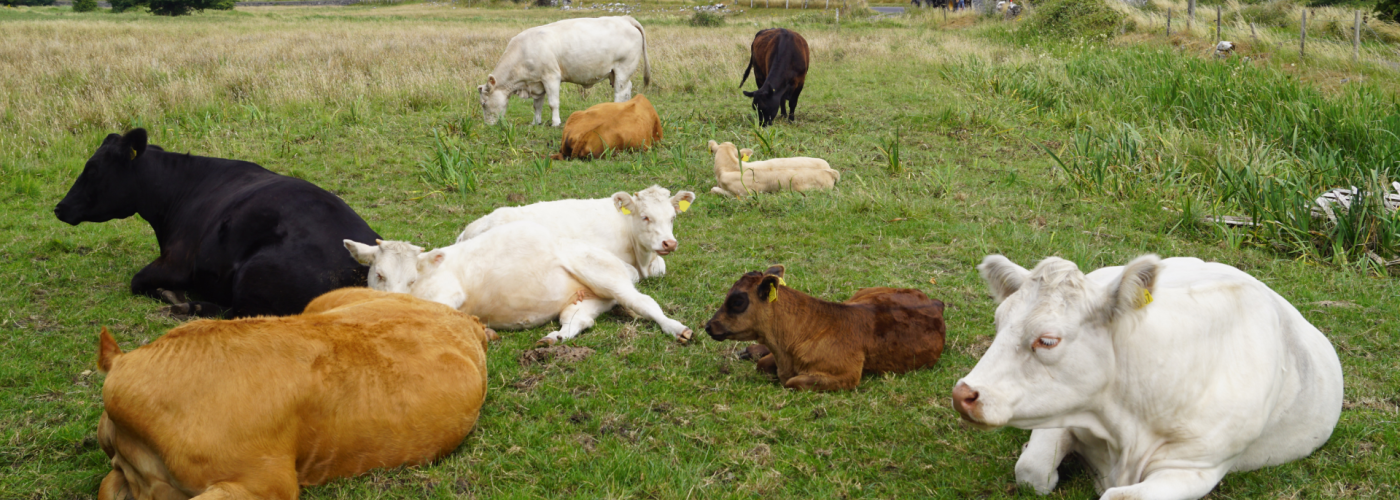
Ireland’s agricultural sector is responsible for about a third of its climate pollution and represents the country’s single largest pollution source.1 Livestock production, for dairy and beef, drives most of these emissions.
Achieving any ambitious climate targets will require action in the sector, yet the government may paper over this fact with a change to how it evaluates the significance of agriculture emissions — specifically agricultural methane.
But the climate won’t be fooled, nor will this benefit farmers and rural communities in the long run. So who does this help?
Irish Budgeting 101: Real climate action or just treading water?
Irish climate policy is based on successive carbon budgets — i.e., the amount of climate pollution the country is allowed to emit over a five-year period. These budgets get progressively smaller as the country works towards its goal of being climate neutral by 2050.
Its climate advisory council recently proposed a larger (and thus weaker) carbon budget for the years 2031-2035, based on the view that Ireland only needs to stabilize its contribution to global warming, an approach which departs from the council’s earlier advice.
The new approach would take the pressure off the agricultural sector to address climate pollution. Given that the warming effect of agricultural methane is relatively short-lived compared to other types of climate pollution, only minor cuts are needed to stabilize its warming contribution.
The problem with the approach is that we have already passed safe levels of warming. The extreme weather events and other climate harms we all — including farmers — face will only get worse the more temperatures rise and the longer they stay elevated. Even if we succeed in bringing warming back down, not all of the harms triggered at peak temperatures will be reversible.
A group of leading climate scientists said as much in a letter to the New Zealand government when they adopted the approach Ireland is now considering.
This “no additional warming” approach to methane pollution is also inconsistent with EU law. Under the European Climate Law, the EU has agreed to cut greenhouse gas (GHG) emissions to net zero by 2050 with net negative emissions thereafter.2 Such an approach will lead to the EU’s warming contribution to peak and the decline.
The climate advisory council’s advice has been widely criticized.
Last October, a cross-party joint committee of Ireland’s two house of Parliament (Oireachtas) unanimously recommended that the government reject this “no additional warming approach” and align its next carbon budget with EU law.
Beyond Parliament, several Irish and international academics have also criticized the proposed change, noting that it “reflects a political choice that protects Ireland’s livestock-dominated, export-oriented agricultural and land use sectors,” rather than supporting sound climate policy. They also called out the argument that industrial animal farming is needed to ensure global food security, instead demonstrating how much of Ireland’s beef and dairy exports go to other wealthy nations.
Why does this matter?
This tactic delays the conversation that is needed about the future of Irish livestock farming.
The advisory council’s analysis is based on mitigation modeling in the agricultural sector that relies primarily on technical fixes (feed additives, biogas, etc.) and does not pay enough attention to the diversification away from livestock production. By slowing down the transition toward more diversification, the council’s proposal puts farmers at risk from quick changes in consumer preferences or government policy.
If consumers embrace eating more fruits, vegetables, and legumes faster than the industry is anticipating, farmers could see falling prices for their livestock and significant losses. Even just a 10% shift in diets towards more plant-based foods could result in 60 billion euros of losses in the EU — with Ireland being the second most impacted country (Denmark is the first.)
Livestock methane represents a quarter of all Irish GHG emissions, and the high concentration of farmed animals puts a strain on the country’s biodiversity and the environment. It will not be possible to respect the goals of Irish law to transition to a climate-resilient, biodiversity-rich society without addressing the methane pollution from this sector.
Rather than attempting to move the goal post, a much more effective approach would be to chart a pollution reduction strategy for the sector with clear emission reduction targets, and establish what the residual emissions from agriculture will ultimately be.
Another Irish government advisory council — this one tasked with ensuring the fairness of the transition to climate neutrality — has noted that such pathways are needed in order to plan accordingly for the structural changes needed for the future agriculture economy.
Ireland’s approach to “no additional warming” could be influential. Ireland will hold the presidency of the EU in the second half of this year and shepherd negotiations on both the future of farm support — including public money to support farmers in the transition away from industrial livestock production — and how the EU will meet its climate targets.
If Ireland intends to align with EU law and meet its commitment to be climate-neutral by 2050, it will need to face the challenge of methane pollution head-on and focus its budget on supporting farmers in a system-wide farming transition.
Read the full letter with the list of signatories here.
1 For most EU countries, agriculture is responsible for only about a tenth of emissions.
2 The advisory council concedes that its approach is inconsistent with achieving net zero GHG emissions by 2050. See page 4: “none of the scenarios modelled by the [Carbon Budgets Working Group] achieve net zero GHG emissions by 2050, on the basis of GWP100.”