As the world hurtles toward climate tipping points, few sectors of the economy sit more squarely at the crossroads of vulnerability and responsibility than agriculture. The food and agriculture sector is responsible for nearly one-third of global greenhouse gas (GHG) emissions, while also driving biodiversity loss, contributing to health-related impacts, and threatening global food security. Because livestock is especially sensitive to climate change, studies project significant climate-related losses for major meat, dairy, and feed companies. This means that major meat and dairy companies are exposed to significant climate-related financial risk.
In response to growing climate-related financial risks across the global economy, jurisdictions around the world have introduced mandatory climate-related disclosure laws which require large companies — including major meat and dairy companies — to report GHG emissions and climate-related risk information in a standardized format for the benefit of investors and the public. Mandatory climate-related disclosure rules have been introduced in over 20 jurisdictions around the world, with rules in the European Union and California leading the world in terms of scope and early implementation. The EU’s Corporate Sustainability Reporting Directive (CSRD) is already in effect for some companies, and more companies will fall under scope in 2026. California’s Climate Accountability Acts will come into effect in 2026, with first reports on climate-related risk due on January 1, 2026.
Mandatory climate-related reporting raises the bar for climate accountability and lends support to global initiatives to reduce methane emissions, like the Global Methane Pledge and the Dairy Methane Action Alliance. Mandatory climate-related reporting also serves as the foundation for credible climate action in sectors with a history of incomplete or misleading climate reporting, like the meat and dairy sector.
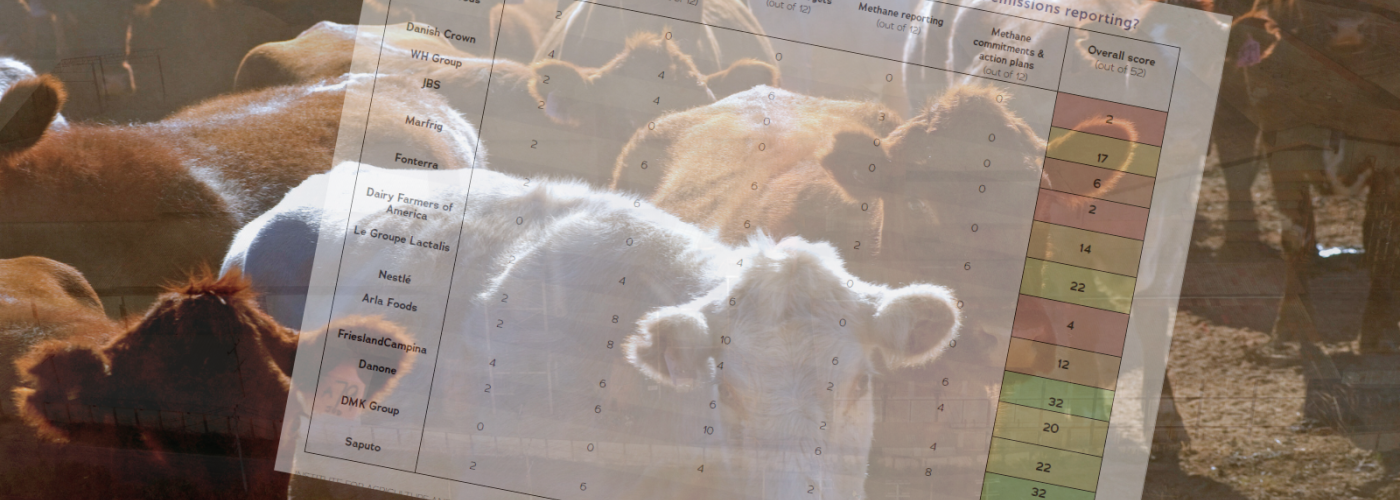
The Meat and Dairy Climate Reporting Scorecard
IATP has produced a new Meat and Dairy Climate Reporting Scorecard that utilizes growing regulatory pressure from climate-related disclosure rules as the backdrop to analyze the climate reporting of 14 major meat and dairy companies. Companies are assessed on five categories, encompassing 13 scoring criteria. These criteria are partially based on requirements of climate-related disclosure rules, but also go beyond what is included in climate-related disclosure rules to provide a more comprehensive scoring framework for meat and dairy companies’ climate-related reporting.
The Meat and Dairy Climate Reporting Scorecard builds on IATP’s work tracking the GHG emissions reporting of major meat and dairy companies in the Meat and Dairy Emissions Dashboard and estimating the methane emissions of the world’s largest meat and dairy companies.
The Scorecard confirms that the world’s major meat and dairy companies are falling short on transparent and reliable reporting of climate-related risk and GHG emissions despite fast-approaching disclosure deadlines. Tyson Foods, JBS, Dairy Farmers of America, and DMK Group currently do not report even the most basic emissions data, even though all four companies will have to report that information in 2026. By waiting until the last minute to disclose their GHG emissions, these companies have tried to postpone investor scrutiny, which weakens the ability of investors to make sound investment decisions. This demonstrates a lack of foresight which hinders the whole industry from mitigating and adapting to the financial impacts of climate change already apparent in the sector.
Other companies are guilty of a methane reporting gap, where companies that score well in climate-related risk and GHG emissions reporting fail to report on their methane emissions. Danish Crown and Marfrig are good examples of the methane reporting gap. These companies may be able to camouflage themselves to meet investor expectations on climate-related reporting requirements without taking meaningful action toward crucial methane reductions. This highlights a major limitation of climate-related disclosure laws, which currently do not require separate disclosure of GHGs and therefore are not useful tools for methane disclosure. Even high-scoring companies have ample room for improvement. Nestlé and Danone scored the highest in the Scorecard, mostly due to their stronger-than-average methane reporting, but still received less than two-thirds of available points.
Urgent action is necessary to close accountability gaps
Mandatory climate-related disclosure rules offer a foundation for tracking and regulating corporate meat and dairy emissions, but further corporate accountability is needed to transition the industry toward operating within planetary boundaries. The climate crisis is already impacting the meat and dairy sector, and lack of corporate action to address climate risk and mitigate climate change only does further damage. Major meat and dairy companies need to act quickly to incorporate climate risks into business strategy, report absolute methane emissions, and set science-based targets and action plans for reducing GHG emissions.
Earlier this year, the International Court of Justice (ICJ) issued a unanimous advisory opinion on climate change, which asserts that governments have a due diligence obligation to tackle the “urgent and existential threat” of climate change, including by regulating private entities operating in their jurisdictions. The ICJ ruling supports the efforts of over 20 jurisdictions around the world that have introduced mandatory climate-related disclosure rules, and opens the door for stricter rules in the future as companies face increasing climate risk.
With COP30 underway in Belém, Brazil, global attention is turned toward national climate action. Just 34 countries have submitted updated Nationally Determined Contributions (NDCs) for the 2025 deadline, as per the Paris Agreement. Of those, only a few countries where major meat and dairy companies are domiciled explicitly address emissions from animal agriculture in their NDCs even though animal agriculture makes up a big portion of these countries’ emissions. Stronger NDCs that explicitly address emissions from animal agriculture are crucial.
Stronger targets need to be accompanied by stronger transition strategies that support farmers. As meat and dairy companies face increased pressure from governments and investors to report climate-related risk and GHG emissions data, they may attempt to pass on the burden of regulation to farmers. This would exacerbate the power imbalance between farmers and the handful of companies that dominate the global food system. Furthermore, smallholder farmers are some of the most vulnerable actors in the food system and bear the brunt of climate impacts, despite contributing the least to GHG emissions. All climate action in the food system should be grounded in the principles of climate justice and food sovereignty, which entails strong support for the farmers, workers, and rural communities at the heart of the global food system.
Click here to access the full report and view the Meat and Dairy Climate Reporting Scorecard.