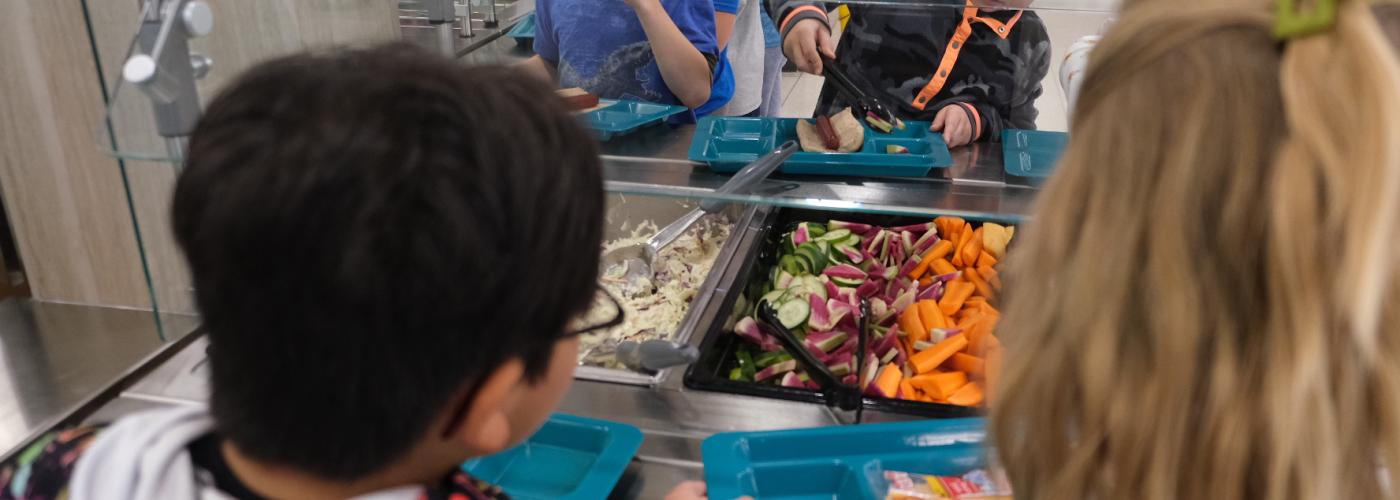
Minnesota farmers and kids had extra reason to celebrate October’s Farm to School and Early Care Month last year, when the U.S. Department of Agriculture (USDA) announced plans to distribute $1 billion in funding nationally to support local food purchasing programs, with $17.9 million coming to Minnesota over the next three years. This landmark investment would have been a game changer for our state, and stakeholders eagerly made plans to support a huge growth in local purchasing for schools, early cares and food shelves. However, it looks like the party is over: despite having signed a Cooperative Agreement for this funding in January, this month MDA was abruptly told that under the new Trump Administration the planned funding had been canceled. This decision is a devastating loss for our farmers, kids and communities who would have benefited from this support.
Though existing Farm to School and Early Care contracts for this year are not affected, the impact of this decision is massive for future rounds of funding. IATP has been partnering with University of Minnesota (UMN) Extension to look at the impact of a previous smaller round of local purchasing support from USDA, and we can extrapolate the potential benefits Minnesota farmers, kids and communities would have seen from this larger investment. In August of 2022, Minnesota was the first state in the nation to sign a cooperative agreement with the USDA as part of its new Local Food for Schools Cooperative Agreement Program. This program was created in 2021 amid pandemic supply chain shortages, with the intention of supporting local farmers and bolstering food security. Over the last couple years and continuing now, this agreement and a subsequent additional infusion from USDA Commodity Credit Corporation (CCC) funds provided $3.4 million for Minnesota school districts to purchase fresh local foods to serve in school meals through the Local Food for Schools Program (LFS) and $8.1 million for food shelves and food banks to purchase from Minnesota producers through the Local Food Purchase Assistance Cooperative Agreement Program (LFPA).
Minnesota was ready to put these dollars to work in part because the Minnesota Department of Agriculture (MDA) already had an existing Farm to School Grant program through which they could distribute the funds, connecting students with fresh, locally grown foods and supporting farmers in their communities. The infusion of federal funding on top of the state’s investment allowed MDA to have the largest round of Farm to School grant funding ever in 2023, when they awarded $4.2 million in funding to 114 grantees to reimburse them for purchases from over 450 Minnesota producers. These purchases included meat, dairy, grain, fruit and vegetable growers around the state, plus kitchen equipment purchases to support cooking local foods.
The anticipated funding — now cancelled — would have been a much larger investment, with $13.2 million to support Farm to School and Early Care through the Local Food for Schools Program and Child Care Cooperative Agreement (LFSCC) and $4.7 to support local food for food shelves through LFPA. These federal funds would likely have been available to apply for in the fall/winter of 2025 and distributed to schools, early care programs and food shelves to support purchases from local farmers starting next year in 2026. Combined with state funding, Minnesota would have had an average of $5.6 million per year in funding for Farm to School and Early Care for the next three years, more than quadrupling the amount we have in state funding.
In our evaluation work examining the impact of this grant program, we saw that the grant can act as an incentive for schools and early cares to establish buying relationships with MN farmers that often extend beyond the terms of the initial grant, with schools purchasing more than they are reimbursed for and integrating local farmers into their regular buying practices. Our partners at U of MN Extension found that every dollar spent on Farm to School generates an additional dollar of local economic activity. A sustained increase in funding would have provided vital stability to farmers, allowing them to plan ahead and make their own investments to scale up to incorporate this critical market into their business plans.
Because the state plan for using the funding was not due until April 30 and was not yet approved by USDA and the distribution of funds had not yet started, there are not clear opportunities to challenge this cancellation. However, it is highly unusual to cancel a signed Cooperative Agreement, and there is national discussion about how to address the termination of these Agreements. In a letter to USDA Secretary Brooke Rollings, Senate Democrats, including Minnesota Senators Klobuchar and Smith, urged USDA to reinstate the canceled local food programs; however, farmers are not optimistic that the administration will reverse course. In fact, more bad news came this week, as USDA made an additional announcement canceling this year’s $5 million round of federal Farm to School grants. At this time it is not clear if the program will be permanently canceled or if it could resume next year. These cuts come on top of pressure on farmers from other federal actions, including uncertainty about trade wars and potential tariffs, as well as efforts by Republican lawmakers in Congress to cut funding for school meals while funding $4.6 trillion in federal tax cuts that mostly benefit the wealthy. Additionally, food shelves are under enormous pressure as rates of hunger are skyrocketing. The Food Group found that Minnesotans made nearly 9 million visits to food shelves in 2024, a record high for the fourth consecutive year. That’s 1.4 million more visits than in 2023 and 2.5 times more visits than pre-pandemic 2019.
Though this expected federal funding has been canceled, Minnesota does still have state funding for Farm to School and Early Care programs. The baseline state funding for Farm to School and Early Care local purchasing and kitchen equipment grants and supporting a state-wide farm to institution coordinator is $1.29 million, but demand for this support is consistently greater than available funding. For the 2023 round of grants, when the previous infusion of federal funding boosted the amount available to $4.2M, MDA received 128 Farm to School grant applications for $5.43M total in requests. For the 2024 round, MDA received 92 applications totalling $1.85 million in requests for the $1 million of state funds available. In light of the canceled federal funding, Minnesota stakeholders are asking for an increase in state funding to meet the consistently high demand for this successful program (SF 1559/HF 1795). Advocates have also introduced a state bill to create a state funded Local Food Purchase Assistance program to complement existing Farm to Food Shelf support (SF2430/HF 2102).
Right now, Minnesota state legislators are working on developing and passing this year’s Agriculture budget which will decide the state funding amount for 2026 and 2027 for these programs. The legislative session is set to end May 19th if legislators are able to pass a balanced budget in time. Farm to School and Early Care initiatives enhance the well-being of Minnesota kids, empower local farmers and create a positive economic impact. If you care about this issue, there are actions you can take:
IATP is a member of the Minnesota Farm to Kids Alliance, and has worked on supporting Farm to School and Early Care programs in Minnesota for over a decade, collaborating with schools, Head Starts and early cares to implement local purchasing, creating supportive resources and conducting evaluation activities to bolster the growth of these initiatives statewide—including evaluation of MDA’s Farm to School Grant Program. IATP and the Land Stewardship Stewardship Project (LSP) co-lead the Farm to School and Early Care policy campaign in Minnesota.
This article draws on an internal MinneAg factsheet co-authored by Erin McKee and the Land Stewardship Project's Laura Schreiber.