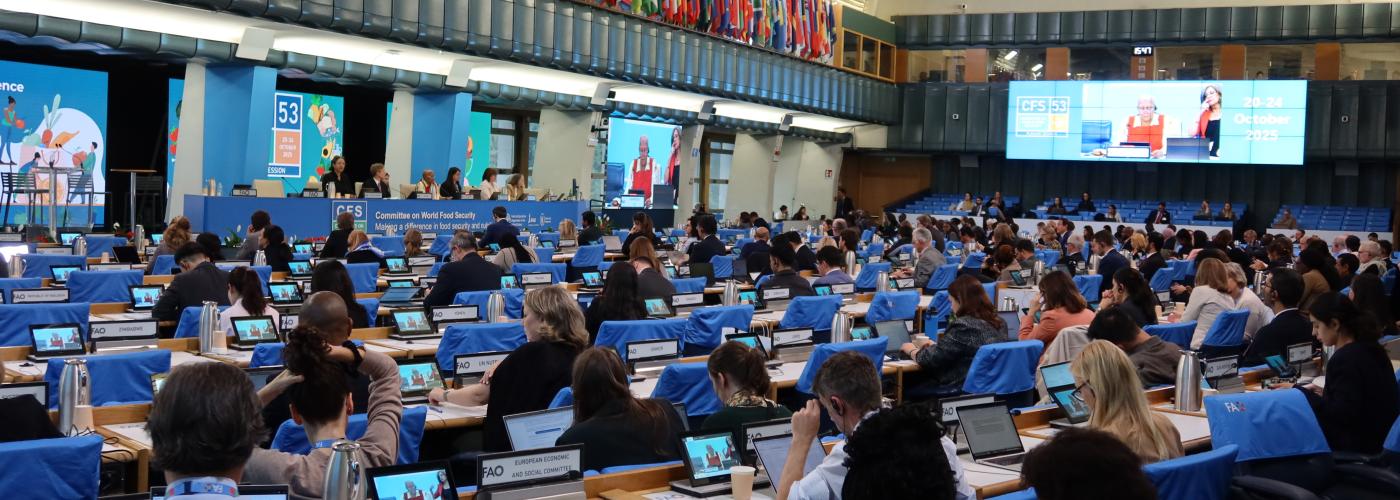
Against the backdrop of multilateralism facing multiple challenges, and the UN remaining a spectator to unprecedented levels of unilateral coercive measures that are suffocating economies, obliterating communities, and impacting millions of lives in the Global South, Ukraine, and the Middle East, it was a relief to see governments coming together last week to adopt "Making a Difference in Food Security and Nutrition" at the conclusion of the 53rd session of the UN Committee on World Food Security (UN CFS).
We at IATP especially focused on two topics: the CFS summary report on “Collaborative Governance for Coordinated Policy Responses to Emerging Global Food Crises Towards Sustainable Agriculture and Food Systems Transformation,” and the outcomes of the CFS High-Level Forum on Tackling Climate Change, Biodiversity Loss, and Land Degradation through the Right to Food. On both topics in the dialogues that preceded these sessions, we pushed against the dominant narrative around financing food systems. More on that a little later.
The CFS 53 plenary helped advance policy goals (on Strengthening Urban and Peri-urban Food Systems, on Building Resilient Food Systems and on Strengthening the Impact of CFS Policy Products) towards realizing right to food globally. The final report was adopted, albeit with some hiccups. A few governments (such as Israel) dissociated from specific paragraphs that had references to their actions, and Argentina dissociated from specific sections in the report. The United States stood alone in dissociating from the entire report with these words: “United States must dissociate from the entirety of the CFS 53 report […] throughout the report multiple references to concepts such as diversity, equity and inclusion and climate change are contrary to U.S. policy as are the routine reaffirmations of the sustainable development goals, which impinge on sovereignty. We also disagree with the description of situation in Gaza though we welcome the acknowledgement of the historic peace agreement.”
And yet, the gathering made meaningful advances in several areas, as those who participated through the Civil Society and Indigenous Peoples’ Mechanism (CSIPM) would attest. United States civil society — those from NGOs, farmers organizations, indigenous people, and academics — was well represented at the UN CFS, with many of them participating in the two-day planning meeting organized by the CSIPM Forum in Rome. Juan Echanove, the Right to Food Lead at the Food and Agriculture Organization (FAO), shared an image from the Forum reminding us that the Forum is a space that not only does the hard work of preparing for the plenary but also celebrates the diversity and commitment of so many civil society organizations and social movements from around the world.
Challenging dominant narratives on solutions for our food systems
Over the last several months IATP served on the facilitation group at the CSIPM, helping to develop the key messages on financing agroecological transitions in the context of multiple crises. Together, we are finding new ways to challenge the dominant narrative, which has been making several incorrect assumptions over the years.
This narrative starts with the false argument that the foremost solution to hunger and food insecurity lies in promoting the use of modern technology to produce more to feed a growing population. But all the evidence points in a different direction. It’s no surprise that this narrative also asserts that there is a need to mobilize external private sector finance to invest in these new technologies. And in parallel, there is the argument on a lack of availability of public finance for addressing food and agriculture. This ignores the fact that even when there are funds available, they are disproportionately allocated to other sectors (for example, global military spending hit a record $2.7 trillion last year) rather than in food and agriculture and other development sectors.
And so, according to this narrative, it becomes necessary to call in large-scale private external investment and adopt public-private partnerships (PPPs) and “innovative” financing solutions such as blended finance (that uses public funding to attract and de-risk private investment) or the commodification of public goods and services by means such as carbon swaps. In the case of developing country governments, this leads to the priorities of external private sector investment determining national public policy (rather than the public policy priorities setting the framework within which external investment is accepted or rejected.)
The crisis in the food and agriculture sector has been worsened by the unprecedented levels of corporate concentration over the past decade. This, combined with cross-border corporate tax abuse and the unbearable burden of debt servicing, limits the ability of many countries in the Global South to help realize the right to food. Many governments of indebted food-import-dependent countries in the Global South are increasingly aware of the need to promote domestic food production, to the point of championing “food sovereignty” (in Africa in particular). However, they are most often reluctant to renounce the prospect of external investment and are swayed in the direction of “modernization” of domestic agriculture under corporate guidance. We have seen how, in the name of addressing food security in the era of climate change, impoverished southern governments take climate financing loans where repayments outstrip disbursements, further increasing their debt burden.
CFS: a space for collaborative dialogue for alternative narratives
In developing its message to the High Level Forum on strengthening responsible investment and financing for food security and nutrition of the CFS 53 on October 21, 2025, the CSIPM drew on its interventions on financing for Food Security and Nutrition that took place earlier this year. They included the dialogue session on Financing for FSN that was held on April 15 in the context of the Collaborative Governance for Coordinated Policy Response workstream (see CSIPM messages were delivered by its speakers, including from IATP), and the side event co-sponsored by CFS at the FFD 4 Conference in Seville in July. The CSIPM intervention stressed not only the need for redirecting available finance but also the importance of looking at the source of funding, and called on the governments to address debt justice, tax justice and trade justice, interconnected issues that can help developing countries generate public finance for addressing the crisis in food and agriculture.
At the CFS 53, the CSIPM spokesperson reminded the plenary that the discussion on financing food system transitions was taking place in a context of drastic cuts in Official Development Assistance (ODA) while trillions are spent on wars and genocide. Drawing on the CFS chair’s summary on Collaborative Governance (which notes that “levels of blended finance are low and have failed to scale”), and the HLPE background note on strengthening responsible investment and financing for food security and nutrition (which pointed out, “where need is greatest, available finance is generally lowest”), the CSIPM statement argued that “profit-oriented private investments will not reach the areas and people who need it most, but will seek opportunities for the highest returns — private objectives of maximizing profits are at odds with agroecological approaches to food systems transformation, whose contribution goes much beyond the economic dimension.” It also noted the massive systemic challenges we face, and that if any financing is to be mobilized it has to be “[n]ew and additional grants-based climate finance.” These must “come as part of recognition, restitution and reparations for climate and ecological debt owed to developing countries.”
Alternative proposals matter, especially in these challenging times. We hope this message resonates widely and supports concrete steps by member governments to generate public finance that would support the development and implementation of public policies that keep small-scale producers and rights holders at the center of food systems transitions.
(Photo credit: Vanessa Black, Biowatch South Africa)