
Search
… use and have failed to increase yield or tackle world hunger and poverty. Food security Food safety Biodiversity Agribusiness Fish Free trade agreements GMO … Argentine Congressman Alberto Cantero, 19 September 2007 The extremely slow response of the Argentine government and agribusiness representatives to the threat posed by glyphosate- resistant Johnsongrass is inexcusable. As discussed … construct a huge harbour in the Paraguay River to export over a million metric tones of grain. This has prompted strong opposition from Paraguayan civil society. The area where construction is planned is home to a great number of traditional …
… ground that "the public has a right to know what they are eating." Last year, almost 270,000 letter writers testified in opposition to a proposal of the U.S. Dept. of Agriculture that would have allowed gene foods to fall within the …
… Francis Thicke of Fairfield used the occasion to accuse Culver's administration of catering to the interests of agribusinesses. "Environmental Protection Commissioner" was printed on the t-shirt Thicke wore to the meeting. But the …
… activities of business diminishes economic efficiency. Free market and free trade policies are heavily promoted by the agribusiness corporations involved in the trading and processing of farm commodities who want to pay as low a price as … Oberwill, Switzerland:Verlag Wirz AG,1978. 2. For additional views on free trade from the perspective of corporate agribusiness see; Runge, C.Ford, H.von Witzke, S. Thompson Liberal Agricultural Trade as a Public Good: Free Trade … Lower farm prices, they argued, would reduce the total value of US farm exports, especially in the grains sector. But agribusiness economists convinced Congress that lower prices would "drive other exporting countries out of the world …
… Nebraska farm activists who have watched Johanns over the years. To them, Johanns is trade-lite, leans heavily toward agribusiness and has little grounding in rural development. Johanns idea of rural development is getting Wal-Mart to …
… Nebraska farm activists who have watched Johanns over the years. To them, Johanns is trade-lite, leans heavily toward agribusiness and has little grounding in rural development. Johanns idea of rural development is getting Wal-Mart to …
… of small producers, for whom there are no alternatives to agriculture, is being threatened by the rise in power of large agribusinesses and their control over markets. Although agricultural production for export offers opportunities for some, … that these generous subsidies do not reach small North American producers. Rather, they are focused on benefiting large agribusinesses. Sixty percent of the direct payments go to only 10% of producers, who control enormous commercial … which are supposed to defend the interests farmers and consumers in their countries, it is the transnational agribusinesses that are the true beneficiaries of the US and international rules that, to a large extent, they themselves …
… in Nebraska. While COOL was part of the 2002 farm bill, Congress has yet to implement the bill because of strong opposition from the packing industry and the Bush administration. Nelson said he would like to see COOL implemented this … that very clear. I want to make sure that they don't do anything to thwart its implementation." Grand Island Independent Agribusiness Farm Bill …
… popular U.S. consumer policy country-of-origin labeling (COOL) for meat cuts and products will only intensify public opposition to more of the same backwards trade pacts, Public Citizen said. A panel report released today announced that … clear that these so-called trade pacts have little to do with trade between countries and a lot to do with our major agribusiness corporations being free to sell mystery meat in the United States, with neither consumers nor our elected …
… lives could be saved by expediting the distribution of food. However, Congress rejected the idea in the face of strong opposition from agribusiness interests and charities that benefit from the aid programs. Charities fund their development projects in …
… and mid-size farmers, and to dilute criticism that existing programs concentrate too much money in the hands of big agribusinesses. But the cap met heavy opposition from a bipartisan coalition of lawmakers from the South and West--including California's two Democratic …
October 24th, 2017,
… and exporting U.S. regulatory shortcuts in the NAFTA 2.0 negotiations Lecture outline GMOs: no longer count on EU opposition against the U.S. Brief explanation of the new post-transgenic GMOs, their non-target effects and possible …
… what the public can do when the state finances research for a product to which the public has frequently voiced its opposition. If the EC continues to invest in the new Termi- nator technology and develops a product or process for which …
… as to stay ahead of inflation and production costs. Growth in financial returns to landowners and to many of the largest agribusiness corporations exceeded the growth in net farm income. These years were also ones in which economic power … one of them: economic power. Economic Power The years covered by Figure 2 were also a time of rapid growth in size of agribusiness concerns. Cargill, for example, entered the 21st century with sales in the $50 billion range and assets in … Competition among themselves. And why do farmers have such low economic power that they lose profits to landowners and agribusiness giants? Again, the answer is competition among themselves. The principal theme of this paper will be simply …
… as to stay ahead of inflation and production costs. Growth in financial returns to landowners and to many of the largest agribusiness corporations exceeded the growth in net farm income. These years were also ones in which economic power … one of them: economic power. Economic Power The years covered by Figure 2 were also a time of rapid growth in size of agribusiness concerns. Cargill, for example, entered the 21st century with sales in the $50 billion range and assets in … Competition among themselves. And why do farmers have such low economic power that they lose profits to landowners and agribusiness giants? Again, the answer is competition among themselves. The principal theme of this paper will be simply …
… course of one year, the United States raised barriers to imported steel, approved the most generous subsidies for U.S. agribusiness in history, and promised to protect U.S. textiles and other sensitive products from foreign competition. … increased imports of cheaper agricultural commodities. The reality is more complicated. Given the clout of domestic agribusiness interests and without the formation of a stronger domestic coalition, it is unlikely that the U.S. … are 130 tariffs that exceed 35 percentcurrently the maximum tariff charged by Brazil. Of those 130 items, 100 are in agribusiness, directly protectingwith what might be described as surgical precisionthe very products that are most …
October 1st, 2019,
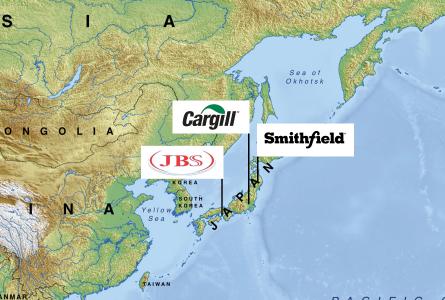
… U.S. and Japanese food and farm groups (including IATP) raised concerns that an agreement would only benefit global agribusiness. In a letter , the groups criticized a deal that serves only to open our respective markets and strengthen … with thousands, if not tens of thousands, of animals producing large amounts of manure) primarily to feed exporting agribusiness companies . These operations are facing rising opposition from rural residents, including independent family farmers themselves . Rural communities suffer from air and …
April 11th, 2007,
… Trade Organization Appellate Body ruling against U.S. cotton subsidies,1 the U.S. Depart- ment of Agriculture (USDA), agribusiness lobbyists and agricultural economists have been looking for ways to make the 2007 U.S. Farm Bill bullet proof against WTO litigation. Agribusiness representatives have proposed that savings from cuts to price supports and direct payments could sub- sidize … revenue insurance that would be safe from WTO challenge.2 The USDAs January 31 Farm Bill proposal adapted agribusinesss revenue insurance idea, seeking to offset anxiety created by an estimated $34 billion in commodity program …
April 10th, 2007,
… Trade Organization Appellate Body ruling against U.S. cotton subsidies,1 the U.S. Depart- ment of Agriculture (USDA), agribusiness lobbyists and agricultural economists have been looking for ways to make the 2007 U.S. Farm Bill bullet proof against WTO litigation. Agribusiness representatives have proposed that savings from cuts to price supports and direct payments could sub- sidize … revenue insurance that would be safe from WTO challenge.2 The USDAs January 31 Farm Bill proposal adapted agribusinesss revenue insurance idea, seeking to offset anxiety created by an estimated $34 billion in commodity program …
… terms that there were no more patents in the works. Why didn't we get the straight story?" asks Shand. "Despite mounting opposition from national governments, United Nations' agencies, farmers, scientists, and civil society organizations … Last month for example, the Director General of the United Nations Food and Agriculture Organization declared FAO's opposition to Terminator. Earlier this month, the state of Maryland (US) introduced a bill to ban Terminator seeds. (See … continues to invest taxpayer dollars on anti-farmer research that, if commercialized, will hold farmers hostage to giant agribusiness corporations," said Goldberg. Destroying National Seed Sovereignty: USDA's growing portfolio of Terminator …