In 2018, IATP worked with GRAIN to analyze some of the biggest meat and dairy company’s climate pollution for the first time. Collecting emission and production data from the companies was a challenge, with many not reporting emissions at all, and others not reporting on their full supply chain. Now, only a few weeks before the UN’s climate meeting at COP30, IATP and partners are publishing new estimates of climate pollution from an expanded number of meat and dairy companies. The results are alarming.
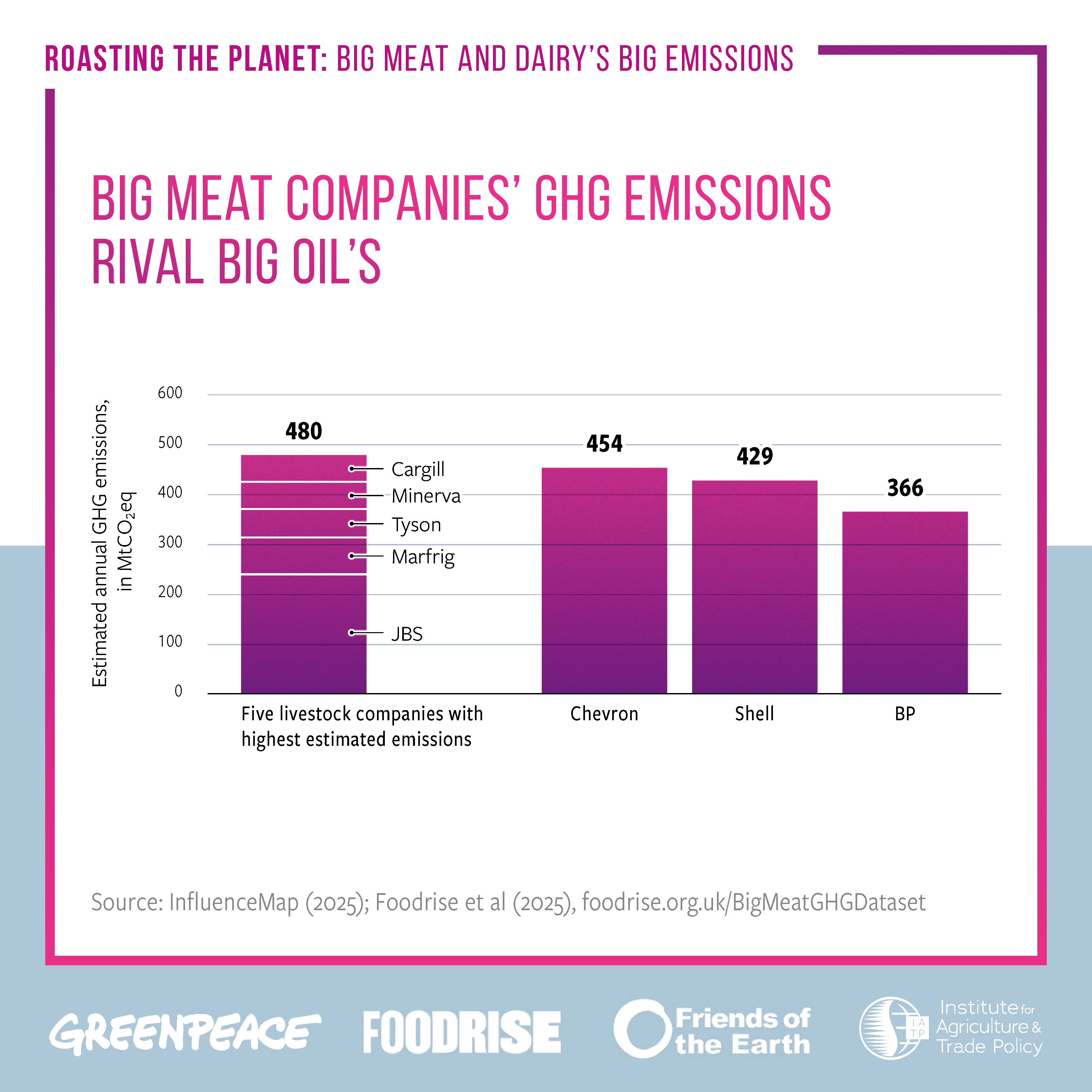
In Roasting the Planet: Big Meat and Dairy’s Big Emissions, IATP partnered with Foodrise, Friends of the Earth, and Greenpeace to utilize a model developed by the UN Food and Agriculture Organization to estimate emissions for 45 meat and dairy companies. Just as we found in 2018, the emissions from the largest meat and dairy companies are extreme, on-par with some of the world’s largest oil companies. The report found that the 45 major meat and dairy corporations generated more than a billion metric tonnes of greenhouse gas emissions — more than has been reported for Saudi Arabia, the world’s second-largest producer of oil. The five largest emitters of this group — JBS, Marfrig, Tyson, Minerva, and Cargill — together produced an estimated 480 million tonnes of greenhouse gas emissions (CO2eq) in 2023/22, surpassing emissions reported for Chevron, Shell, or BP.
Since our 2018 report, several of the major corporate players have publicly announced climate plans to reduce emissions, only to backtrack on those claims. IATP challenged the credibility of global meat giant JBS’s net zero plan at the National Advertising Board, winning a ruling in 2023 that called on the company to discontinue its net zero claims. Last year, the Environmental Working Group sued Tyson Foods over deceptive net zero and climate-marketing claims. And earlier this month, Nestle quit the Dairy Methane Action Alliance, where it had committed to report its agriculture methane emissions and make a plan for reductions.
Most emissions from meat and dairy companies are from methane, a potent greenhouse gas. Ruminants, like cows, emit methane from their stomachs and manure. Hog manure also is a source of methane. The factory farm system of production tied to the companies in our report concentrates large numbers of cows or hogs in a small place, often indoors, where large amounts of manure are stored. This factory farm system is tied to methane emissions, water and air pollution.
The Intergovernmental Panel on Climate Change (IPCC) has identified reductions in methane as critical to keeping the planet from warming beyond 1.5°C. The UN Environmental Program reports that global methane emissions need to drop by 45% by 2030 to limit climate damage. Unlike carbon dioxide, which can remain in the atmosphere for up to 1,000 years, methane only remains in the atmosphere for around a decade. Reductions in methane emissions would have an immediate impact in slowing global warming.
But as we approach COP30, most governments once again are not taking action to address big meat and dairy company emissions. Last month, IATP joined over 100 organizations calling for countries to address agriculture methane within their climate action plans, along with policies supporting a just transition toward less emitting and more resilient agroecological farming.
New mandatory climate disclosure rules are coming online in 2026 in California and the European Union, among other countries. These rules will require most of the largest meat and dairy companies to report their climate risk and emissions, some for the first time. More transparency and comparability of data is badly needed in order to assess climate action by these companies. Ultimately, we hope this is the last of these emissions reports we need to publish, and companies and governments establish their own system of transparent, comprehensive and comparable climate pollution reporting. The climate pollution from big meat and dairy companies is simply too large to remain in the shadows.
Find the full report, executive summary, and underlying dataset here.