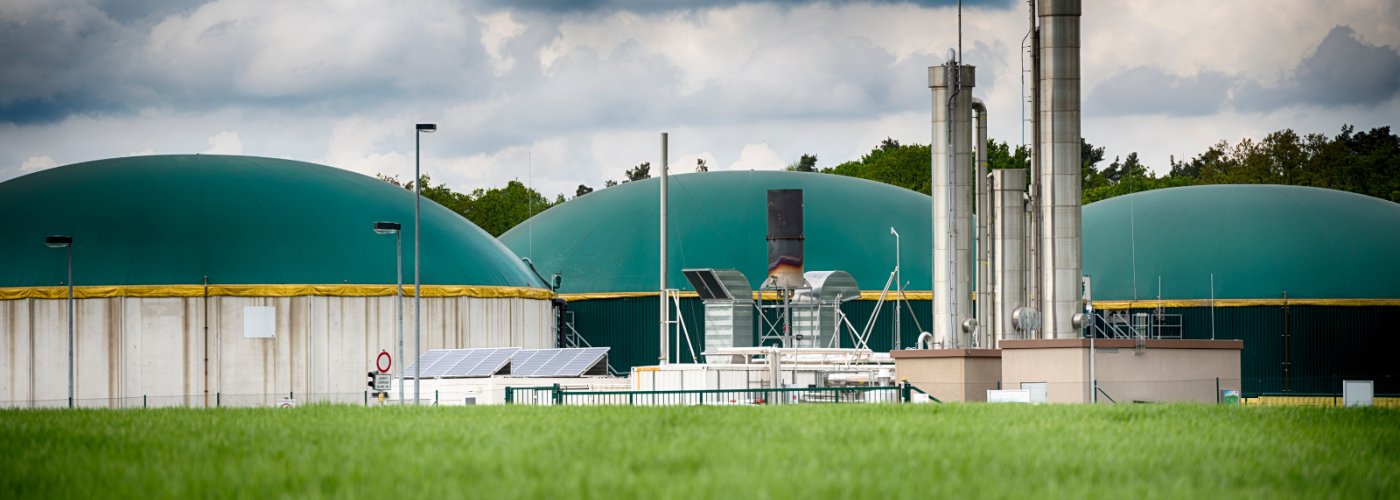
As the European Union (EU) looks for ways to cut its agricultural greenhouse gas (GHG) emissions and manage its energy transition, biogas and with it biomethane has gained renewed traction.
While biogas is often discussed as a solution to the climate crisis and the EU’s energy independence, there is a catch — it risks maintaining or even scaling up a factory farm system that contributes to the climate crisis; pollutes water, soil and air; and harms local communities.
IATP, along with several other civil society organisations, has launched the #StopTheBiomethaneRush coalition to highlight where large-scale factory farm gas falls short on solving the challenges of the climate crisis and a just transition to more sustainable and agroecological farming.
The coalition’s new booklet lays out the many environmental, community and climate risks of large-scale biogas and biomethane production. This article focuses on one major concern: how this trend could further entrench factory farming across Europe.
Biogas and biomethane relies on factory farm animal manure
Biogas is produced by breaking down organic materials in the absence of oxygen — a process called anaerobic digestion. Crops, mostly maize, are grown for the sole purpose of biogas production, sewage sludge, wastewater and food waste, as well as animal manure are used as feedstocks. Once the gas is captured, the leftover sludge, called “digestate”, is often spread on fields as fertilizer.
Large amounts of livestock manure — concentrated in a small area — presents a large environmental challenge. It is not only a major source of methane and nitrous oxide emissions, contributing to the climate crisis, but also contaminating soil and air.
Because animal manure from large industrial livestock farms is one of the major feedstocks, this type of biogas is also called factory farm gas.
Biomethane is a purified form of biogas. It can be injected into the gas grid and used just like fossil gas. This has caught the attention of major fossil gas providers, like Shell or Eni, who are setting up to partner with the meat and dairy industry to expand biomethane production.
EU plans to boost its biomethane production
In 2023, the EU produced about 17 billion cubic meters (bcm) of biogas and 5bcm of biomethane, which covered around 7% of the EU’s gas demand, in around 20,000 biogas plants. 1,000 of those are capable of upgrading biogas into biomethane.
While the current biogas production was spurred by renewable energy policies, some EU policymakers would like to double down on scaling up infrastructure and production in the next decade.
In 2022, the European Commission suggested that in order to gain independence from Russian energy imports the EU should produce 35bcm of biomethane by 2030 — a number that appears to be taken from industry. Yet, recent analysis concluded that the amount of feedstock required to meet this target could not be sourced sustainably.
Although a binding biomethane target was later rejected by EU Member States, it was still included in the Commission’s recently updated roadmap to phase out Russian gas. The Biomethane Action Plan, adopted in 2022, defines EU level measures to drive biogas developments, including generating access to finance.
The plan to build up biogas production in the EU is underpinned by significant subsidies of EU member states into biogas plants and infrastructure. Many such support programs have increased in the last years, such as in Ireland or Italy.
In addition, new prospects for scaling up incentives for biogas production may come from the EU’s new carbon farming scheme, adopted in November 2024. The framework defines rules for the certification of carbon farming activities that may be traded as carbon offset credits. While the current scope of the scheme does not include biogas, the Commission has been mandated to develop pilot methodologies and make recommendations to the European Parliament and the Council by July 2026 about whether to include livestock — including biogas — in the carbon farming framework. If approved, factory farms with biogas plants could sell carbon credits to companies wanting to offset their GHG emissions, and would serve as a source of funding.
In the U.S., biogas credit certification is already being implemented in practice under California’s Low Carbon Fuel Standard, and on the private market with credits generated by companies such as Athian.
Expanding biogas production means expanding factory farms
While it may seem promising, massively scaling up biogas and biomethane production in the EU comes with the risk of locking in a broken and harmful factory farm system. To be economically viable, industrial biogas plants require a constant supply of feedstocks, including crops and manure.
In 2020, 42% of the biogas and biomethane produced in the EU came from crops, roughly 24% come from animal manure, though there is significant variation between countries.
According to industry scenarios for scaling up biomethane production only, the share of manure would need to increase to 32% by 2030 to produce 35bcm of biomethane. The total amount of biomethane produced from manure would increase by more than 50% between 2030 and 2050.
The biogas build-out will inevitably benefit larger farms over smaller farms. Large factory farms are better placed to collect manure, given their concentration. Animals raised in smaller, extensive systems distribute their dung across pastures and cannot provide sufficient manure for the biogas plant to be economically viable.
The International Energy Agency concluded that the EU’s average of 50 dairy cows per farm is largely economically unattractive for biomethane production, but future consolidation increases the potential for biogas production. Biogas and digestate production contribute to the financial viability of large-scale, intensive livestock farms, providing an economic advantage over smaller-scale farms
Assessments in the U.S. found that the installation of biogas infrastructure promoted through public subsidies led to a growth in factory farms. In Germany, manure used for biogas production mostly comes from farms with more than 2,000 pigs or more than 200 cattle.
Biogas is a technological fix, not a holistic solution
Biogas is promoted as a climate fix through an accounting trick, assuming manure is an inevitable source of pollution, rather than a by-product.
While the EU emphasizes that biogas should be produced sustainably, it is wrong to view the amount of manure needed to meet such a goal as an unavoidable waste stream that is best addressed through biogas production.
Methodologies to assess the climate footprint of biogas usually ignore the broader scope of emissions connected to industrial animal farming, in particular from the animals themselves and from growing the vast amounts of feed needed to sustain them, thus inflating the climate potential of biogas.
In addition, recent assessments found that methane and nitrous oxide leaks — which occur during biogas production, upgrading and the storage and application of digestate — can reduce any climate benefits further.
No distractions in a just transition of the industrial livestock sector
The coalition’s new booklet highlights the serious risks posed by large-scale biogas and biomethane production — not only for our food system, but also to local communities, animal welfare and the energy transition.
Massive public support for biogas without conditionalities sends the wrong signal, reinforcing intensive livestock systems instead of helping farmers and rural communities transition to more sustainable forms of animal farming.
To address the climate and biodiversity crises as well as local harms, we must shift towards smaller, pasture-based system, starting with those areas of Europe with the highest animal densities.
Technological solutions alone, including biogas, are not sufficient to deliver the necessary GHG emission reductions. Several research groups have shown that a broader transformation would be needed, not only to meet climate targets but also to restore ecosystems.
In this reformed system, manure would be more scarce and less concentrated. While small, community-based biogas plants may have a niche role to play, current EU plans risk entrenching factory farming and encouraging investments in costly infrastructure that is neither sustainable nor aligned with long-term climate goals.