This year’s harvest time brought me to three different places — from Minneapolis over to Copenhagen, Denmark then to Malmö, Sweden — to learn and discuss what we can do to make our food systems work for the people. I could summarize my journey as a hug — rebellious and hopeful communities across two continents squeezing in the bleak analysis from policymakers who are convinced that the current state of the world leaves little wiggle room for change.
My first stop brought me to Minneapolis, home of IATP, and the stage for this year’s Farm Aid 40. If you never heard about Farm Aid, don’t be ashamed (especially my fellow non North-Americans), neither had I before I joined IATP.
Starting in 1985, musical icons Willie Nelson, John Mellencamp, and Neil Young organized the first Farm Aid benefit concert to shine a spotlight on the financial struggles of family farmers during the 1980s U.S. farm crisis and to raise money to support them.
IATP’s history is closely tied to that farm crisis. IATP’s founding document “Crisis By Design”, published in 1987, guides our understanding of the problems our agriculture and food systems face yet today.
As someone focusing on Europe’s challenges, taking a deep dive into the U.S. conversations not only tested my English skills trying to engage with accents I don’t often come across, but also showed me up-close how similar the challenges are for family farms on both sides of the Atlantic: uncertain markets dominated by large corporations, increasing disruptions by climate change and volatile government policies that do not meet the challenges facing farmers.

At my second stop, a policy conference in Copenhagen, policymakers from across the EU offered a less ambitious sentiment, urging the audience concerned about the lack of climate ambition that now is not the time for ambitious climate action. Why? Because, according to the speakers, not only do global economics and geopolitics demand different priorities but climate policies that raise the cost of living plays into the hand of the rising far-right parties’ narrative in Europe.
This analysis, however, points more to faulty design of climate policies rather than climate action itself. Such policies should be designed to make people’s lives better and to ensure future generations have a planet they can thrive on.
Rather than backing off climate action, we must create policies that link climate action to smart economic development and redistributive measures lead by just transition principles. The cost of inaction will be much higher than today’s investments in our future.
At the conference, I had the opportunity to present IATP’s perspective on what policies could help to put a just transition to sustainable agri-food systems in motion — highlighting the need for three elements in particular:
- A binding and ambitious emission reduction target for the agriculture sector: not only to ensure we have a more honest conversation about what society needs from the sector but also what farmers, workers and other stakeholders in the system need to make it a reality.
- A strategy for the future of animal farming: to support a transition away from high-density factory farming (also recommended by the Strategic Dialogue consensus), rethinking the role of livestock within our agriculture and food systems in line with an overall reduction of livestock production and consumption to allow for better and integrated systems of animal farming in the EU.
- Just transition funding: to support farmers and other actors in the food systems with the heavy lifting in the transformation and to create new opportunities, such as whole-farm shifts away from factory farming or establishing new supply chains and infrastructure.
Even if we choose to ignore the climate crisis, Francois Dejean, Head of Secretariat of the European Scientific Advisory Board on Climate Change, emphasized the fact that the reality of the climate crisis will not go away — but only encroach more and more on people’s daily lives.

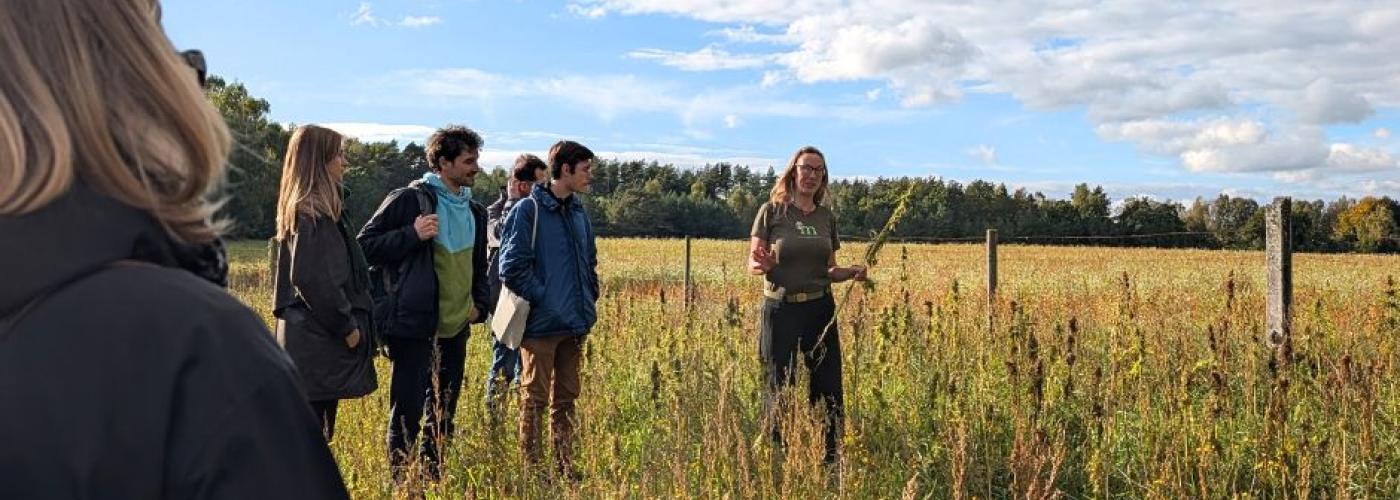
My last stop, the Agroecology Europe Forum in Malmö, one of Sweden’s largest cities, drew together the agroecology community across Europe. Not only did it come with the most delicious food I ever had at a conference (shoutout to the chefs at MAT and the farmers providing us with wonderful produce), the menu of the forum was filled with inspiring brain snacks.
If you work on agroecology, hearing a visionary like Miguel Altieri speak live and in color about the potential of agroecology and the importance of learning to distinguish real from false solutions is a humbling experience.
It was inspiring to see the agroecology community understand that in order to create an agroecological food system, we need to address a livestock sector and industry dominated by factory farms. Agroecology Europe’s work is a valuable contribution to a vision for a just transition of livestock systems — challenging both notions that either technological efficiency is the only way to address the sector’s climate and environmental pollution, or that the sector has no problem at all.
For someone like me, who spends most of their days glued to the computer trying to make sense of complicated legal texts and often convoluted speeches of policymakers, dispersing my knowledge into the community and learning about what we can do about the issues we are facing was a refreshing change of scenery. It was a humbling and rich experience to learn from so many dedicated and hands-on members of the community, from efforts to improve food served to children in Malmö’s schools to farmers like Alnarp’s Agroecology Farm or Mossagården that provide the basis of the movement.
At the end of weeks spent across two continents, I have many more thoughts on my mind than I can summarize here. But there are a few seeds of hope that may share:
- Challenging times squeeze our resources — but also bring communities and people closer together to stand in solidarity and fight for a better future for all. Crises expose the system’s faults and create opportunities for change if we take a chance.
- If we reduce climate policies to the ones that put pressure on people without offering and supporting alternatives, we will harvest resentment and disillusionment. True climate justice means that social justice and climate action are deeply intertwined, not nice add-ons. A just transition must guide how we transform our food systems and economies to work within the boundaries of our planet. An agroecological food system means offering farmers and workers a fair income, while allowing everyone to be a “qualitarian”.
- With a new generation of farmers entering the sector, we have an important opportunity to support and work with them in furthering an alternative beyond industrialized food systems strangled by corporate power.
A phrase that echoed through the rooms and stadium during the days of Farm Aid was, “We all do better when we all do better.” A sentence coined by former Minnesota senator Paul Wellstone during a 1999 speech to the Sheet Metal Workers Union that could not be much more adequate for the current state of the world — and a good reminder that we need to hold our governments accountable when they are failing to deliver on a better life for everyone.