This report is published in collaboration with the Biodiversity and Biosafety Association of Kenya (BIBA-Kenya) and was made possible through a grant from the Tiny Beam Foundation.
Download a PDF of this report here.
Executive Summary
This report provides a value chain analysis of Kenya’s livestock sector with a focus on beef, pork and poultry. It examines the impact of trade liberalization on Kenya’s domestic livestock and meat producers and within the East African Community (EAC) market. It has been developed in response to trade negotiations between the United States and Kenya that began in 2020. The Biden administration launched the U.S.-Kenya Strategic Trade and Investment Partnership (STIP) in July 2022. The STIP aimed to establish “high-standard commitments” between the United States and Kenya on various non-tariff trade issues, including on agriculture, anti-corruption efforts, environmental issues, workers' rights, and trade facilitation. Unlike the Biden administration, the current Trump administration has expressed a clear preference for reciprocal trade deals.
Throughout these negotiations, the U.S. meat sector has expressed interest in addressing both tariff and non-tariff barriers to improve their access to Kenya’s market. This has raised concern among civil society and within Kenya’s livestock and meat sector about the threat of cheaper U.S. meat imports on their sector’s viability. To better understand the potential trade implications and provide policy guidance, this report offers an overview of the beef, pork, and poultry value chains, mapping current production, distribution models and trade concerns.
Kenya is home to one of Africa’s largest livestock herds. Meat products exports in 2023 were valued at KSh19 billion (US$146.15 million), compared to KSh 11.5 billion (US$88.95 million) in 2022, representing a 39% increase. Exports include meat from goat, sheep, fowls, rabbit, and turkey, among others. Kenya’s major export markets for meat are in the Gulf region, notably, the United Arab Emirates, Saudi Arabia, Bahrain, South Sudan, Oman, Qatar and Kuwait. At the same time, Kenya is currently unable to meet its domestic demand for beef and poultry without imports from other countries. Achieving fair, balanced and sustainable trade in livestock and meat products is essential for Kenya and the broader East Africa region for whom livestock is a significant sector, especially for rural communities. Trade flows must allow domestic and regional producers to thrive, enhance their sustainability and improve quality and good agriculture practices. There is still a high degree of informality across Kenya’s livestock value chains and this ranges from production to processing segments. Value addition remains limited and presents an opportunity for further investment, including sustainable meat processing and cold chain.
The poultry sector has witnessed rising demand and faces the greatest threat of import competition both from the U.S. and other suppliers. The Kenya Poultry Breeders Association (KPBA) and the Federation of Poultry Farmers in Kenya have accused Uganda of dumping surplus chicken meat in Kenya at reduced prices, making it difficult for local farmers to compete. Several foreign investors from countries like China and South Africa have also established local poultry operations, which is driving the rise of industrial agriculture and intensification. There is evidence of rising industrial agriculture across all livestock sectors as small-scale producers seek to improve competitiveness and emulate commercial producers. This has also increased pressure for the use of genetically modified grains in animal feed to lower costs of feedstock.
Comparative lessons from South Africa — which has a long history of dealing with U.S. poultry and pork imports and has relied on anti-dumping duties and other safeguards to protect its domestic industry from a surge of cheaper imports from the U.S. and other producers — offer valuable strategies and lessons that Kenya could adopt that include quotas.
While this study focuses on beef, pork, and poultry, it acknowledges that other sub-sectors — such as dairy, eggs, leather and animal feed — warrant their own detailed investigations to fully capture the breadth of Kenya’s livestock economy.
Key takeaways
- Meat production in Kenya is dominated by small-scale and pastoralist production. With the right public policies and support, it could provide a potential pathway out of poverty and food and nutrition insecurity for many households.
- While meat consumption in Kenya is relatively low compared to other countries like South Africa, there is a notable shift to poultry consumption in Kenya relative to beef for a variety of reasons, including health and cost concerns.
- Industrial agriculture is increasing across all livestock sectors, especially in poultry and beef production. Foreign investment, especially in poultry production, is driving a shift to industrial agriculture. In general, Kenya’s livestock and meat industries face significant challenges due to presence of cartels and anti-competitive behavior that need to be addressed through regulatory reforms.
- Kenya is highly intertwined in the East African regional market for trade in livestock, meat, dairy, feed and to a smaller extent eggs, both as a supplier and as a market. The growth of sustainable intra-regional trade should be safeguarded from potential import disruptions during trade discussions with the United States.
- The Trump administration is interested in trade concessions, and U.S. industry associations are pushing to remove market access barriers in Kenya, including changes to the import licensing for meat. Experience in South Africa demonstrates the pressures to increase meat imports from the U.S. to maintain market access in other areas like apparel, and the need to consider use of trade remedies to safeguard domestic producers from a surge in cheap imports.
1.Introduction
1.1 Background, scope and objectives
This report examines the impact of potential trade liberalization on Kenya’s domestic livestock and meat producers. It responds to pressures created by trade negotiations between the U.S. and Kenya trade negotiations beginning in 2020, when U.S. President Donald Trump and then-President Uhuru Kenyatta of Kenya agreed to negotiate a free trade agreement (FTA). The Biden administration did not continue the FTA talks and instead launched the U.S.-Kenya Strategic Trade and Investment Partnership (STIP) in July 2022. The STIP aimed to establish “high-standard commitments” between the U.S. and Kenya on various nontariff trade issues, including on agriculture, anti-corruption efforts, environmental issues, workers' rights, and trade facilitation. The U.S. meat sector has expressed interest in addressing both tariff and non-tariff barriers to improve their access to Kenya’s market. This interest raised concerns among civil society and Kenya’s livestock and meat sector about the threat of cheaper U.S. meat imports on their sector’s viability.
The report assesses emerging trends and risks tied to commercial and industrial agriculture trade policies for livestock and meat and delivers evidence-based recommendations to support Kenya’s small-scale farmers and foster local economic growth in the livestock and meat sector. These insights should guide advocacy initiatives and inform trade policymakers in Kenya and the United States on how to support sustainable livestock and meat production and fair trade.
The livestock sector is integral to Kenya’s food system and economy. In 2023, Kenya’s agriculture, forestry and fishing sector contributed US$23.6 billion, or 21.8% of the country’s total GDP[1]. Livestock production accounts for about 40% of agricultural value added (US$9.4 billion) and represents some 12% of national GDP, while providing employment for nearly half of the agricultural labor force.[2] In addition, the livestock sector contributes 22% to the food system GDP.[3]With Kenya’s population expected to reach 96 million by 2050 — up from 55.3 million today — the share of urban residents is project to rise from 27% in 2019 to nearly 50%.[4]This demographic shift and rising incomes are expected to drive a substantial increase in demand for animal-source foods and diversified dietary patterns.[5]
Kenya’s livestock sector remains underdeveloped with high levels of informality, which often results in low productivity and limited profitability for livestock farmers. Other constraints include inadequate market infrastructure and marketing systems and weak animal health services. Kenya's Vision 2030 emphasizes the need for accelerated development of the livestock sector, including value addition in the sector’s and food system’s long-term sustainability.[6]
Industrialization of livestock production is now a global trend, with industrial breeding lines responsible for roughly one third of pigs, half of eggs, two thirds of beef, and three quarters of poultry worldwide.[7] Although industrial animal agriculture is often promoted as raising productivity, it also raises critical socio-economic and environmental concerns — ranging from entrenched inequality and market volatility to land degradation, greenhouse gas emissions, and water pollution. Kenyan regulators are thus challenged to balance growth with sustainability by enforcing biosecurity laws, regulating antibiotic use, and incentivizing low‐impact feed systems, such as those integrating agro‐industrial byproducts and pasture‐based rotations.[8]
Kenya’s rapid shift toward industrialized meat production — especially in poultry and beef — has substantially increased overall output but often at the expense of small-scale producers and the environment. Large commercial farms and vertically integrated processors now dominate peri-urban markets, marginalizing pastoralists and indigenous chicken keepers who struggle with rising input costs, limited access to quality feeds and veterinary services, and volatile prices (World Bank, 2020). Intensive feed cultivation and concentrated waste from industrial operations have exacerbated land degradation, water stress, and biodiversity loss — risks amplified by recurring droughts that have decimated herds and wildlife alike.[9]
International trade agreements offer new challenges for Kenya’s livestock sector. Negotiations with the U.S. could open export opportunities, including for value-added products like dairy and leather, yet they also threaten to flood the domestic market with cheaper imports and impose stringent sanitary standards that small and medium operators find difficult to meet.
1.2 Research scope and report structure
The study provides a value chain and trade analysis of Kenya’s beef, pork, and poultry sectors. It highlights the challenge posed by industrial agriculture and U.S. trade policies on Kenya’s livestock and meat sectors. It does not delve into other significant livestock sub‐sectors like dairy, eggs, and animal feed — each of which merits an exhaustive analysis.
The study involved a mixed‐methods field study combining structured surveys and in‐depth interviews with a diverse cross‐section of stakeholders across Kenya’s livestock value chains. Data was collected from various sources including the Kenya National Bureau of Statistics (KNBS). At the industry level, we engaged the Kenya Livestock Producers Association, Farmers Choice Company, and Kenchic Enterprise; production managers, quality‐assurance officers, and policy analysts. These interviews helped provide information on the evolution of industrial animal‐agriculture systems in Kenya and explored how international trade policies have reshaped production, import and export dynamics, and value‐chain practices. Through collaboration with the Kenya Pig Farmers Association and local livestock officers, we identified pig producers across small, medium, and large scales for one‐on‐one interviews. To capture broader sectoral perspectives, we deployed an online questionnaire gathering quantitative data on farm operations, economic pressures, and trade‐related challenges. To assess downstream market impacts, we interviewed procurement managers and meat‐section staff at Carrefour Supermarket as well as public health officers responsible for retail outlet inspections. These discussions focused on sourcing strategies, pricing shifts, consumer preferences, and compliance with food safety regulations.
2. Mapping the current landscape of meat production in Kenya
2.1 Overview
Kenya’s livestock sector makes important contributions to the country’s GDP and employs nearly half of the agricultural labor force. It sustains the livelihoods of nearly 10 million Kenyans through farming, processing, and trade activities. Kenya’s projected population growth from 55.3 million today to about 96 million by 2050, coupled with rising incomes, is expected to drive a substantial increase in demand for animal-source foods such as meat, milk, and eggs.[10] Significant production gains and infrastructure investments are necessary to meet food demand.[11] Local producers currently meet 65% of overall meat demand, leaving a 35% gap that is filled by imports, especially from regional suppliers.[12]
With proper support, the livestock sector’s contribution to GDP could grow from the current 12% to as much as 20%.[13] However, serious under-investment persists, with private-sector livestock ventures receiving only about 10% of the US$500 million channeled into agriculture from the national fiscal allocations since 2015.[14] Between 2020 and 2022, one of the worst drought cycles on record in Kenya killed some 2.5 million head of livestock, highlighting the sector’s vulnerability to climate shocks.[15] Investments are needed to improve feed supply, processing facilities, storage, transport, and cold chain infrastructure.[16]
2.2 Production and value chain dynamics of the livestock sector
Kenya’s livestock production landscape can be divided into four overlapping segments:
- Subsistence smallholder systems: Most livestock‐keeping households in Kenya fall into this category. According to the 2019 Agricultural Census, of the approximately 6.36 million households engaged in livestock farming, about 4.61 million (72.5%) were classified as subsistence producers with farms that keep animals primarily for home consumption and occasional local sales rather than for regular market supply. [17]
- Pastoral and agro-pastoral systems: Pastoralists make up roughly 36% of the population living in arid and semi-arid lands; their herds account for a large share of Kenya’s beef output. These pastoral systems hold about 70% of the national cattle herd and generate some 76% of the total value of beef production.[18]
- Market-oriented smallholder or commercial farms: Smaller than industrial enterprises but more sales-focused than purely subsistence farms, these producers numbered about 1.12 million households (17.6% of livestock households) in 2019.[19]
- Industrial and intensive systems: Zero-grazing units, feedlot facilities for commercial beef and dairy, large-scale poultry farms are a growing segment as discussed below.
Commercialization and scale
A growing share of livestock production — especially dairy and poultry — is conducted by medium-to-large-scale enterprises, which increasingly use “modern production technologies”.[20]”These modern production technologies refer primarily to enhanced husbandry practices — improved animal health management through medicines, vaccines, genetics and biosecurity. Medium and large‐scale commercial livestock and poultry enterprises in Kenya have increasingly adopted systematic vaccination campaigns, therapeutics, and reproductive technologies to boost productivity. In February 2025, the Kenyan government rolled out a mass livestock-vaccination drive, relying on locally manufactured veterinary vaccines to improve both domestic and export supply. [21] Nonprofit partnerships (e.g., GALVmed) link smallholders and larger farms with affordable vaccine supply chains and trained community vaccinators, expanding coverage across rural counties. Innovations like KALRO’s refrigeration-free poultry vaccine technology are reducing cold-chain barriers and making immunization more accessible in remote areas.
Integration into the wider economy
Kenya's livestock sector plays a big role contributing to subsectors such as dairy and leather goods manufacturing industries.[22][23] In Kenya, ownership structures within the livestock sector are predominantly local, with communal and individual ranches forming the backbone of animal production. Under the Land Control Act, non-citizens and companies with foreign shareholders are legally prohibited from holding agricultural land outright, except through presidential exemptions or by owning shares in public companies that hold land. There are 51 group ranches and over 375 individual ranches, which collectively occupy nearly 1.5 million hectares and are managed by local pastoralist communities, ensuring community-based stewardship of rangelands.[24] Nevertheless, some high-profile commercial ranches have foreign involvement through conservation trusts and international NGOs.
2.3 Regulatory landscape for livestock and meat in Kenya
The Kenyan government has advanced efforts to grow the livestock sector through targeted legislation and institutional strengthening. The foundational Sessional Paper No. 2 of 2008 (the National Livestock Policy) sets out sector‐wide objectives including productivity enhancement, value‐addition and institutional reform. It identifies gaps in processing infrastructure and calls for public-private partnerships in breeding, genetic improvement, feed production and veterinary services. Policy updates in 2020 re‐oriented livestock governance around a devolved structure, clarifying national versus county mandates for disease surveillance and control strategies, extension services and market regulation. The Meat Control Act (Cap. 356), first passed in 1972 and revised in 2007, establishes the regulatory requirements governing establishment and operation of slaughter facilities, meat hygiene standards, import/export controls, inspection regimes and sanitary standards for meat destined for domestic and export markets. The Kenya Veterinary Policy (2015) mandates professional standards for veterinary practitioners and biosecurity measures. This policy underscores the importance of enhancing farm‐level biosecurity to reduce disease burden and improve productivity through accreditation of veterinary service providers.
A new Livestock Bill (2024) — which is pending approval before Parliament — seeks to streamline industry governance by establishing a Livestock Marketing Council and bolstering training institutions such as the Animal Health and Industry Training Institute (AHITI). The Bill — which aims in part to position Kenyan brands for export readiness — will streamline licensing, promote mobile abattoirs, and establish a Livestock Development Fund to finance smallholder producers and SMEs in processing. Among the promotional and development policies include Vision 2030 and the Agricultural Sector Transformation and Growth Strategy (ASTGS) 2018–2028, which promote livestock breeding programs, artificial insemination services, veterinary drug access and value‐addition infrastructure. It further supports feed reserve schemes and range improvements to stabilize production in arid and semi-arid lands. ATSTGS prioritizes livestock as a growth corridor through nine flagship projects covering breeding, feed production, market linkages and export promotion.
The Strategic Plan for State Department of Livestock Development (2023-2027) operationalizes Vision 2030 and the ASTGS by defining measurable targets for production growth, export earnings and disease control. It emphasizes gender inclusion, digital extension services and climate‐smart livestock practices to boost resilience and market competitiveness.[25] These legislative and technological interventions, alongside breed improvement programs and feed initiatives, are designed to elevate the sector’s global competitiveness and sustainable growth. However, smallholder farmers and pastoralist groups worry that the bill’s strict feed registration, certification and licensing requirements may marginalize informal producers and threaten traditional systems. Organizations such as Kilimo Cha Haki and local farmer advocates are concerned that provisions could criminalize everyday practices and prioritize commercial producers over small-scale producers, stressing that the legislation must contain exemptions and support for subsistence livelihoods. Another challenge is mobilizing the resources for full implementation of the above-listed initiatives.
2.4 Emerging trends of the major meat and livestock commodities
In 2023, Kenya produced a record 556,653 metric tons (MT) of meat, valued at KSh 304.6 billion (US$2.14 billion), up 19.8% from 464,512MT in 2022, driven by both increased slaughter volumes and higher meat prices. About 65% of that output is consumed locally, equal to roughly 362,800 MT.[26] This translates to per capita consumption of approximately 7.3 kg of meat in 2023, up modestly from around 6.6 kg in 2020.[27] FAO estimates place total per capita meat intake — including poultry, fish, informal trade and smallholder sales — at about 15 kg per year, with imports totaling some 300,000 MT per annum.[28] Figure 1 illustrates per capita meat consumption in Kenya by meat type (2022), while Figure 2 illustrates the evolution of meat consumption over time.
Figure 1: Per capita meat consumption by type in Kenya (2022)
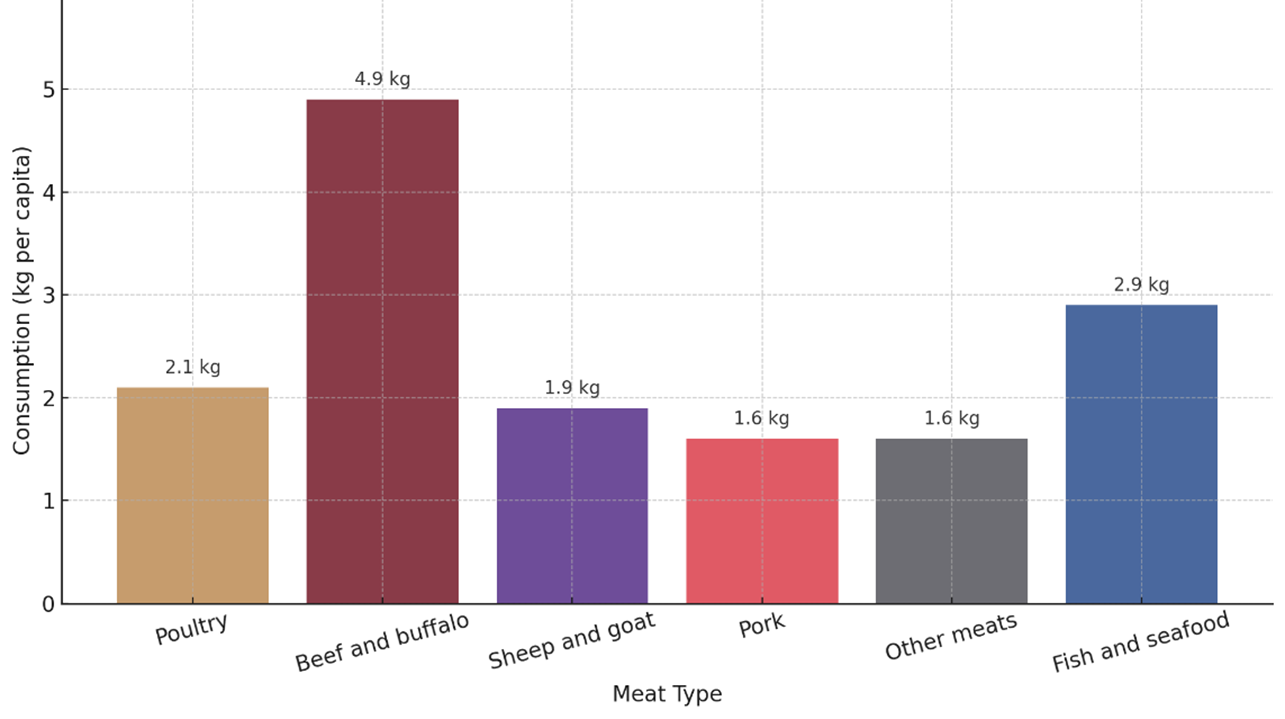
Poultry consumption has grown faster than other meat products, with per capita poultry consumption reaching 2.1 kg in 2022, while per capita beef consumption has declined.[29] FAO data indicate that regional meat supply increased from 17.3 kg per capita in 2010 to 17.7 kg in 2022, suggesting that Kenya’s growth mirrors broader African trends.[30] Despite these gains, Kenya’s per capita consumption remains low by international benchmarks, trailing the African average of 17.7 kg.[31]
Figure 2: Per capita meat supplies in Kenya (1961-2022)
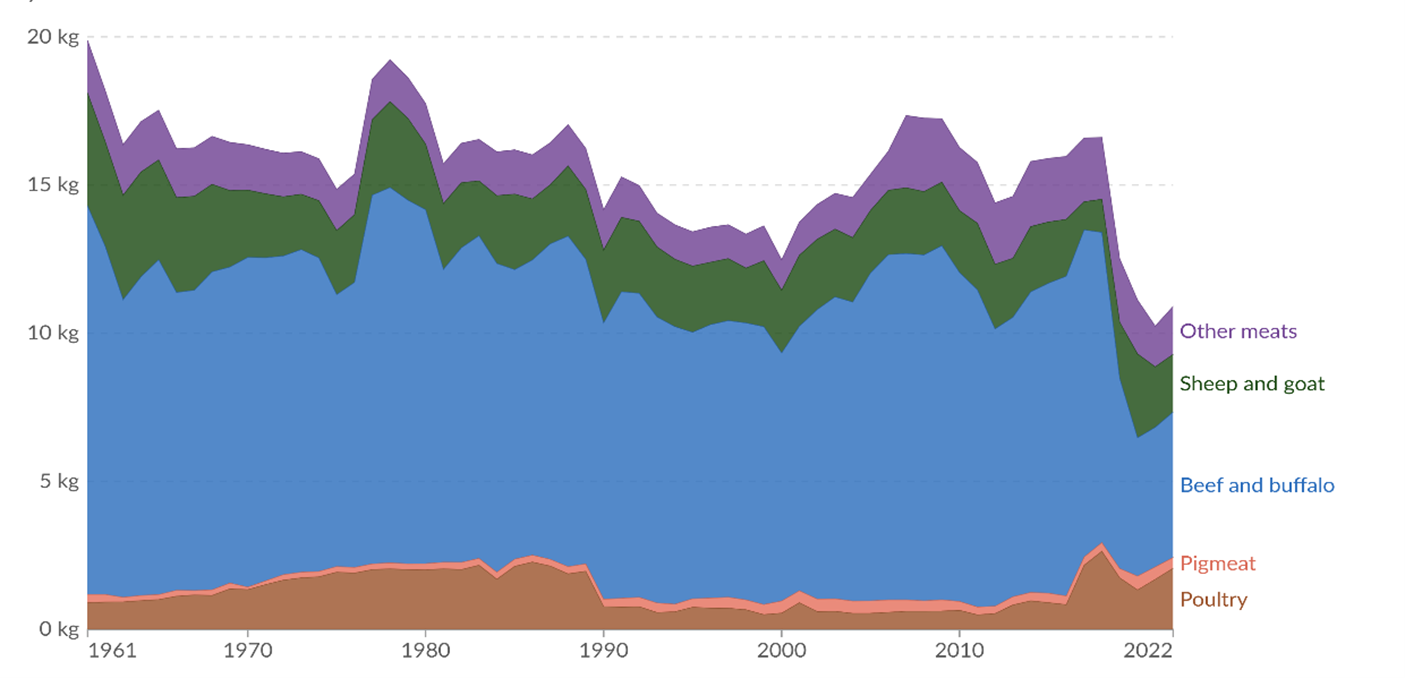
Source: FAO. 2024. Available online at Our World in Data
Per capita supply (not including household waste) measured in kg/person per year. Does not include fish and seafood.
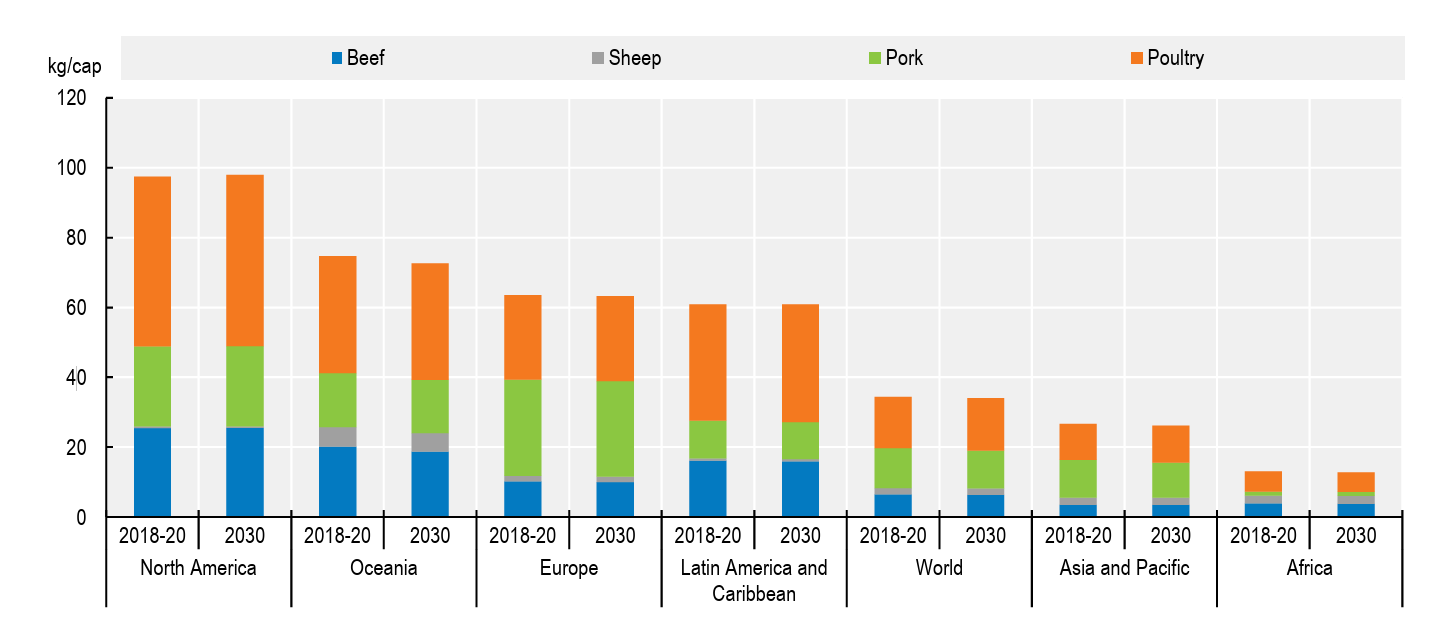
Figure 3 illustrates that North America and Oceania have the highest meat consumption per capita while Africa has the lowest consumption by far, even with increases projected by 2030.
Figure 3: Projected meat consumption by region (2018-20 vs 2030)
Consumption patterns are shifting. A study by the Kenya Markets Trust found that fewer than 25% of Kenyans now consume red meat — down from 67% a decade ago.[32] Kamau Kuria, CEO of KMT, attributes this drop to growing health consciousness, concerns over drug residues, unhygienic handling, and uncertainty about meat origin.[33] This change echoes findings from the Food Systems Dashboard, which highlight consumer wariness around meat safety and quality in Kenya’s urban markets. Poultry has emerged as the fastest-growing component of meat supply, mirroring global trends.[34]
Expansion of Industrial Operations — foreign investors and production practices: Kenya’s animal agriculture sector has traditionally been dominated by smallholder and pastoral systems.[35] However, peri‐urban zones around Nairobi, Nakuru, and Eldoret have seen the emergence of semi‐commercial and fully industrial poultry and feedlot enterprises that aim to optimize production cycles and supply chains.[36] Large domestic firms are expanding vertically integrated production lines that include hatcheries, feed mills, and climate-controlled housing to ensure year‐round supply. Leading Kenyan companies are capitalizing on scale and integration. Kenchic, East Africa’s largest day‐old chick and poultry producer, controls genetics, feed formulation, and traceability from hatcheries to retail. Quality Meat Packers (QMP) operates the region’s largest private slaughterhouse and processing plant, exporting to regional markets under stringent hygiene protocols. Farmers’ Choice and Kenya Meat Processors similarly manage end-to-end operations, forming a basis for domestic supply while meeting growing consumer preferences for branded, processed meats. Foreign entrants are reshaping the competitive landscape.
In April 2025, Kenya and China signed agricultural investment agreements worth US$430 million, earmarking significant funds for poultry, feed mills, and allied sectors.[37] As part of this, China’s Shandong Jialejia Agriculture and Animal Husbandry Technology Co. pledged US$30 million to establish a poultry operation on a 40-hectare site south of Nairobi, which will include a layer farm producing 500,000 birds with on-site feed mills.[38] These developments raise questions about antibiotic use, environmental impact, and the adequacy of Kenyan regulatory frameworks. Additionally, Dutch firm De Heus Animal Nutrition — with production facilities in Egypt, Ethiopia, South Africa, Ghana and Ivory Coast — are investing in farmer training and a plant near the Athi River to produce an estimated 200,000 MT of animal feed per year for the Kenyan market covering livestock and aquaculture.
Industrial poultry operations in Kenya employ deep‐litter or battery cage systems within controlled‐environment houses, automated feeding and watering lines, and rigorous biosecurity measures to maintain flock health and productivity. Large integrators frequently use antimicrobial growth promoters and prophylactics — practices now under scrutiny as part of Kenya’s National Action Plan on antimicrobial resistance.[39] Beef and pork enterprises increasingly favor confined feedlots, administering concentrated rations to shorten finishing times; modern waste‐treatment installations at facilities like Quality Meat Packers’ (QMP) abattoir help mitigate effluent risks. Modern abattoirs and processing facilities have emerged like QMP with capacity to handle up to 900 cattle and 3,000 small stock per day, reflecting substantial investments in cold‐chain logistics and improved food safety standards.[40] Kenya’s formal slaughterhouses and abattoirs can be broadly categorized into those licensed to slaughter for the domestic market only and those licensed to slaughter for both for domestic and export markets. The latter include, the Kenya Meat Commission, Neema and Choice Meat.[41]
Economic Implications, Tariff Liberalization and Sensitive Products: Kenya’s commitments under the East African Community (EAC) Customs Union (2005) and EAC Common Market (2010) have driven significant changes in the livestock sector. Intra‐EAC tariffs on originating goods were eliminated in 2005 for most products and phased out over five years for others, culminating in duty‐free trade for almost all livestock products by 2010, subject to rules of origin.[42] Simultaneously, the EAC established a three‐band Common External Tariff (0%, 10%, 25%) to protect the regional market; a “sensitive items” list, however, allowed higher rates (for example, Kenya maintained a 30% duty on butter and dairy spreads for one year beyond 2010) to afford local industry time to adjust to foreign competition.[43] Subsequent CET reforms in 2022 introduced a 35% band explicitly covering dairy and meat products.[44]
The removal of intra‐EAC tariffs coincided with a surge in regional agricultural trade. Total intra‐EAC trade in agricultural commodities jumped by 76% from US $26 million in 2005 to US$46 million in 2008.[45] Uganda’s share of intra-EAC exports grew from 5% to 15.3% over the same period, reflecting broad gains for agricultural producers — including livestock exporters — across the region. Opening the market further to U.S. products under a trade deal will increase competition for both Kenyan and EAC livestock producers
2.5 Beef sector
Value chain overview
Over the past three years, Kenya’s beef‐cattle production volumes rose from about 244,000 MT in 2020 to roughly 268,000 MT in 2022, reflecting a cumulative increase of 9.8% equivalent to an average annual growth rate of approximately 4.8%.[46] During the same period, total meat production across all species climbed from 464,512 MT in 2022 to 556,653 MT in 2023, marking a year-on-year surge of 19.8%.[47] Kenya’s red meat consumption is expected to reach 626,000 MT by 2026, up from 464,512 MT in 2022.[48] Per-capita meat consumption is about 15–16 kg per year. Cattle account for 77% of red meat consumed with pastoral communities in arid and semi-arid lands (ASAL) contributing 80% of the red meat supply in Kenya.[49] Pastoral communities dominate beef production accounting for over 75% of the national cattle herd and accounting for about 60–65% of countrywide red meat production. Kenya is a meat deficit country and is currently unable to meet its domestic demand for beef without imports from other countries.
Extensive livestock systems — especially pastoralism — have long bolstered livelihoods across Kenya’s ASALs, which historically spanned the former North Eastern, Rift Valley, Eastern and Coast provinces.[50] In particular, the North Eastern Province (including Garissa, Wajir and Mandera) has been overwhelmingly pastoral, with as much as 95% of the population relying on livestock herding. The Rift Valley Province’s Turkana, Samburu, Baringo and Laikipia districts similarly host major Turkana, Samburu, Borana and Maasai communities whose primary livelihood is herd mobility and communal grazing. Together, these former provinces encompass the bulk of Kenya’s ASALs, where pastoralism remains the dominant production system.[51]
Pastoral livelihoods are challenged by climatic shocks, land‐use change, and market failures. Recurrent droughts, for example, in 2020-2023 which was declared “the worst in 40 years” — have decimated rangelands and livestock herds, exacerbating feed shortages and heightening vulnerability to climate variability.[52] At the same time, traditional communal grazing lands are fragmenting under private enclosure, protected‐area expansion, and agricultural conversion, undermining the mobility that pastoral systems require.[53] Compounding these ecological stresses, many pastoral districts lack efficient, competitive livestock markets, with minimal information, formal market models are absent, and weak coordination erodes profitability for producers and buyers alike.[54]
The pastoral supply chain in Kenya’s ASALs typically involves long treks to market, multiple trader categories (from village buyers to export agents), variable animal weight due to seasonal feed fluctuations, several on‐route fattening and auction stages, and myriad service‐providers (transporters, brokers, feed suppliers) operating with little regulatory oversight and high levels of informality.[55] These complex chains generate employment and linkages, yet they also inflate transaction costs and expose pastoralists to price volatility when drought or disease disrupts the flow of livestock to urban and export abattoirs.[56]
Livestock prices in ASAL regions can be notably lower than in neighboring countries, for example, Grade 1 goats in Lokiriama typically fetch KSh 3,500-4,000 locally, compared to KSh 5,500–7,000 in Uganda and KSh 9,000-10,000 in Sudan.[57] Meanwhile, urban Kenyan consumers are paying higher prices — up to KSh 800 per kilogram for goat and KSh 600 per kilogram for beef, reflecting both rising feed costs (up 60% in two years) and the impact of import-demand dynamics. This price gap shows that Kenyan pastoralists are underpaid at source while urban consumers overpay, indicating structural inefficiencies and a pricing dynamic that disadvantages both ends of the chain.
As stated earlier, production in Kenya’s cattle sector consists of three systems: (i) pastoralists, who account for about 80% of national beef output; (ii) commercial ranches that account for about 2-5% of production targeting high‐value markets with pedigree stock; and (iii) highland mixed‐farming systems comprising of predominantly small to medium-scale dairy and beef farms in Kenya’s highlands, where livestock is integrated with crop production.[58] Pastoralists rely on extensive, low‐input strategies of herd mobility and communal resource management, while ranches and highland farmers adopt more intensive practices tailored to market demands.
The recent severe drought underscored the critical need for a coordinated feed response.[59] Investors are urged to convert idle or under‐utilized tracts of ASAL land into fodder farms — growing drought‐tolerant forage species and processing surplus into pellets — to stabilize feed supply year‐round. Embedding pelletization into a forthcoming national beef strategy aims to buffer herds from seasonal feed shortages, reduce post‐harvest losses in hay and silage, and strengthen storage and distribution networks.
Kenya’s commercial beef sector is dominated by a handful of large-scale processors and export-oriented slaughterhouses, notably:
- Kenya Meat Processors Ltd. (KMP) — a family-owned enterprise specializing in poultry and beef processing and distribution, with a focus on chilled carcasses and boxed beef cuts for both domestic and export markets.
- Quality Meat Packers (QMP) — operates Kenya’s largest privately-owned slaughterhouse and meat-processing complex, supplying chilled and frozen boxed beef, including bone-in and boneless cuts, to regional and Middle East buyers.
- KenMeat — operated by the Kenya Meat Commission’s export processing arm and operates as Export Processing Zone beef processing facility in Eastern and Central Africa near the Athi River, handling fresh, chilled, and frozen carcasses for air, sea and road shipment.
- EastMeat Supplies — a specialist in pure indigenous beef and poultry processing, focusing on niche “indigenous” beef cuts for high-end domestic and export consumers.
Together, these firms anchor a relatively fragmented beef sub-sector, with a large informal segment, channeling live animals, chilled carcasses, and boxed cuts to regional and Middle Eastern markets.
Trade analysis
In 2023, Kenya exported roughly 500 MT of beef (predominantly fresh and frozen cuts), shipped 30,000 live bovines, 7,000 MT of lamb and 20,000 MT of goat meat.[60] Key destinations were the United Arab Emirates, Saudi Arabia, Qatar and Bahrain, while targeting African markets like the DRC, Libya, Nigeria, Rwanda and South Sudan.[61] Although export-zone processors like KenMeat have some in-house cutting, deboning and packaging capacity, value addition remains modest, and most beef exports consist of carcasses or primal cuts rather than branded, processed products. Secondary processing (cut-to-order, portioning, marination, ready-to-cook products) is still nascent. [62]
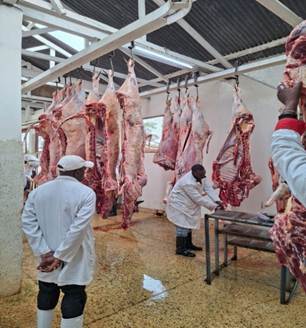
Slaughterhouse
Export Processing Zones like KenMeat provide bonded warehousing and packaging, yet most exports are unpackaged carcasses or bulk cuts rather than consumer-ready formats. Informal cross-border trade in small ruminant meat to Ethiopia, Somalia and Tanzania involves minimal processing or grading, reducing opportunities for premium pricing. A handful of branded chilled-cut lines (e.g., vacuum-packed steaks and cubes) are emerging from QMP and KMP, but volumes remain under 5% of total beef exports.
Per capita beef consumption is larger than pork consumption and is mostly from domestic production (primarily informal producers). Imports are minimal and beef imports from the United States are negligible. According to UN Comtrade data, total Kenyan imports of “meat and edible meat offal” from the U.S. amounted to just US$ 0.03 million in 2023, with no recorded shipments of fresh or frozen beef (HS 0201–02), pork (HS 0203) or poultry (HS 0207) from U.S. suppliers.[63] In terms of price, local retail beef in Kenya sells for between KSh 600 and KSh 625 per kilogram (US$4.00-4.16 per kg) as of early 2024 — up from around KSh 500 per kg two years earlier — due to drought‐induced shortages and rising feed costs.[64] Were U.S. beef to enter the Kenyan market, it would face freight and handling charges plus a 35% import duty, implying a landed cost on the order of US $5.50-6.00 per kilogram — well above prevailing domestic prices — making U.S. imports commercially uncompetitive under current conditions.[65] All meat imports, including fresh, chilled or frozen beef, pork and poultry, are subject to a uniform 35% ad valorem duty under the EAC’s fourth‐band Common External Tariff, which Kenya implemented on July 1, 2022.
The U.S. Meat Export Federation (USMEF) submitted comments to the Office of the U.S. Trade Representative on the U.S.-Kenya STIP noting that historical exports to the market were negligible and that Kenya’s 35% duty rate on imported beef and pork (raised from 25% in May 2022) is trade-prohibitive.[66] Noting Kenya’s bound rate of 100%, USMEF argued that the introduction of tariff rate quotas and safeguards should also be avoided in any future trade deal. In addition to a significant reduction of tariff rates, USMEF also called for Kenya to implement Codex standards for veterinary drug residues, animal health standards that align with those established by the World Organization for Animal Health (WOAH), establishing science-based microbiological standards, and recognizing a systems-based approval for U.S. establishments. USMEF also had concerns that Kenya’s existing import license system is a barrier to imports of U.S. red meat and will limit future opportunities. USMEF also raised concerns about Kenya’s rules of origin requirements that “the animals from which the meat, meat products, and meat by-products were derived originated from the country of origin.” (Kenya’s Imported Meat and Meat Products Regulations, 1997) It argued that compliance with this requirement adds administrative burden and cost to product destined for Kenya, compromising the commercial viability of U.S. red meat exports.
USMEF also complained that Kenya requires that “the meat [and] meat products shall be transported directly from the country of origin to Kenya without any trans-shipment.” Based on current carrier routes, this would very likely limit direct shipments from the U.S. to air freight only. USMEF also called for further clarity on the testing requirements for import into Kenya, as a zero or limited tolerance on certain pathogens and veterinary drug residues can result in non-science-based trade barriers. Moreover, USMEF argued that sustainability or environmental-related requirements should not be included in any market access provisions as this would result in additional regulatory requirements for trade.[67]
2.6 Pork sector
Value chain overview
Kenya’s pork sector is relatively small, producing around 24,000 MT of pork in 2022, but the sector is rapidly evolving to meet rising domestic demand.[68] Smallholder farmers (5-100 pigs) dominate production (accounting for 70% of farms), chiefly in Western, Rift Valley, Nyanza, Eastern, Central and Nairobi regions; medium‐scale producers operate with 100-500 pigs, and a nascent industrial sub‐sector (~5-10 large farms) is emerging around major urban centers.[69] Per‐capita consumption remains low at roughly 0.4 kg per year, well below beef (12.2 kg) and poultry (2.5 kg), but demand is projected to surge by nearly 168% between 2010 and 2050, driven by urbanization and a growing middle class.[70]
Producers include: (i) small-scale farmers (about 5,000 operations nationwide) with between 5-100 pigs per farm, who account for about 70% of all pig farmers — challenges include limited access to quality feed, veterinary services, and formal markets;[71] (ii) medium-scale producers with between 100–500 pigs, that operate family‐run farms but with commercial objectives — these producers tend to have better biosecurity, and some vertical integration (owning small slaughter slabs) compared to small-scale producers, but also face high costs of commercial feed and competition from cheaper imports; and (iii) large-scale producers with over 500 pigs — these are typically near major urban centers like Nairobi, Nakuru, Kisumu and tend to be fully integrated commercial and industrial agriculture operations (incorporating feed milling, slaughter, packaging and cold‐chain distribution).
Foreign investors are increasingly eyeing Kenya’s pig sector, particularly its integrated large-scale operations. Donor agencies and development partners — such as the Turkish International Development and Coordination Agency, the UK government (US$5.3 million investment), and the Bill & Melinda Gates Foundation — have been channeling funding into feed production, animal health, breeding, and slaughter infrastructure. Such investments align with rising domestic demand which is projected to increase up to 50% by 2030, complementing policy support like the Kenya Livestock Master Plan,[72] which paves the way for more private-sector and foreign capital inflow.
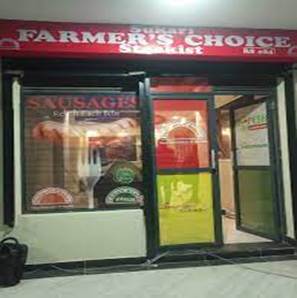
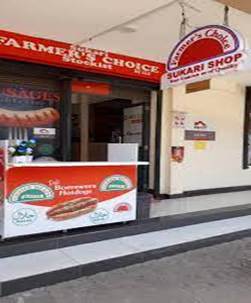
Pork outlets
Trade analysis
Pork production in Kenya has grown at about 3% CAGR over the past decade. In 2023, pork production reached 40,055 MT from about 840,160 pigs and generating around KSh 19.5 billion in revenue. This is a sizeable increase from roughly 25,800 MT in 2020, highlighting the upward trajectory in domestic production. On the demand side, market projections suggest current domestic consumption is roughly in line with supply — around 40,000 tons annually. However, with ongoing efforts to dispel myths and boost intake (e.g., promoting hygienic standards), growth in consumption may outpace production if supply-side challenges like high feed costs and limited informal slaughter frameworks can be addressed.[73] Per-capita pork consumption rose from 0.2 kg in 2010 to 0.4 kg in 2022. Kenya is a sizeable importer of pork meat from the EU, China and other sources. Imports include both fresh or chilled cuts and frozen or chilled pork meat.[74] Kenyan pork imports are projected to grow at 5-7% annually through 2028.[75]
U.S. pork export sales show modest interest but no significant shipments to Kenya have been recorded in the USDA export‐sales database U.S. Export Sales. The U.S. National Pork Producers Council (NPPC) has called for the removal of Kenya’s import duties of 35% and all non-tariff barriers to U.S. pork exports.[76] According to USTR’s National Trade Estimate Report (a compendium of trade complaints across sectors), Kenya maintains complex, non-transparent, and costly requirements for importation of meat products, including pork. These requirements include a standardized sanitary certification, a “Letter of No Objection to Import Permit” issued by the Ministry of Agriculture’s Department of Veterinary Services (DVS) and physical inspection and testing of meat imports at the port of entry to ensure conformity with relevant Kenyan standards. NPPC has called on Kenya to eliminate its discretionary import permit approval procedures and commit to an automatic licensing process for U.S. pork imports, based on presentation of the USDA Food Safety and Inspection Service (FSIS) Certificate of Wholesomeness, as well as recognition of the equivalence of the U.S. food safety inspection and approval system for pork slaughter, processing, and storage plants.
2.7 Poultry sector
Value chain overview
Poultry farming in Kenya contributes about 30% of the agricultural sector’s GDP with about 50 million birds slaughtered in Kenya annually.[77] The country boasts a diverse range of poultry types that include chickens, turkeys, ducks, and geese, with opportunities for both small-scale and commercial farmers. The industry supports the livelihoods of millions of Kenyans, both directly and indirectly, through farming, feed production, retail, veterinary services, and other activities. Kenya’s poultry meat production reached an estimated 123,000 MT in 2023. Per-capita poultry consumption rose to 2.5kg and egg consumption remains around 1.42 kg per person annually.[78][79] Indigenous chicken (Kienyeji) constitutes 75% of the poultry population, while broilers and layers make up 22%.[80]
The sector is divided across three segments: (i) small-scale producers (50–500 birds) accounting for about 90% of all poultry farms, primarily backyard and peri-urban operation; (ii) mid-tier farms (501–5,000 birds) that represent a sizeable but much smaller share of producers; and (iii) large vertically integrated farms (>5,000 birds) which account for fewer operations supplying day-old chicks, feed, health services, and processing. Despite their numerical dominance, small-scale units contribute a small share of total output with mid-tier and large farms supplying the bulk of commercial meat and eggs.
Kenya’s poultry sector has struggled with rising feed prices, with the price for a 50 kg bag of layers mash increasing from US$14 to US$32 in the last five years, while egg prices have remained at about US$2 per tray.[81] Multinational firms such as Cargill and Kemin Industries supply feed additives and technical services to local producers. Animal feed represents up to 70% of Kenyan poultry production costs, driven by imported feed ingredients and lack of local milling capacity.[82] The Competition Authority of Kenya’s 2024 Feed Inquiry reported that high feed costs, coupled with water and land expenses, place Kenyan farmers at a 20–30% cost disadvantage relative to subsidized foreign producers.[83] Rising input costs (water, veterinary services, energy) also make it difficult for local producers to compete with the low prices of imported products (if they enter the market without a tariff). Some farmers have moved to alternative feed solutions like Black Soldier Fly larvae, azolla, duckweed, Omena and homemade feed formulations which can cut feed costs by as much as 75%, or have exited production altogether.[84] At least 30 feed producing firms have shut down over the past three years, costing 1,000 jobs and over 4,000 chicken farms have shut down.[85]
Despite importing feed ingredients like soybean meal, sunflower cake and maize from regional countries local feed costs in Kenya remain high — even compared to the price of imported feed from Tanzania. Kenya’s poultry value chain also faces domestic competition issues as it is controlled by powerful intermediaries (some being politically connected). Farmers accuse the players of dictating artificially low prices at local markets, causing farmers to struggle to break even or sell below cost of production. Farmers have demanded government intervention, fair pricing regulations and a transparent pricing mechanism that accurately reflects the cost of production.
Trade analysis
Kenya exported US$818,000 of poultry meat (about 188 MT), mainly to Rwanda, South Sudan and DRC, but meets only 60% of domestic poultry meat demand and 50% of egg demand. The balance is imported, largely from Tanzania and Uganda.[86] Leading commercial integrators include Kenchic, Unga Group, Muguku Farms, Softkenya, and Sigma Supplies, with feed‐sector players such as Pembe Feeds and Bidco. As stated earlier, there has been recent investment from countries like China, South Africa and from the EU. In 2023, Kenya imported about 412 MT (US$1.5 million) of hatching eggs primarily from Tanzania, Zambia, Turkey, and the Netherlands.[87] Major commercial players include Kenchic PLC (the leading day-old chick and processed chicken supplier in East Africa), Unga Group, Pembe Feeds, MolaPlus Feeds, Bidco Africa, Chandaria Industries, Sigma Feeds (key poultry-feed manufacturers) Muguku Farms, Softkenya Farm, and Sigma Supplies (prominent layer and broiler integrators).
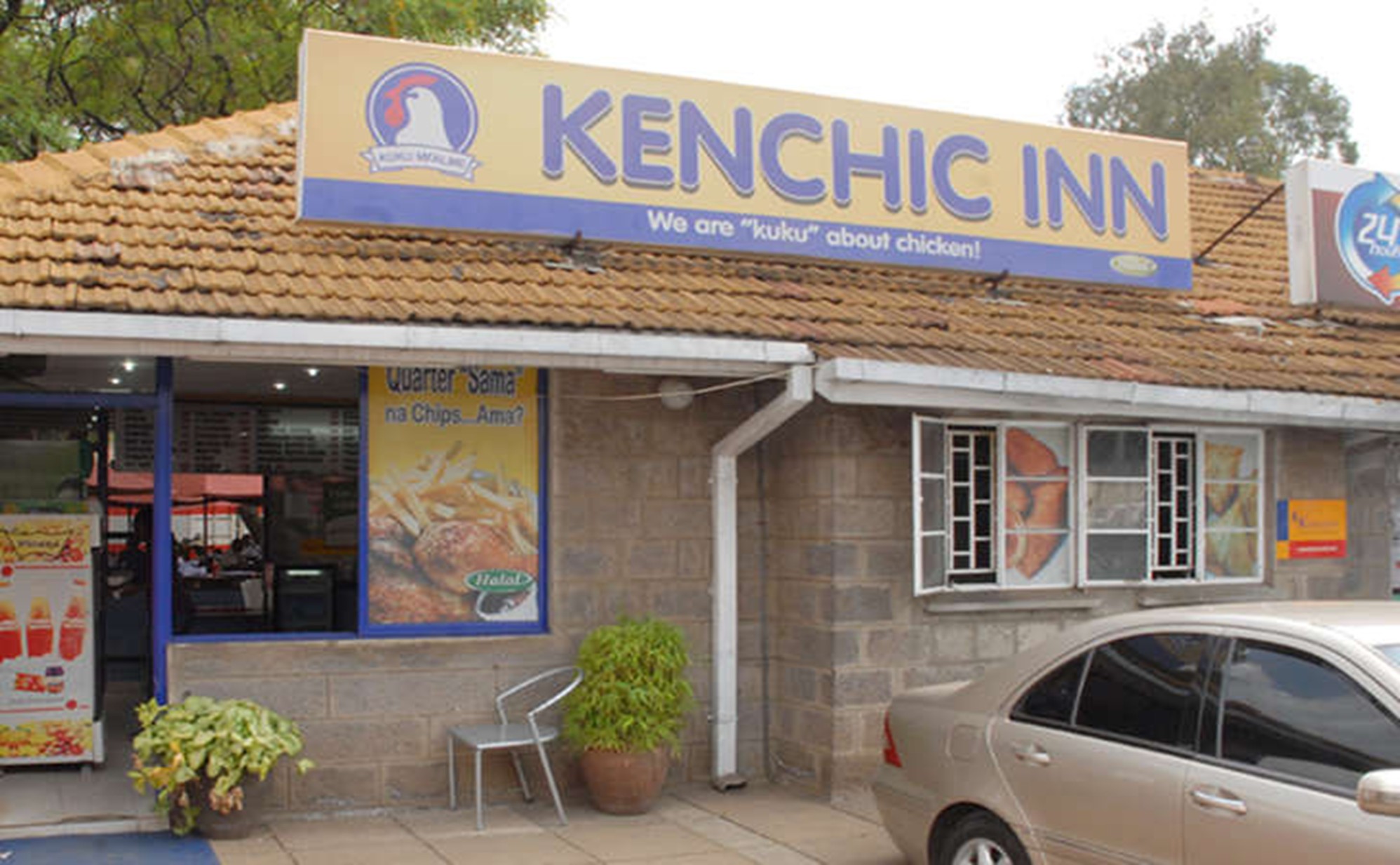
Kenchic outlet
The poultry sector faces major challenges from import competition — predominantly from the East Africa region and industry stakeholders warn that granting U.S. poultry full market access could cost the sector up to KSh 172 billion (US$1.28 billion) [88] or example, poultry meat and eggs are imported from Uganda without tariff restrictions. Kenya Poultry Breeders Association (KPBA) and the Federation of Poultry Farmers in Kenya have accused Ugandan exporters of dumping surplus chicken meat in Kenya at reduced prices, making it difficult for local farmers to compete. Over 540,000 farmers are reported to have reduced production in 2020 due to increased competition from Uganda. They have cited Ugandan’s exporters like HNH Rainbow, a Ugandan company, imported 72,000 kilograms of chicken meat into Kenya at US$1.90 (KSh 250).[89] This price was significantly lower than the market rate of US$2.50 (KSh 450) in Kenya and US$2.55 (KSh 460) in Uganda, prompting accusations of unfair trade practices.
In recent years the poultry sector has witnessed an influx of foreign investment from China, Europe and South Africa. For example, in April 2024, two Chinese companies pledged US$430 million for investment in Kenyan agriculture, specifically targeting poultry, aloe, and agrochemicals.[90] In 2024, Kenya signed a memorandum with World Bank to help the country expand poultry farming in the country by 300%, growing to 240,000 birds raised in the following six months, compared with 78,000 units reported previously. According to the Kenya Agriculture and Livestock Research Organization, the new indigenous breed may lay around 250 eggs per year, compared with 100 eggs collected annually currently.
Kenya does not import poultry meat from the United States. Similarly, U.S. feed exports to Kenya are minimal, largely due to high tariffs and regulatory restrictions, including Kenya’s ban on genetically modified (GM) products, which effectively excludes most U.S. corn and soy. In 2023, Kenya imported over 250,000 metric tons of maize, again mostly from neighboring Tanzania, Zambia, and Uganda, while soybean and soybean meal imports were also small and sourced regionally. Poultry meat from outside the East African Community (EAC) is subject to a 35% duty, while maize carries a steep 50% tariff. U.S. government and industry stakeholders are pushing for greater market access, which includes elimination of tariffs on poultry meat and feed grains, removal of GM-related bans, and alignment of sanitary and phytosanitary (SPS) regulations.
3. U.S.-South Africa trade in meat and comparative lessons for Kenya
The livestock sector in South Africa offers some lessons for Kenya and the shaping of its trade relationship with the USA. South Africa has a population of 63 million, close ties with western markets, robust infrastructure across the livestock supply chain (including cold chain) and ports, and is the 11th-largest beef producer globally, with high per capita consumption.[91] Livestock farming is South Africa's largest agricultural sector. It accounts for over 40% of agricultural output's total value — generating a gross income of 193.87 billion rand in 2024 (US$10.84 billion).[92] South Africa's livestock production has a well-established private sector and strong support for small and emerging commercial farmers. Commercial agriculture dominates the sector, using about 86.2 million hectares of land, while the smallholder sector occupies about.[93]
South Africa has the highest rate of meat consumption in Africa averaging 60-70 kilograms of meat per person, per year.[94] This is higher than the upper-middle and middle-income country averages of 53 kg and 42 kg, though lower than the high-income country average of 77 kg (Bennie et al, 2024). Like Kenya, industry in South Africa faces challenges with rising animal feed prices since 2020, erratic power supply, coupled with worsening consumer incomes and food price inflation due to the COVID-19 pandemic. This has dampened demand for red meat products as consumers opt for cheaper forms of protein like poultry.
Evolution and characteristics of commercial livestock farming
In recent decades, due to concentration and integration, commercial farming companies have replaced many individual farmers. Today, South Africa has over 13,500 animal farms or farming units, with about one third being commercial farms. Increased meat demand has seen growth in animal factory farms around the country, also known as CAFOs (Concentrated Animal Feeding Operations), which specialize in intensive animal feeding systems.[95] Between 70% and 80% of South Africa’s beef is produced through feedlots, supplying up to 1.7 million cattle for slaughter annually.[96] Unlike free grazing in traditional African livestock systems, feedlots animals are exposed to potentially harmful conditions and health concerns, such as the rise in zoonotic diseases.[97] Cattle production also has the highest environmental footprint in the food system, including greenhouse gas emissions.[98] South Africa’s meat industry is working on developing a coordinated response to climate change and defining a “just transition” that addresses sustainability questions under the Agriculture and Agro-Processing Masterplan 2022 and Red Meat Industry Strategy 2030.[99] Like Kenya, South Africa’s beef industry is largely domestically oriented with growing exports to markets in the Gulf region, Europe and Africa.
South African beef production has outpaced domestic consumption. In 2024, there was a 7.3% increase in production of 777,706 MT compared to the previous year.[100] The feedlot industry supported production with live imports from Namibia and Botswana — which trended from 138,477 MT and 206,471 MT in 2022 to 152,933 MT and 76,095 MT, respectively (Red Meat Industry Services, 2024). Sheep meat production saw similar trends to beef and is forecast to increase to nearly 100,000 MT in 2025 (Red Meat Industry Services, 2024).
South Africa imports a significant amount of meat to supplement domestic production and meet consumer demand. South Africa consumed approximately 2.23 million tons of poultry (23 million chickens a week), 3.94 million tons of pork and 1.54 million tons of red meat in 2022-2023.[101] Poultry, particularly chicken, is the largest imported meat type, followed by meat meal and pork. Major import sources include Brazil, the U.S., and the EU. South Africa in particular, has emerged as a substantial destination for U.S. beef variety meat and holds potential for beef muscle exports. U.S. beef exports to Africa increased 49% in 2023, reaching 20,464 MT with export value increasing 22% to $25.4 million.[102] Within this context, U.S. beef shipments to South Africa increased 69% to 13,142 MT worth $14.1 million (up 31%) led by beef variety meat, including beef kidney and liver exports.
In 2024, South Africa’s poultry imports reached 320,000 MT and a further decrease to 300,000 MT is projected for 2025, in part due to increased domestic production, high tariffs, and anti-dumping duties.[103] Poultry has been the most contentious and sensitive issue in meat trade between South Africa and the U.S. The South African poultry industry, with a gross value of more than 63 billion rand (US$3.5 billion), is the country's largest individual agricultural industry and contributes close to 14% to agriculture GDP.[104] This is similar to the trend observed in Kenya. However, in South Africa commercial broiler meat production accounts for almost 90% of the poultry meat industry, with the remaining 10% comprised of subsistence farming production and spent hens. The industry provides direct employment to over 58,000 people. It is the second largest consumer of maize in the country.
U.S. poultry meat products exports to South Africa have been limited by South African phytosanitary requirements and anti-dumping duties since 2000. The U.S. has challenged these health requirements as not backed up by science and South Africa risked losing preferential market access benefits to the U.S. under the African Growth and Opportunity Act (AGOA, a U.S. program granting unilateral trade preferences). In 2016, the two sides temporarily resolved issues surrounding U.S. poultry, pork and beef exports. To maintain its AGOA market access, South Africa agreed to an annual quota of 65,000 MT of frozen bone-in cuts of chicken originating from the United States (adjusted to 71,632 tons in April 2022) and a poultry at a tariff rate of 37%.[105]However, in 2020, citing a flood of cheap imports and to help protect local producers, South Africa raised tariffs on frozen bone-in chicken pieces from 37% to 62% and from 12% to 42% for frozen boneless chicken cuts.[106] The South African Poultry Association had requested tariffs of 82% on poultry shipments from the U.S. and Brazil which it argued had contributed to annual losses of 6.5 billion rand (US$393 million) for the local industry. In 2021, following negotiations, South Africa increased quotas for U.S. exports of bone-in poultry, and in September 2022 agreed to resume imports of U.S. poultry from states that have been declared free from highly pathogenic avian influenza (HPAI). In 2022, U.S. poultry meat exports to South Africa were valued at US$57 million.[107]
However, in 2021, the South African Poultry Association (SAPA), on behalf of the Southern African Customs Union (SACU), applied to South Africa’s International Trade Commission (ITAC) for a sunset review investigation alleging that the expiry of the anti-dumping duties on bone-in chicken meat imports from the U.S. would likely lead to the continuation or recurrence of dumping and material injury to the SACU industry.[108] ITAC considered responses from Merlog Foods, a major importer of bone-in chicken meat in South Africa, USA Poultry & Egg Export Council, and the Association of Meat Importers and Exporters. ITAC made a final determination that the expiry of the anti-dumping duties on frozen bone-in chicken meat imported from the U.S would likely lead to the continuation and/or recurrence of dumping and the recurrence of material injury. ITAC had also previously investigated and concluded that some poultry-exporting companies in Brazil, Denmark, Ireland, Poland, and Spain were “dumping” chicken products in South Africa and causing material harm to the South African poultry industry. ITAC recommended the imposition of anti-dumping duties ranging between 2% and 265% on these importers. During the 2022-2023 quota year the total quota allocated was 71,632 tons, and only 58% of the quota was utilized by poultry importers. According to the USDA, this was due to high tariffs, structural challenges with quota utilization, and unfavorable market conditions.[109] The industry in South Africa argues that they are among the most globally competitive poultry producers — especially given the softer currency — but they must be shielded from unfair trade practices.[110]
These livestock and meat trade concerns experienced by South Africa are relevant for Kenya, which may have to consider demands (and possible quotas) for improved market access for U.S. poultry, pork and beef under a new U.S.-Kenya trade agreement. It is important for Kenya to maintain policy flexibilities and trade remedies to safeguard its livestock producers.
4. Conclusion & key takeaways
This report presented a value chain analysis of Kenya’s beef, pork, and poultry sectors. Kenya’s meat industry could offer an important possible pathway out of poverty and food and nutrition insecurity for many households. Other sub-sectors such as dairy, eggs, leather and animal feed warrant their own detailed investigations to fully capture the breadth of Kenya’s livestock economy. We highlighted the trends and key takeaways in different segments of the livestock industry in Kenya. First, we noted the growth of poultry consumption, and red meat exports. Second, these trends notwithstanding, there are serious challenges facing the livestock sector. These include the high cost of agri-feed.
Third, we noted with great concern that some livestock farmers and feed millers have petitioned the government to permit importation of GM soy and maize for feed, citing cost savings of up to 30% compared to conventional grain feeds. We support the stance by the Kenyan Peasants League and other smallholder coalitions that have challenged GM adoption as a threat to seed sovereignty and traditional livestock feed systems, arguing that reliance on patented GM seed companies undermines rural livelihoods and exposes farmers to corporate control. The debate over GM products and legal challenges continues — in March 2025, the Kenyan Court of Appeal upheld an interim injunction blocking all GM corn imports, citing gaps in public participation and biosafety protocols.[111] This prohibition should be made permanent.
Fourth, we highlighted that there is still a high degree of informality across Kenya’s livestock value chains which are dominated by smallholder and pastoral agriculture. This ranges from production to processing like abattoirs. Value addition remains limited and a potential opportunity for further investment, including in meat processing and cold chain. There is also evidence of rising industrial agriculture across all sectors in a bid to improve competitiveness and emulate commercial producers which supply urban and export markets.
Fifth, we observed that the livestock sector, including agri-feed, is characterized by challenging anti-competitive practices and dominant firms. We argue for greater competition regulation, transparency, and enforcement. The Livestock Bill 2024 mandates public-private partnerships (PPPs) for feedlots, cold-chains and export zones, and establishes a national traceability system — effectively institutionalizing large-scale, industrial production. The Kenya Investment Authority has secured KSh 54 billion (roughly US$415 million) to build 450 county feedlots, projected to add 108,500 MT of red meat annually.[112] Regulations for zoning and environmental safeguards within the Livestock Bill would help to ensure these feedlots meet waste-management and water-use standards. The Bill should also mandate public disclosure of PPP contracts through the Marketing Boards.
Sixth, the current U.S. administration has expressed a clear preference for more transactional trade deals. The future of non-reciprocal trade arrangements like U.S. Generalized System of Preferences (GSP) and AGOA have become uncertain beyond 2025.[113] U.S. industry demands for improved access to the Kenyan market for livestock and meat products — including dairy — are expected to persist, as well as calls for Kenya to address non-tariff barriers. The poultry sector is highly contested and faces the greatest threat of import competition both from the U.S. and other suppliers. Foreign investments in local poultry operations is driving the spread of industrial agriculture.
Any trade agreement between the U.S. and Kenya must support Kenya’s livestock farmers and foster sustainable local economic growth and investment in the livestock and meat sector. This includes improvements in quality and good agriculture practices. The report also highlighted the importance of the regional EAC market for both livestock and agri-feed, which should not be undermined by external trade agreements.
Finally, seventh, the comparative experience from South Africa — a major meat producer in its own right — demonstrates the market challenges that smaller producers like Kenya are facing when negotiating with large meat producers like the United States. South Africa has a long history of engagement with U.S. poultry and pork exporters and has relied on anti-dumping duties and other safeguards to protect its domestic industry from a surge of cheaper imports. This demonstrates the importance of having a full suite of trade remedies available to help safeguard the domestic industry, especially small-scale producers.
Download a PDF of this report here.
Footnotes
[1] Sirak Bahta et al., “Livestock Sector Transformation in Kenya: Current State and Projections for the Future,” Food Systems Transformation in Kenya, 2023, 51–74.
[2] Kenya Markets Trust, “A Study on Meat End Market Trends in Kenya,” 2019, 128, https://www.kenyamarkets.org/wp-content/uploads/2019/11/Meat-End-Market-Trends-in-Kenya.pdf.
[3] Kenya Markets Trust.
[4] Clemens Breisinger et al., “Transforming Food Systems in Kenya for a New Era of Growth and Prosperity: Research-Based Recommendations for the New Government” 2022, no. May (2022), https://uda.ke/downloads/manifesto.pdf.
[5] Clemens Breisinger et al., Food Systems Transformation in Kenya Policy Options for the Future, 2023.
[6] FAO, “FAO Food Security and Nutrition in the World,” Journal of Nutritional Science and Vitaminology 65 (2019): S4–8, https://doi.org/10.3177/jnsv.65.S4.
[7] Dolapo Enahoro, Mario Herrero, and Nancy Johnson, “Promising Options for Improving Livestock Production and Productivity in Developing Countries,” ILRI Project Report, 2019, 36.
[8] Muloi et al., “Analysis of Antibiotic Use and Access to Drugs among Poultry Farmers in Kenya.”
[9] Breisinger et al., 2023; Trade et al., 2018)
[10] Bahta et al.
[11] Bahta et al.
[12] Carol Kamau, Matthew Snyder, and Ryan Scott, “Market Fact Sheet: Kenya,” 2024.
[13] Revolutionizing Kenya's Livestock Industry through the Meat Industry: Insights from the Kenya MEAT Expo 2024 | AU-IBAR)
[14] ILRI, “Unlocking Investment for the Kenyan Livestock Sector,” no. February (2024).
[15] UN Reliefweb. Kenya 2022 Drought Response in Review. 23 February 2023. Available online at https://reliefweb.int/report/kenya/kenya-2022-drought-response-review
[16] Kenya Market Trust, “Kmt-Livestock-Case-Study-Reduced,” no. May (2020).
[17] KNBS, “KENYA_CENSUS_OF_CCFGH_REPORT_2022.Pdf,” 2022.
[18] FAO, “Livestock Production Systems Spotlight: Cattle and Poultry Sectors in Kenya.,” Livestock Production Science 48, no. 1 (2018): 75–76.
[19] KNBS, “KENYA_CENSUS_OF_CCFGH_REPORT_2022.Pdf.”
[20] Caroline K. Bosire et al., “Meat and Milk Production Scenarios and the Associated Land Footprint in Kenya,” Agricultural Systems 145 (2016): 64–75, https://doi.org/10.1016/j.agsy.2016.03.003.
[21] Veronica Mwangi et al., “Beef Production in the Rangelands: A Comparative Assessment between Pastoralism and Large-Scale Ranching in Laikipia County, Kenya,” Agriculture (Switzerland) 10, no. 9 (2020): 1–15, https://doi.org/10.3390/agriculture10090399.
[22] In 2023, the formal dairy market processed approximately 810 million litres of milk, generating a value of KSh 40.5 billion (about USD 280 million), marking a 13% increase from the previous year. The government aims to further enhance this sector by increasing the proportion of value-added dairy products from the current 40% to 60%, focusing on items such as butter, cheese, ghee, and yogurt. This strategy is expected to not only boost domestic consumption but also expand export markets, with dairy exports projected to reach USD 69.5 million by 2025, up from USD 56 million in 2023. See Kenya eyes $69.5mn of dairy product exports in 2025, in CapitalFM, 18 March 2025. Available online at https://www.capitalfm.co.ke/business/2025/03/kenya-eyes-69-5mn-of-dairy-product-exports-in-2025/ (Kenya eyes $69.5mn of dairy product exports in 2025 - Capital Business)
[23] In 2023, the leather and related products sub-sector experienced growth of 21.7%, a substantial increase from the 2.4% growth in 2022. The sector's contribution to the economy stands at KSh 10.6 billion (approximately USD 70 million), with exports ranging between KSh 2–3 billion (USD13–20 million) annually over the past five years USDA. 2024. Assessment of Kenya’s Dairy and Beef Sectors and Opportunities for US Investment. Available online at Despite these figures, the industry faces challenges such as high levels of wastage and minimal value addition Bhoopal, A., Wathuta, W. and Girvetz, K. 2024. Unlocking investment for the Kenyan Livestock Sector. Nairobi, Kenya: International Livestock Research Institute, Gatsby Africa and AgThrive. Available online at https://cgspace.cgiar.org/server/api/core/bitstreams/d6e665c2-2ebd-448d-a2a2-94c4f8d3bd0a/content
[24] Mwangi et al., “Beef Production in the Rangelands: A Comparative Assessment between Pastoralism and Large-Scale Ranching in Laikipia County, Kenya.”
[25] Catalyse Returns and F O R Livestock, “Ministry of Agriculture and Livestock Development State Department for Livestock Development Nairobi News Release,” no. July (2024).
[26] Peter Mburu, “Value of Meat Produced in Kenya,” Daily Nation, January 23, 2025, https://nation.africa/kenya/business/value-of-meat-produced-in-kenya-hits-record-sh305bn-on-demand--4898486#story.
[27] FAO, “Food Balance Sheets 2010-2022 Global, Regional and Country Trends Food and Balance Sheets 2010-2022 Global, Regional and Country Trends FAOSTAT Analytical Brief 91 FAOSTAT FOOD BALANCE SHEETS BACKGROUND,” 2024, https://files-faostat.fao.org/production/FBS/New FBS methodology.pdf.
[28] FAO.
[29] Helgi Library, “Poultry Meat Consumption Per Capita in Kenya,” 2025, https://www.helgilibrary.com/indicators/poultry-meat-consumption-per-capita/kenya/.
[30] FAO, “Food Balance Sheets”
[31] FAO, “Food Balance Sheets”
[32] Kenya Market Trust, “Kmt-Livestock-Case-Study-Reduced.”
[33] Euromeat, “Kenyans Have Reduced Their Red Meat Consumption,” June 4, 2025, https://www.euromeatnews.com/Article-Kenyans-have-reduced-their-red-meat-consumption/2964?
[34] FAO, “Food Balance Sheets”
[35] Bahta et al., “Livestock Sector Transformation in Kenya: Current State and Projections for the Future.”
[36] Masfi Sya’fiatul Ummah, “A MAPPING AND ANALYSIS OF LIVESTOCK FATTENING AND FINISHING ENTERPRISES AND BUSINESS MODELS IN KENYA,” Sustainability (Switzerland) 11, no. 1 (2019): 1–14, http://scioteca.caf.com/bitstream/handle/123456789/1091/RED2017-Eng-8ene.pdf
[37] Food business Asia/Africa, “Kenya Strikes US$430M Agricultural Investment Deal with China,” 2025, https://www.foodbusinessafrica.com/kenya-strikes-us430m-agricultural-investment-deal-with-china/.
[38] Singapore Nanyang Technological University, “Kenya Receives US$430m in Agriculture Investment Pledges from China” (Nairobi, 2025), https://www.ntu.edu.sg/cas/news-events/news/details/kenya-receives-us-430m-in-agriculture-investment-pledges-from-china.
[39] Dishon M. Muloi et al., “Analysis of Antibiotic Use and Access to Drugs among Poultry Farmers in Kenya,” One Health 20, no. December 2024 (2025), https://doi.org/10.1016/j.onehlt.2025.100987; Jeniffer Waiyego Kariuki et al., “Antibiotic Use by Poultry Farmers in Kiambu County, Kenya: Exploring Practices and Drivers of Potential Overuse,” Antimicrobial Resistance and Infection Control 12, no. 1 (2023): 1–11, https://doi.org/10.1186/s13756-022-01202-y.
[40] FAO, “Livestock Production Systems Spotlight: Cattle and Poultry Sectors in Kenya.”
[41] Kenya Markets Trust (2020). The Economics of Modernising the Meat Industry in Kenya: Untapped potential of meat industry in Kenya. KMT Livestock Research. Available online at www.kenyamarkets.org
[42] EAC trade Policy, “W ORLD T RADE Report by the Secretariat” 2014, no. October (2014): 133–60.
[43] Laurent Levard and Damian Gabagambi, “Intra-Regional Trade Limitations for Agricultural Commodities in the East African Community With the Fi Nancial With the Fi Nancial Support of: Support Of,” no. December (2012), www.gret.org; Barry Turner, “East African Community,” The Statesman’s Yearbook 2007, 2006, 63–63, https://doi.org/10.1057/9780230271357_67.
[44] East Africa Grain Council, “The East Africa Community Publishes the New Common External Tariff Schedule with a New 35% Tariff Band,” 2025, https://eagc.org/2022/08/18/the-east-africa-community-publishes-the-new-common-external-tariff-schedule-with-a-new-35-tariff-band/.
[45] Christopher H Onyango, “Liberalization of Services and Its Implications on Cross-Border Agricultural Trade in Eastern Africa By,” 2010.
[46] USDA. 2024. Assessment of Kenya's Dairy and Beef Sectors and Opportunities for US Investment. Available online at https://apps.fas.usda.gov/
[47] FAO, “Livestock Production Systems Spotlight: Cattle and Poultry Sectors in Kenya.” USDA. 2024. Assessment of Kenya's Dairy and Beef Sectors and Opportunities for US Investment. Available online at https://apps.fas.usda.gov/
[48] Mulubrhan Balehegn et al., “Livestock Sustainability Research in Africa with a Focus on the Environment,” Animal Frontiers 11, no. 4 (2021): 47–56, https://doi.org/10.1093/af/vfab034.
[49] USDA. 2024. Assessment of Kenya's Dairy and Beef Sectors and
Opportunities for US Investment. Available online at https://apps.fas.usda.gov/
[50] Bahta et al., “Livestock Sector Transformation in Kenya: Current State and Projections for the Future.”
[51] M. Rakotoarisoa et al., “Investment Opportunities for Livestock in the North Eastern Province of Kenya: A Synthesis of Existing Knowledge,” no. April 2014 (2008): 62, http://www.resakss.org/index.php?pdf=39395.
Alessio Paduano, “Kenya’s devastating drought is the worst in 40 years,” Aljazeera, December 15, 2024, https://www.aljazeera.com/gallery/2024/12/15/photos-kenyas-devastating-drought-is-the-worst-in-40-years
[53] Fath Saalu. Jop Njiru. Alphayo Lutta., Oliver Wasonga., Rebecca Karanja., “Costs and Benefits of Sustainable Rangeland Management Practices in Northern Kenya. Report for the Economics of Land Degradation Initiative in the Frame Work of the Reversing Land Degradation in Africa through Scaling-up Evergreen Agriculture Project.,” The Economis of Land Degradation, 2020, 1–84.
[54] J Beno, A.P Silen, and M Yanti, “LIVESTOCK MARKET ACCESS IN PASTORAL AREAS: A CASE OF TURKANA COUNTY IN KENYA,” Braz Dent J. 33, no. 1 (2022): 1–12.
[55] Guyo M. Roba et al., “Making Decisions without Reliable Information: The Struggle of Local Traders in the Pastoral Meat Supply Chain,” Food Policy 76, no. January (2018): 33–43, https://doi.org/10.1016/j.foodpol.2018.01.013.
[56] Beno, Silen, and Yanti, “LIVESTOCK MARKET ACCESS IN PASTORAL AREAS: A CASE OF TURKANA COUNTY IN KENYA.”
[57] George Matete and Conisia Shumba, “Market-Driven Value Chain for the Livestock Sector Turkana County Report,” 2010.
[58] Mwangi et al., “Beef Production in the Rangelands: A Comparative Assessment between Pastoralism and Large-Scale Ranching in Laikipia County, Kenya.”
[59] Treasury Kenya, “Kenya Development Corporation,” 2023, 1–23.
[60] Ngotho, Agatha. Kenya Is Seeking New Markets for Its Meat, and Livestock Products, in the Star, February 7, 2025. Available online at https://www.the-star.co.ke/news/star-farmer/2025-02-07-kenya-is-seeking-new-markets-for-its-meat-and-livestock-products
[61] Ngotho, Agatha. Kenya Is Seeking New Markets for Its Meat, and Livestock Products, in the Star, February 7, 2025. Available online at https://www.the-star.co.ke/news/star-farmer/2025-02-07-kenya-is-seeking-new-markets-for-its-meat-and-livestock-products
[62] Kenya Markets Trust, “A Study on Meat End Market Trends in Kenya.”
[63] Trading Economics, “Kenya Imports from United States of Meat and Edible Meat Offal,” 2025, https://tradingeconomics.com/kenya/imports/united-states/meat-edible-meat-offal.
[64] Elijah Ntongai, “List of Commodities Whose Retail Prices Increased,” April 2, 2024, https://www.tuko.co.ke/business-economy/economy/543373-list-commodities-retail-prices-increased-march-2024-beef-onions-others/; Farmbiz Africa, “Dollar-Touting Gulf Buyers Fly into Kenya Hunting Beef for Export,” June 15, 2024, https://farmbizafrica.com/dollar-touting-gulf-buyers-fly-into-kenya-hunting-beef-for-export/.
[65] Informa, “U.S. Beef Gaining Traction in Africa but Obstacles Remain,” 2023, https://www.beefmagazine.com/market-news/u-s-beef-gaining-traction-in-africa-but-obstacles-remain.
[66] Comments by the U.S. Meat Export Federation Regarding Negotiating Objectives for the United States-Kenya Strategic Trade and Investment Partnership (STIP), September 13, 2022. Available online at https://agoa.info/images/documents/16088/usmef-comments-on-kenya-partnership-9-16-22.pdf
[67] Ibid.
[68] Kahariri S, “Kenya Pork Value Chain,” 2022.
[69] Kahariri S.
[70] Cianjo M. Gichuyia et al., “Consumer Preferences and Willingness to Pay for Safe Pork Products in Rural Kenya,” Meat Science 211, no. January (2024): 1–10, https://doi.org/10.1016/j.meatsci.2024.109450.
[71] Kahariri S, “Kenya Pork Value Chain.”
[72] Bahta et al., “Livestock Sector Transformation in Kenya: Current State and Projections for the Future.”
[73] Kahariri S, “Kenya Pork Value Chain.”
[74] Kenya Imports from China of Meat of swine (pork), fresh, chilled or frozen - 2025 Data 2026 Forecast 2005-2022 Historical
[75] Forecast: Pork Export Volume in Kenya
[76] See Letter from the NPPC to the Office of the USTR, September 16, 2022 (Document No. USTR-2022-0008). Available online at https://nppc.org/wp-content/uploads/2022/09/2022-09-16_NPPC-Kenya-STIP-Comments.pdf
[77] Agriculture. 2024. Poultry Farming in Kenya: The Complete Guide. Available online at https://agriculture.co.ke/poultry-farming-in-kenya/
[78] Masfi Sya’fiatul Ummah, “Commercial Poultry in Kenya,” Sustainability (Switzerland) 11, no. 1 (2019): 1–14, http://scioteca.caf.com/bitstream/handle/123456789/1091/RED2017-Eng-8ene.pdf?sequence=12&isAllowed=y%0Ahttp://dx.doi.org/10.1016/j.regsciurbeco.2008.06.005%0Ahttps://www.researchgate.net/publication/305320484_SISTEM_PEMBETUNGAN_TERPUSAT_STRATEGI_MELESTARI.
[79] Kenya National Bureau of Statistics, 2024 Economic Survey, 2024, https://www.knbs.or.ke/reports/2024-economic-survey/.
[80] Ummah, “Commercial Poultry in Kenya.”
[81] Feed Business Middle East and Africa. Kenyan Poultry Industry in Crisis as Feed Prices Soar. February 12, 2025. Available online at https://www.feedbusinessmea.com/2025/02/12/kenyan-poultry-industry-in-crisis-as-feed-prices-soar/
[82] Tanui and Wamae, “Utilization of Agricultural Information by Poultry Farmers in Enhancing Productivity: The Case of Menengai West, Nakuru County, Kenya.”
[83] Competition Authority of Kenya, “COMPETITION AUTHORITY OF KENYA ANIMAL FEED MARKET INQUIRY REPORT , 2024 NON-CONFIDENTIAL VERSION,” 2024.
[84] Feed Business Middle East and Africa. Kenyan Poultry Industry in Crisis as Feed Prices Soar. February 12, 2025. Available online at https://www.feedbusinessmea.com/2025/02/12/kenyan-poultry-industry-in-crisis-as-feed-prices-soar/
[85]Poultry farmers in Kenya struggle as feed costs continue to soar, in Food Business, February 10, 2025. Available online at https://www.foodbusinessafrica.com/poultry-farmers-in-kenya-struggle-as-feed-costs-continue-to-soar/
[86] Kenya National Bureau of Statistics, 2024 Economic Survey.
[87] Breisinger et al., Food Systems Transformation in Kenya Policy Options for the Future.
[88] Poultry Producer, “Kenyan Poultry Industry Faces $1.28 Billion Loss in US Trade Deal,” April 30, 2024, https://www.poultryproducer.com/kenyan-poultry-industry-faces-1-28-billion-loss-in-us-trade-deal/.
[89] See Kenya struggles with rising chicken imports from Uganda, in Food Business, March 10, 2025. Available online at https://www.foodbusinessafrica.com/kenya-struggles-with-rising-chicken-imports-from-uganda/
[90] Nanyang Technological University, “Kenya Receives US$430m in Agriculture Investment Pledges from China.”
[91] Bennie, A., Naidoo, L., Bowman, A., and Sandi, A. 2024. Opportunities and Challenges for a Just Transition in the South African Food System: Insights from the beef industry. Institute for Economic Justice and East Cape Agricultural Research Project Working Paper. Available online https://iej.org.za/wp-content/uploads/2024/08/Food-System-Working-Paper-Beef-Industry.pdf
[92] BFAP. Perspectives on Agriculture Performance in Q3 Of 2024. Available online at https://www.bfap.co.za/wp-content/uploads/2025/01/AgGDP-Q3-of-2024.pdf See also Department of Agriculture, Land Reform and Rural Development. 2022. Economic Review of the South African Agriculture. Available online at https://www.dalrrd.gov.za/
[93] South Africa National Treasury. 2025. Provincial Budgets and Expenditure Review 2020/21 to 2026/27. Available online at https://www.treasury.gov.za/publications/igfr/2025/
[94] Ndlela, TS and Murcott, MJ. Innovative Regulation of Meat Consumption in South Africa: An Environmental Rights Perspective. Potchefstroom Electronic Law Journal (PELJ) Vol.24 No.1 Potchefstroom 2021. Available online at https://doi.org/10.17159/1727-3781/2021/v24i0a7519 See also USDA. 2024. The South African Animal Feed Industry. Available online at https://apps.fas.usda.gov/
[95] Slayi M, Zhou L and Jaja IF. 2023. Smallholder farmers’ adoption and perception of communally established cattle feedlots for climate change resilience in the Eastern Cape, South Africa. Frontiers in Sustainable Food Systems. Available online at https://www.frontiersin.org/
[96] Scholtz, MM and Jordaan, FJ. Biological factors that affect feedlot profit in South Africa. Applied Animal Husbandry & Rural Development 2025, Volume 18. Available online at https://www.sasas.co.za/
[97] South Africa Animal Law Reform. 2021. # Live Kinder for Farm Animals in South Africa. Available online at https://www.animallawreform.org/wp-content/uploads/2021/12/LiveKinder-Farm-Animal-SA-Report-1.pdf
[98] C. Alan Rotz, Senorpe Asem-Hiablie, Sara Place, Greg Thoma. Environmental footprints of beef cattle production in the United States, Agricultural Systems, Volume 169, 2019, Pages 1-13, ISSN 0308-521X,
https://doi.org/10.1016/j.agsy.2018.11.005. Available online at https://www.sciencedirect.com/science/article/pii/S0308521X18305675
[99] See further Bennie, Andrew and Bowman, Andrew. The beef with climate change: Growth, equity, and a just transition in the beef sector in South Africa, September 12, 2024. Available online at
https://www.issuelab.org/resources/44306/44306.pdf
[100] Red Meat Industry Services. 2024. Red Meat Industry Report: Global and Domestic Perspective. Available online at https://rmis.co.za/wp-content/uploads/2024/12/Red-Meat-Industry-Analysis-Dec-2024-compressed.pdf
[101] See USDA. 2024. Poultry and Products Annual – South Africa. Available online at https://apps.fas.usda.gov/
[102] U.S. Meat Export Federation (USMEF). U.S. Pork Export Value Sets Annual Record; Strong Finish for Beef Exports. February 8, 2024. Available online at https://usmef.org/news/u-s-pork-export-value-sets-annual-record-strong-finish-for-beef-exports-1
[103] USDA. 2024. South Africa: Poultry and Products Annual. Available online at https://apps.fas.usda.gov/
[104] Milling and Grain. South African feed production driven by rising meat consumption, November 6, 2024. Available online at https://millingandgrain.com/
[105] Cochrane, Nancy. After 15 years, the United States resumed bone-in chicken exports to South Africa in 2016. USDA, March 20, 2017. Available online at https://www.ers.usda.gov/
[106] See South Africa raises poultry tariffs to protect producers. Farm Progress, March 13, 2020. Available online at https://www.farmprogress.com/business/south-africa-raises-poultry-tariffs-to-protect-producers
[107] US Trade Representative. 2024. Factsheet: Biden-Harris Administration Secures Access to Foreign Markets for American Agriculture. Available online at https://ustr.gov/
[108] See The International Trade Administration Commission of South Africa (ITAC). Sunset review of the anti-dumping duties on frozen bone-in portions (chicken) imported from the United States of America: Final Determination, April 30, 2024. Available online at https://www.itac.org.za/
[109] Makgopa, Makoma and Caldwell, Amy. South Africa Extends Anti-Dumping Duties on US Bone-in Poultry at Current Levels. USDA, May 3, 2024. Available online at https://apps.fas.usda.gov/
[110] The South African Poultry Association. Defending the Domestic Poultry Industry Against Dumping. June 14, 2022. Available online at https://www.sapoultry.co.za/dumping-duties-defend-domestic-industry/
[111]Kenya Ministry of Health, “Biosafety & Biosecurity Protocol,” Biochemical Engineering Journal 11, no. 1 (2019): 1–14, http://scioteca.caf.com/bitstream/handle/123456789/1091/RED2017-Eng-8ene.pdf?sequence=12&isAllowed=y%0Ahttp://dx.doi.org/10.1016/j.regsciurbeco.2008.06.005%0Ahttps://www.researchgate.net/publication/305320484_SISTEM_PEMBETUNGAN_TERPUSAT_STRATEGI_MELESTARI.
[112] Ministry of Health.
[113]Ana Monteiro and Alexander Parker. Can Africa’s AGOA Trade Deal Survive Trump? In Bloomberg, June 6, 2025. Available online at https://www.bloomberg.com/news/newsletters/2025-06-06/next-africa-can-the-agoa-trade-deal-with-the-us-survive-trump
References
Act, Meat control. “Cap 356 The Meat Control Act,” 2022.
Administration, International Trade. “Kenya - Import Tariffs,” 2024. https://www.trade.gov/country-commercial-guides/kenya-import-tariffs.
Africa, Farmbiz. “Dollar-Touting Gulf Buyers Fly into Kenya Hunting Beef for Export,” June 15, 2024. https://farmbizafrica.com/dollar-touting-gulf-buyers-fly-into-kenya-hunting-beef-for-export/.
Alphayo Lutta., Oliver Wasonga., Rebecca Karanja., Fath Saalu. Jop Njiru. “Costs and Benefits of Sustainable Rangeland Management Practices in Northern Kenya. Report for the Economics of Land Degradation Initiative in the Frame Work of the Reversing Land Degradation in Africa through Scaling-up Evergreen Agriculture Project.” The Economis of Land Degradation, 2020, 1–84.
Asia/Africa, Food business. “Kenya Strikes US$430M Agricultural Investment Deal with China,” 2025. https://www.foodbusinessafrica.com/kenya-strikes-us430m-agricultural-investment-deal-with-china/.
Bahta, Sirak, Francis Wanyoike, Leonard Kirui, Charles Mensah, Dolapo Enahoro, Joseph Karugia, and Isabelle Baltenweck. “Livestock Sector Transformation in Kenya: Current State and Projections for the Future.” Food Systems Transformation in Kenya, 2023, 51–74.
Balehegn, Mulubrhan, Ermias Kebreab, Adugna Tolera, Sarah Hunt, Polly Erickson, Todd A. Crane, and Adegbola T. Adesogan. “Livestock Sustainability Research in Africa with a Focus on the Environment.” Animal Frontiers 11, no. 4 (2021): 47–56. https://doi.org/10.1093/af/vfab034.
Beno, J, A.P Silen, and M Yanti. “LIVESTOCK MARKET ACCESS IN PASTORAL AREAS: A CASE OF TURKANA COUNTY IN KENYA.” Braz Dent J. 33, no. 1 (2022): 1–12.
Bosire, Caroline K., Maarten S. Krol, Mesfin M. Mekonnen, Joseph O. Ogutu, Jan de Leeuw, Mats Lannerstad, and Arjen Y. Hoekstra. “Meat and Milk Production Scenarios and the Associated Land Footprint in Kenya.” Agricultural Systems 145 (2016): 64–75. https://doi.org/10.1016/j.agsy.2016.03.003.
Breisinger, Clemens, Joseph Karugia, Michael Keenan, and Juneweenex Mbuthia. “Transforming Food Systems in Kenya for a New Era of Growth and Prosperity: Research-Based Recommendations for the New Government” 2022, no. May (2022). https://uda.ke/downloads/manifesto.pdf.
Breisinger, Clemens, Michael Keenan, Juneweenex Mbuthia, and Jemimah Njuki. Food Systems Transformation in Kenya Policy Options for the Future, 2023.
Council, East Africa Grain. “The East Africa Community Publishes the New Common External Tariff Schedule with a New 35% Tariff Band,” 2025. https://eagc.org/2022/08/18/the-east-africa-community-publishes-the-new-common-external-tariff-schedule-with-a-new-35-tariff-band/.
Data, Our world in. “Per Capita Meat Consumption by Type, 1970 to 2022,” 2024. https://ourworldindata.org/grapher/per-capita-meat-consumption-by-type-kilograms-per-year?time=1970..latest&country=OWID_WRL~KEN.
Economics, Trading. “Kenya Exports of Meat and Edible Meat Offal to United States,” 2025. https://tradingeconomics.com/kenya/exports/united-states/meat-edible-meat-offal.
———. “Kenya Imports from United States of Meat and Edible Meat Offal,” 2025. https://tradingeconomics.com/kenya/imports/united-states/meat-edible-meat-offal.
Enahoro, Dolapo, Mario Herrero, and Nancy Johnson. “Promising Options for Improving Livestock Production and Productivity in Developing Countries.” ILRI Project Report, 2019, 36.
Euromeat. “Kenyans Have Reduced Their Red Meat Consumption,” June 4, 2025. https://www.euromeatnews.com/Article-Kenyans-have-reduced-their-red-meat-consumption/2964?
FAO. “FAO Food Security and Nutrition in the World.” Journal of Nutritional Science and Vitaminology 65 (2019): S4–8. https://doi.org/10.3177/jnsv.65.S4.
———. “Food Balance Sheets 2010-2022 Global, Regional and Country Trends Food and Balance Sheets 2010-2022 Global, Regional and Country Trends FAOSTAT Analytical Brief 91 FAOSTAT FOOD BALANCE SHEETS BACKGROUND,” 2024. https://files-faostat.fao.org/production/FBS/New FBS methodology.pdf.
———. “Livestock Production Systems Spotlight: Cattle and Poultry Sectors in Kenya.” Livestock Production Science 48, no. 1 (2018): 75–76.
Gichuyia, Cianjo M., Nadhem Mtimet, Eric M. Fèvre, Lian F. Thomas, Peter B. Gathura, Joshua O. Onono, and Faical Akaichi. “Consumer Preferences and Willingness to Pay for Safe Pork Products in Rural Kenya.” Meat Science 211, no. January (2024): 1–10. https://doi.org/10.1016/j.meatsci.2024.109450.
ILRI. “Unlocking Investment for the Kenyan Livestock Sector,” no. February (2024).
Informa. “U.S. Beef Gaining Traction in Africa but Obstacles Remain,” 2023. https://www.beefmagazine.com/market-news/u-s-beef-gaining-traction-in-africa-but-obstacles-remain.
Kahariri S. “Kenya Pork Value Chain,” 2022.
Kamau, Carol, Matthew Snyder, and Ryan Scott. “Market Fact Sheet: Kenya,” 2024.
Kariuki, Jeniffer Waiyego, Jan Jacobs, Marie Paule Ngogang, and Olivia Howland. “Antibiotic Use by Poultry Farmers in Kiambu County, Kenya: Exploring Practices and Drivers of Potential Overuse.” Antimicrobial Resistance and Infection Control 12, no. 1 (2023): 1–11. https://doi.org/10.1186/s13756-022-01202-y.
Kenya, Competition Authority of. “COMPETITION AUTHORITY OF KENYA ANIMAL FEED MARKET INQUIRY REPORT , 2024 NON-CONFIDENTIAL VERSION,” 2024.
Kenya Market Trust. “Kmt-Livestock-Case-Study-Reduced,” no. May (2020).
Kenya Markets Trust. “A Study on Meat End Market Trends in Kenya,” 2019, 128. https://www.kenyamarkets.org/wp-content/uploads/2019/11/Meat-End-Market-Trends-in-Kenya.pdf.
Kenya National Bureau of Statistics. 2024 Economic Survey, 2024. https://www.knbs.or.ke/reports/2024-economic-survey/.
Kenya, Treasury. “Kenya Development Corporation,” 2023, 1–23.
Kibogy, Margaret. “State Rolls out Mass Vaccination for Livestock to Secure Export Markets,” 2025.
KNBS. “KENYA_CENSUS_OF_CCFGH_REPORT_2022.Pdf,” 2022.
Levard, Laurent, and Damian Gabagambi. “Intra-Regional Trade Limitations for Agricultural Commodities in the East African Community With the Fi Nancial With the Fi Nancial Support of: Support Of,” no. December (2012). www.gret.org.
Library, Helgi. “Poultry Meat Consumption Per Capita in Kenya,” 2025. https://www.helgilibrary.com/indicators/poultry-meat-consumption-per-capita/kenya/.
Mburu, Peter. “Value of Meat Produced in Kenya.” Daily Nation, January 23, 2025. https://nation.africa/kenya/business/value-of-meat-produced-in-kenya-hits-record-sh305bn-on-demand--4898486#story.
Ministry of Health, Kenya. “Biosafety & Biosecurity Protocol.” Biochemical Engineering Journal 11, no. 1 (2019): 1–14. http://scioteca.caf.com/bitstream/handle/123456789/1091/RED2017-Eng-8ene.pdf?sequence=12&isAllowed=y%0Ahttp://dx.doi.org/10.1016/j.regsciurbeco.2008.06.005%0Ahttps://www.researchgate.net/publication/305320484_SISTEM_PEMBETUNGAN_TERPUSAT_STRATEGI_MELESTARI.
Muloi, Dishon M., Mitchelle R. Kasudi, Maurice K. Murungi, Eugine Lusanji Ibayi, Samuel Kahariri, Charity Karimi, Max Korir, et al. “Analysis of Antibiotic Use and Access to Drugs among Poultry Farmers in Kenya.” One Health 20, no. December 2024 (2025). https://doi.org/10.1016/j.onehlt.2025.100987.
Mwangi, Veronica, Samuel Owuor, Boniface Kiteme, and Markus Giger. “Beef Production in the Rangelands: A Comparative Assessment between Pastoralism and Large-Scale Ranching in Laikipia County, Kenya.” Agriculture (Switzerland) 10, no. 9 (2020): 1–15. https://doi.org/10.3390/agriculture10090399.
Nanyang Technological University, Singapore. “Kenya Receives US$430m in Agriculture Investment Pledges from China.” Nairobi, 2025. https://www.ntu.edu.sg/cas/news-events/news/details/kenya-receives-us-430m-in-agriculture-investment-pledges-from-china.
NGOTHO, AGATHA. “Kenya Is Seeking New Markets for Its Meat, and Livestock Products,” February 7, 2025. https://www.the-star.co.ke/news/star-farmer/2025-02-07-kenya-is-seeking-new-markets-for-its-meat-and-livestock-products.
Ntongai, Elijah. “List of Commodities Whose Retail Prices Increased,” April 2, 2024. https://www.tuko.co.ke/business-economy/economy/543373-list-commodities-retail-prices-increased-march-2024-beef-onions-others/.
OEC. “Poultry Meat in Kenya,” 2024. https://oec.world/en/profile/bilateral-product/poultry-meat/reporter/ken.
Onyango, Christopher H. “Liberalization of Services and Its Implications on Cross-Border Agricultural Trade in Eastern Africa By,” 2010.
Policy, EAC trade. “W ORLD T RADE Report by the Secretariat” 2014, no. October (2014): 133–60.
Producer, Poultry. “Kenyan Poultry Industry Faces $1.28 Billion Loss in US Trade Deal,” April 30, 2024. https://www.poultryproducer.com/kenyan-poultry-industry-faces-1-28-billion-loss-in-us-trade-deal/.
Rakotoarisoa, M., S. Massawe, A. Mude, R. Ouma, A. Freeman, G. Bahiigwa, and J. Karugia. “Investment Opportunities for Livestock in the North Eastern Province of Kenya: A Synthesis of Existing Knowledge,” no. April 2014 (2008): 62. http://www.resakss.org/index.php?pdf=39395.
ReportLinker. “Kenya Poultry Industry Outlook 2024 - 2028,” 2023. https://www.reportlinker.com/clp/country/1761/726252?
Returns, Catalyse, and F O R Livestock. “Ministry of Agriculture and Livestock Development State Department for Livestock Development Nairobi News Release,” no. July (2024).
Reuters. “The US-Africa Trade Programme under Threat from Trump Tariffs,” April 3, 2025. https://www.reuters.com/world/africa/us-africa-trade-programme-under-threat-trump-tariffs-2025-04-03/?
Roba, Guyo M., Margareta A. Lelea, Oliver Hensel, and Brigitte Kaufmann. “Making Decisions without Reliable Information: The Struggle of Local Traders in the Pastoral Meat Supply Chain.” Food Policy 76, no. January (2018): 33–43. https://doi.org/10.1016/j.foodpol.2018.01.013.
Robinson, Timothy P.Thornton, Philip K.Francesconi. Global Livestock Production Systems. Poultry Science. Vol. 84, 2005. file:///D:/Users/Agnes Maina/Desktop/faoglobalLivestock TRENDS.pdf%0Ahttps://link.aps.org/doi/10.1103/PhysRevA.86.010102%0Ahttp://www.ncbi.nlm.nih.gov/pubmed/16463978.
Shumba, George Matete and Conisia. “Market-Driven Value Chain for the Livestock Sector Turkana County Report,” 2010.
Solution, World Integrated Trade. “Kenya Frozen Boneless Bovine Meat Exports by Country in 2023,” 2024. https://wits.worldbank.org/trade/comtrade/en/country/KEN/year/2023/tradeflow/Exports/partner/ALL/product/020230?
———. “Kenya Frozen Whole Chickens Imports by Country in 2023,” 2024. https://wits.worldbank.org/trade/comtrade/en/country/KEN/year/2023/tradeflow/Imports/partner/ALL/product/020721?
Star, The. “Why Kenya Can No Longer Make the Goods It Used To,” February 27, 2023. https://www.the-star.co.ke/news/realtime/2023-03-04-why-kenya-can-no-longer-make-the-goods-it-used-to.
Tanui, Gerald, and Peter Wamae. “Utilization of Agricultural Information by Poultry Farmers in Enhancing Productivity: The Case of Menengai West, Nakuru County, Kenya.” International Journal of Current Aspects 6, no. 1 (2022): 96–107. https://doi.org/10.35942/ijcab.v6i1.247.
TellMedia. “Kenya’s Livestock Agency Steps up Pig Breeding to Meet Demand for Piglets as Pork Consumption Spikes BusinessCultureEditors ChoiceFeatureLifestyleNews Kenya’s Livestock Agency Steps up Pig Breeding to Meet Demand for Piglets as Pork Consumption Spikes,” May 13, 2025. https://tell.co.ke/kenyas-livestock-agency-steps-up-pig-breeding-to-meet-demand-for-piglets-as-pork-consumption-spikes/.
Trade, T H E, Finance Bank, and F O R Africa. “African Trade Report 2018,” 2018.
TrendEconomy. “Annual International Trade Statistics by Country (HS),” 2024. https://trendeconomy.com/data/h2/Kenya/0201.
Turner, Barry. “East African Community.” The Statesman’s Yearbook 2007, 2006, 63–63. https://doi.org/10.1057/9780230271357_67.
Ummah, Masfi Sya’fiatul. “A MAPPING AND ANALYSIS OF LIVESTOCK FATTENING AND FINISHING ENTERPRISES AND BUSINESS MODELS IN KENYA.” Sustainability (Switzerland) 11, no. 1 (2019): 1–14. http://scioteca.caf.com/bitstream/handle/123456789/1091/RED2017-Eng-8ene.pdf?sequence=12&isAllowed=y%0Ahttp://dx.doi.org/10.1016/j.regsciurbeco.2008.06.005%0Ahttps://www.researchgate.net/publication/305320484_SISTEM_PEMBETUNGAN_TERPUSAT_STRATEGI_MELESTARI.
———. “Commercial Poultry in Kenya.” Sustainability (Switzerland) 11, no. 1 (2019): 1–14. http://scioteca.caf.com/bitstream/handle/123456789/1091/RED2017-Eng-8ene.pdf?sequence=12&isAllowed=y%0Ahttp://dx.doi.org/10.1016/j.regsciurbeco.2008.06.005%0Ahttps://www.researchgate.net/publication/305320484_SISTEM_PEMBETUNGAN_TERPUSAT_STRATEGI_MELESTARI.
UNdata. “Trade of Goods, US$, HS, 02 Meat and Edible Meat Offal,” 2025. https://data.un.org/Data.aspx?d=ComTrade&f=_l1Code%3A3%3BrtCode%3A404&q=kenya+datamart%5BComTrade%5D&utm_source=chatgpt.com.
USDA. “Report Name : Assessment of Kenya ’ s Dairy and Beef Sectors and Opportunities for US Investment,” 2024.
Veterinary policy. “Veterinary-Policy-Sessional-Paper-No_-2-of-2020-Final-1,” no. 2 (2020).