Across the United States, U.S. Department of Agriculture (USDA) local service centers provide essential person-to-person resources for farmers and rural landowners. Loans, grants and conservation technical assistance are available in local communities as a service. For years, popular resources such as the conservation cost-share programs Environmental Quality Incentives Program (EQIP) and Conservation Stewardship Program (CSP) have been in high demand while local offices have been understaffed. These programs help farmers address needs as varied as soil erosion, water quality and forest land conservation. In the face of extreme weather, many of the practices a farmer can implement through these programs build resilience.
A recent announcement by the Department of Government Efficiency (DOGE) put many of these local USDA offices in the crosshairs — leases would be terminated for at least 56 offices, including those for the Farm Service Agency (FSA), the Natural Resources Conservation Service (NRCS), and the Rural Housing Service (RHS), plus more for agencies such as the Animal and Plant Health Inspection Service (APHIS).
According to some reporting, these leases were targeted because of their lease conditions — if no language exists in the lease penalizing the government for backing out, the government is backing out. It is not apparent that these leases were subject to any further analysis — nothing on how well these offices are serving farmers or community needs, just the lack of repercussions when backing out of a contract. It appears that DOGE is running afoul of a Farm Bill provision which requires the notification of Congress before closing local offices.
Others have written well about USDA’s lease terminations, including the National Sustainable Agriculture Coalition, Farm Policy News, Successful Farming, DTN, and Agri-Pulse. The New York Times has written about lease terminations across the government more broadly. The announcement of these lease terminations, which USDA spokespeople are claiming as a rent negotiation tactic, comes at a time when thousands of USDA employees have been fired. There are some counties across the country where so many recent hires have been let go that the local office has no employees working there.
This lack of transparency, stability, and resources for farmers is not good. There are enough other variables in a farmer’s life, from input costs to crop prices, to weather and more. Other administration actions such as the gutting of the National Oceanic and Atmospheric Administration (NOAA), which oversees the National Weather Service, make knowing when it’s the optimal time to plant or harvest much harder. If it’s unclear where one’s local USDA office is, or whether there will even be one, a farmer may be less likely to seek the services of USDA. If leases are terminated completely with no replacement location, it will add to a trend of counties merging offices and farmers needing to drive further and further to access popular programs.
Below we dive a little deeper into the announced lease terminations of 48 NRCS offices.
Where are NRCS leases being terminated?
The 48 NRCS lease terminations occurred in the communities highlighted below (Figure 1) across 23 states and two territories. Most of these offices are county offices, though some, such as the office in Syracuse, New York, are the headquarters of their state’s NRCS. We chose to examine both state and county offices and the communities they serve:
Digging into the numbers
The communities affected by lease closures are spread across the country, diverse, and serve a wide variety of farmers. According to DOGE’s website, these lease terminations will save just under $15 million, a drop in the bucket (one tenth of 1%) compared to USDA’s roughly $214 billion budget. DOGE admits that closing some of these offices will result in $0 in savings. These offices are not just numbers on a page — they are parts of their communities, the place where farmers interface with their government and plan for economic and environmental resilience. Figure 1 examines in detail the communities where these lease closures will occur, including racial demographics, median farm size, the number of farms in the county (or county equivalent), and the number of EQIP and CSP contracts awarded in the county since 2014. These last two metrics show the popularity of conservation in all types of communities and do not reflect the number of farmers lining up out the door to apply for these programs.

Data comes from the 2020 U.S. Census, 2022 Census of Agriculture, and the RCA Data Viewer. CSP and EQIP data includes both Farm Bill and IRA contracts. There are some values where only an estimated range is possible due to NRCS data privacy rules. Some data was not available at a county or county-equivalent level in Alaska, Puerto Rico or the Northern Mariana Islands.
Of the 42 NRCS office counties where farm size data was available, 21 (50%) counties have a smaller median farm size than the state as a whole. Since the adoption of “get big or get out” as de facto USDA policy going back to the Nixon Administration, small and midsize farms have had a more difficult time accessing public resources across the department. Today, while roughly three quarters of applicants to EQIP are turned away, the program continues to fund practices targeted toward larger farms. The potential closure of local NRCS offices where small farmers can receive the outreach and technical assistance they need means that the remaining system will likely benefit those who already know how to navigate it. With reduced staff capacity from layoffs and resignations, there will be more incentive to sign fewer, larger conservation contracts.
Of 44 NRCS office counties where demographic data was available, 21 (48%) are located in counties less white than the state population as a whole. The other three offices are located in the U.S. territories of Puerto Rico and the Northern Mariana Islands, which are both heavily nonwhite. Nonwhite farmers and prospective USDA employees have been subject to discrimination over the course of the department’s history. Today, we have an administration that seeks to dismantle programs that explicitly help farmers of color, with White House Deputy Chief of Staff Stephen Miller heavily involved in said dismantling. Lease closures in communities of color are just one more assault on farmers of color in the United States.
Removing NRCS offices will undoubtedly lead to regression of on-farm conservation, including helping farmers respond to climate change. In the counties where office leases may be terminated, between 7,485 and 7,503 EQIP contracts have gone out to farmers since 2014, and between 1,478 and 1,520 CSP contracts. We use EQIP and CSP contract count as a stand-in for the popularity of conservation in a county. Comparing the number of conservation contracts to number of farms shows that, in many of these locations, a sizeable chunk of farmers use these programs, funding projects ranging from cover crops to water quality improvements to pasture improvements and more. While many of these contracts would still likely have existed without a local office, many would not if a farmer’s drive to the local NRCS office was 40 miles rather than 10.
Leflore County, Mississippi has had 435 EQIP contracts go out to farmers since 2014. According to the 2022 Census of Agriculture, Leflore County has 242 farms. While this doesn’t mean that each farm has had 1.8 EQIP contracts, undoubtedly a sizable share of the county’s farms has benefited from EQIP. Sometimes the difference between one county using a conservation program measurably more than the county next door, despite having similar agricultural landscapes and conservation needs, is committed NRCS staff.
In conversations we have had with multiple farmers and conservationists in Alaska, the potential closure of two offices — plus the attempted termination of the state NRCS agronomist, archeologist, and three Tribal Liaisons, among other key staff — will harm Alaska farmers and Native communities. Alaska relies on the federal government more than other states and is on the front lines of a rapidly changing climate. Conservation resources are needed now more than ever — this is the wrong time to be disinvesting in our northernmost state.
Locally-led conservation means boosts to the local economy. According to analysis done in Minnesota by NRCS Agricultural Economist Samuel Porter, conservation investments have a multiplier effect of 1.81. This means that for every dollar invested in conservation programs, $1.81 is returned to the economy. When looking at a national scale, NRCS investments directly and indirectly create thousands of jobs for technical service providers, conservationists, and those throughout the value chain of equipment and materials.
Congress should act to protect local NRCS offices
21 of the offices highlighted for lease termination are represented by Democrats and 27 are represented by Republicans in the U.S. House of Representatives. Eight offices are represented by members of the House Agriculture Committee and 11 offices are represented by at least one member of the Senate Agriculture Committee. As is apparent in Figure 3, some states have multiple office closures, such as California, Arkansas, New Mexico, Mississippi, Washington, and North Carolina, while other states escape unscathed.
Figure 3: Congressional Districts of Lease-Terminated NRCS Offices
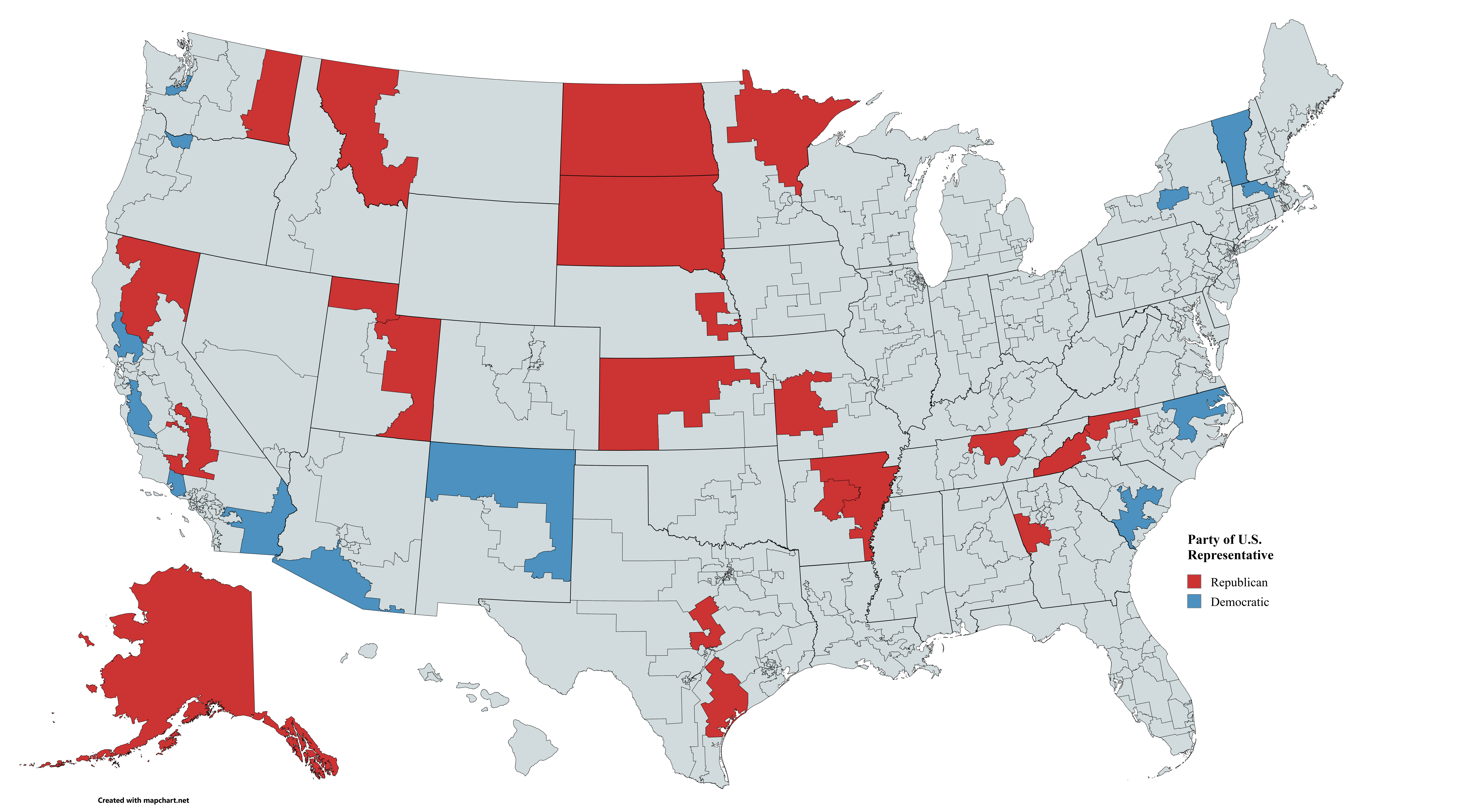
Map created with Mapchart.net
Members of the House and Senate Agriculture Committees should speak out forcefully in defense of county offices and show that Congressional power still exists. Congress should hold oversight hearings, including hearing directly from farmers on how these actions will affect them, as well as from USDA leadership on the rationale for their possibly illegal actions. The administration is required to inform Congress of office closures, and it is clear that this is not currently happening.
Conclusion
There are no winners in the termination of these NRCS leases. This announcement is a clumsy way to negotiate lower leases, there is no real system in determining the merits of closing offices or keeping them open, and these actions will only sow more confusion for farmers while adding to their burden of time and miles traveled for basic services that have been appropriated by Congress. It is unclear what the administration’s goal is with this announcement, but the impacts will be felt on farmers at all scales and life experiences, as well as in blue and red states. Less than one tenth of 1% of USDA’s budget is not worth the thousands of farmers these actions will alienate and make life more difficult for. It’s not good business, it’s not good politics, and it does not reflect the locally-led ethos of NRCS. We urge the reversal of these actions.
[1] Full list of NRCS offices with lease terminations:
-
Saipan, Northern Mariana Islands
-
Arecibo, Puerto Rico
-
San Sebastian, Puerto Rico
-
Utuado, Puerto Rico
-
Fairbanks, Alaska
-
Wasilla, Alaska
-
Yuma, Arizona
-
Batesville, Arkansas
-
Conway, Arkansas
-
Paragould, Arkansas
-
Bakersfield, California
-
Blythe, California
-
Oxnard, California
-
Salinas, California
-
Woodland, California
-
Yreka, California
-
Griffin, Georgia
-
Lawrence, Kansas
-
Amherst, Massachusetts
-
Baudette, Minnesota
-
Columbia, Missouri
-
Greenwood, Mississippi
-
Pearl, Mississippi
-
Missoula, Montana
-
Lincoln, Nebraska
-
Dover, New Hampshire
-
Clovis, New Mexico
-
Gallup, New Mexico
-
Raton, New Mexico
-
Roswell, New Mexico
-
Syracuse, New York
-
Goldsboro, North Carolina
-
Greensboro, North Carolina
-
Hendersonville, North Carolina
-
Wilkesboro, North Carolina
-
Fargo, North Dakota
-
Portland, Oregon
-
Ridgeland, South Carolina
-
Watertown, South Dakota
-
Gallatin, Tennessee
-
Gonzales, Texas
-
Temple, Texas
-
Logan, Utah
-
Monticello, Utah
-
St. Johnsbury, Vermont
-
Dayton, Washington
-
Puyallup, Washington
-
Renton, Washington


