Since 2021, EQIP contracts for "climate-smart" practices have increased above general practices in all 12 Midwest states with help from IRA funding
Summary
IATP has extensively analyzed federal conservation cost-share programs such as the Environmental Quality Incentives Program (EQIP), with a focus on numbers of applications and awards, the share of program dollars going toward industrial agriculture, and differences in implementation across states. In this analysis, we look at how the top 10 practices across the 12 Midwest states have shifted between 2021 and 2024.
We found that, once funds from the Inflation Reduction Act (IRA) started being disbursed in fiscal year 2023 (FY2023), on-farm practices defined as “climate-smart” and their facilitating practices began to dominate the top 10 practices in every Midwest state. But changes to EQIP funding in the recent budget bill and the Farm Bill extension may reduce access to climate-smart practices made possible by EQIP going forward.
What is EQIP?
EQIP is administered by the U.S. Department of Agriculture (USDA), and is a popular and voluntary program that aims to increase environmental benefits to farmers through cost sharing and technical assistance on farms in the United States. Farmers work with their local Natural Resources Conservation Service (NRCS) to understand their farm’s conservation needs and implement strategies that work best for their land. Historically, thousands more farmers have applied to EQIP than have been awarded contracts. In FY2024, between 56-57% of applicants to EQIP were rejected, while between 2010-2020 the rejection rate averaged 69%.
What is a climate-smart practice?
Climate change directly impacts farmers in several ways, including increasing frequency and intensity of floods, droughts, and pest pressures. Through USDA’s NRCS Climate-Smart Agriculture and Forestry (CSAF) practices, targeted funding is provided to help farmers address climate challenges and make their farms more resilient to extreme climate events. Programs like EQIP and the Conservation Stewardship Program (CSP) contain extensive lists of voluntary practices that can qualify for cost-share funding. CSAF practices cover several areas including soil health, nitrogen management, livestock partnership, and agroforestry — examples of practices included in USDA’s CSAF list are no- or reduced-till farming and planting cover crops, windbreak and shelterbelt establishment, and renovation for reducing erosion and carbon sequestration.
Why does this matter?
Since the passage of the IRA in 2022, there has been a dramatic increase in funding for EQIP, and thus also an increase in the number of EQIP practices implemented on the ground. IRA funding was intended to stair-step up to a peak in FY2027, then back down until funds were exhausted in FY2031. Changes in policy in the One Big Beautiful Bill Act (OBBB) in 2025 mean that, in the short-term, EQIP funding will be lower than expected, but increase again a few years in the future, starting in 2031. Perhaps more importantly, the restriction of IRA funds to CSAF practices will no longer apply, meaning that we may not see the focus on climate-smart agriculture within EQIP.
Additionally, recent changes to policy mean wealthier farms are better able to access EQIP dollars. Highly profitable farms often have more time and resources to apply and receive funding for projects, at the expense of small and mid-size farms. Before Congress extended the Farm Bill in late 2025, a single farm could not access more than $450,000 in EQIP funds over the course of five years. Likewise, before the OBBB, farms with an adjusted gross income (AGI) of $900,000 or more were not eligible for program payments.
For example, farms can receive six-figure EQIP contracts to build anaerobic digesters, technology which is designed to reduce methane emissions from manure. Despite the promise of emissions reductions, they can also lead to an increase in herd size, which may negate emissions reductions from the digester. The recent policy changes from the OBBB and the Farm Bill extension only amplify the risk of making EQIP opportunities out of reach for local small to mid-size farms.
What have we found?
Top 10 EQIP practices (by number of contracts) in 12 Midwest states, 2021-2024
Use the arrows in the upper left corner to switch between states. Use the replay button in the lower left corner to watch the change in EQIP practice ranking from 2021 to 2024.
This data visualization analyzes EQIP practice adoption from FY2021 to FY2024 in the 12 Midwest states (defined as Illinois, Iowa, Indiana, Michigan, Ohio, Wisconsin, Minnesota, North Dakota, South Dakota, Nebraska, Kansas, and Missouri). The data display shows the top 10 EQIP practices in each state by number of contracts each year. Note the key that distinguishes which practices are climate-smart (deep green), those that are needed to facilitate the climate-smart practices (light green), and those that are general practices (purple).
In an initial glance as you click through the Midwest states (in alphabetical order), you can see an overwhelming popularity in cover cropping. The only states where other practices take the lead are Indiana (narrowly leading by brush management), North Dakota, Ohio, and South Dakota. States such as South Dakota and North Dakota have a larger affinity towards soil health maintenance and grazing animals. Additionally, as the bar chart race is played from 2021 to 2024 across the 12 states, climate-smart practices become increasingly prevalent.
A prime example is Illinois. In 2021, the top two practices (Underground Outlet and Water and Sediment Control Basin) are general practices, but by 2024, those quickly drop down to eighth and ninth place, behind CSAF practices. By 2024, Minnesota’s top 10 list was entirely CSAF practices. Several other states consistently see contract awards for practices like Heavy Use Area Protection that require the installation of concrete or gravel to reduce erosion by large animals (cattle) and equipment. This practice provides mitigation for land erosion but may also incentivize confined animal feeding operations (CAFOs).
The combination of increased funding for EQIP and loosening restrictions on farm revenue requirements along with potentially unlimited awarded funding may lead to a shift in practices funded in the future. Activities that help large operations may compete with more cost-effective and widespread use of practices like cover crops. Through this year-to-year analysis we can better compare the changing policies with the changing practices.
Notes on the data
EQIP contracts are publicly available through a request to USDA and provide insights into which EQIP practices are being contracted, how much is being spent on the practices, and which states are employing which practices most frequently.
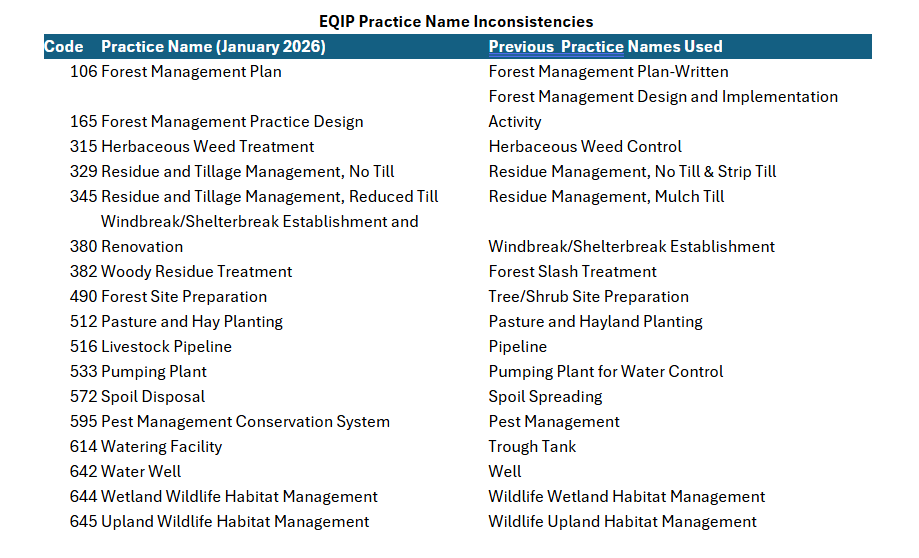
There are limitations to the EQIP data. One key variation across the four years of EQIP awards is the naming of practices. For example, the practice “Watering Facility” was referred to as “Trough Tank” in FY2023 and FY2022. All practices were referred to by their FY2024 name. Please refer to Appendix A for a list of the displayed practices, their associated codes that remain constant, and the previously used names.
The climate-smart mitigation activities list has been modified and added to, and its relevance going forward is up in the air. We will continue to monitor changes to the list that emerge from NRCS.
Appendix: Table of EQIP Practice Name Inconsistencies
Note: IATP does not advocate for use of "climate-smart" as a general term relating to climate resilience or agroecology, and as a term co-opted by corporate ag groups. Here we use it as an official USDA designation.