In March, IATP Executive Director Sophia Murphy traveled to Cameroon for the World Trade Organization (WTO) Ministerial Conference. While the WTO still struggles to adapt and advance negotiations between member nations, proposals from civil society organizations held promise for new ways to approach trade in a changing world. Read on to learn more about what she took away from the conference, where the WTO stands in a shifting international landscape, and the work that's left to be done.
I landed in Yaoundé, Cameroon for the 14th World Trade Organization (WTO) Ministerial Conference (MC14) late on March 23, two days before the main event. Cameroon was ready for us — the arrivals hall funneled conference participants into dedicated channels to go through the steps for entry. The process was cumbersome and the travelers were tired, yet the whole was cheerfully managed by the staff. It was easy to find the humor in the situation, and to appreciate the welcome it betokened. The arrival experience set the tone for the host country for the entire week: not everything ran as promised, but things got done with big smiles and a generous spirit. Sadly, that spirit did not carry over into the conference itself.
Ministerial conferences are important. The governments that belong to the WTO — at this time there are 166 members — hold a meeting every two years for the Ministers of Trade (in the U.S. that person is called the U.S. Trade Representative) to sign agreements on what has been negotiated, and to set the agenda for the next two years. Past ministerial conferences include MC3 held in Seattle in 1999, which proved a major inflection point for global trade negotiations. Outside in the streets, peaceful labor union and environmental organization protests turned into violent confrontations with an inexperienced police force, ultimately ending in the city’s mayor handing in his resignation. Inside the conference, the first big blow to the WTO agenda of globalization was struck by Global South governments, in the first instance from Africa, who refused to adopt an unfair agenda the U.S. and EU had agreed to in advance.
Another notable ministerial, albeit far less dramatic, was MC10 in Nairobi in 2015 when the membership finally committed to the elimination of all export subsidies on agricultural commodities, keeping a promise first made at the WTO’s inception in 1995. That said, re-reading my final roundup on MC10 is a reminder of just how long the WTO has been struggling to do something.
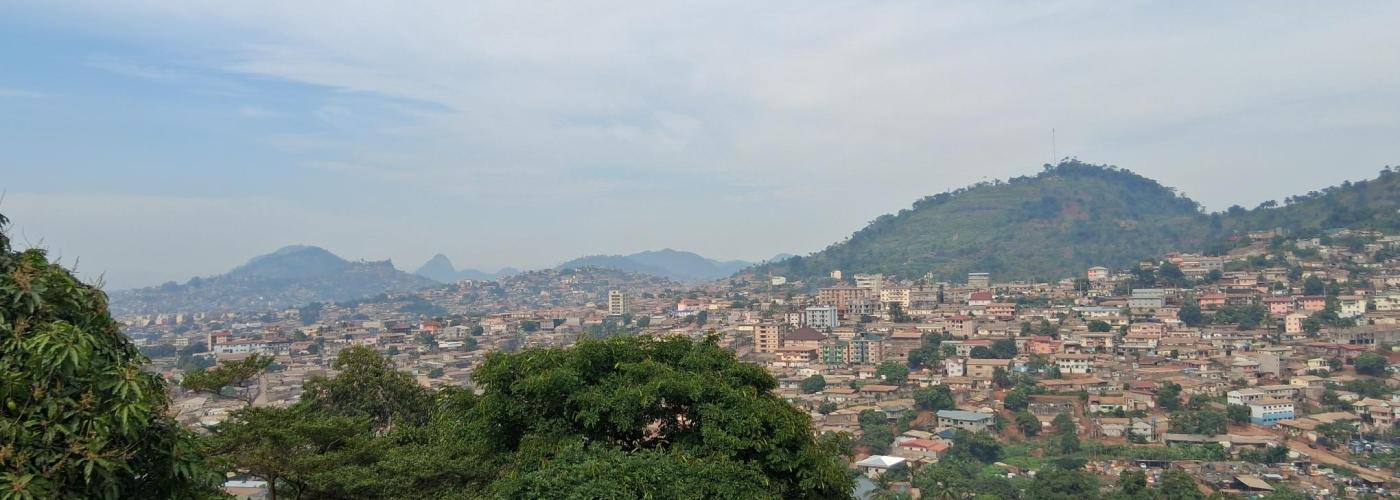
Cameroon proved neither riotous, nor consequential. The WTO negotiators met at the Palais des Congrès, a palatial building atop one of Yaoundé’s many scenic hills. There, diplomats and ministers expressed mistrust, frustration and, in the case of the U.S. delegation, distain, too. U.S. Trade Representative (USTR) Jaimeson Greer’s post-conference op-ed in the Wall Street Journal — like his speeches in Yaoundé — displayed a new low of national self-absorption and discourtesy.
What is the WTO’s role in an ever-changing global trade landscape?
Setting aside the demands of an administration that is allergic to multilateralism and wedded to unpredictable and punitive tariffs, it is also true that the WTO struggles to remain relevant. It has proven to be profoundly unable to adapt, even in the face of huge changes in international trade over the last 30 years. Today’s three most powerful members — the U.S., EU, and China — have mutually incompatible interests, while other emergent trading powers, such as Brazil and India, have the power to stop other members, but lack the clout to successfully advance their own agendas.
The economic objectives of the WTO’s rules — greater integration of national economies into international markets — have largely been realized but the politics of that integration remain deeply divisive.
That has made blaming others more appealing than finding solutions to the negotiating paralysis. Nor are civil society organizations immune. The few NGO stalwarts who track the WTO (IATP is one) are on high alert for any changes, which tend to be immediately viewed with suspicion — and not without reason. Yet the result is not that different to the U.S. governmental wrecking ball: trust no one, do not allow new topics for discussion, distrust even informal discussion spaces in case they become rule-making spaces, and continue to insist on tying every area of the negotiations together in a so-called “single undertaking”, meaning that nothing can be agreed until everything is agreed, even on unrelated issues. Between that and the veto that each member state enjoys, it is hardly surprising that talks falter repeatedly.
The second night I was there I called my daughter, now an undergraduate in college. She asked me what I was doing in Yaoundé and I had to pause. What was I doing? No one was expecting the WTO members to overcome their deadlocked talks. There was a time, for instance back in Seattle in 1999, when civil society organizations including IATP did not just block proposals — they also promoted ideas. We wanted to change the rules, and the way the organization worked.
But the chances of getting useful reforms to WTO agricultural trade rules are low. As if to parody how little they respect international agreements, the U.S. government objected on day one to the use of the word “sustainable” in a simple paragraph on continuing work in the agriculture committee that members had agreed to bring to the conference. This, despite the U.S. being party to countless agreements that not only use the word but that are built around it (for example, the UN’s 2030 Agenda for Sustainable Development). How can we hope to see positive change if that is how what has been the most powerful WTO member approaches the negotiations?
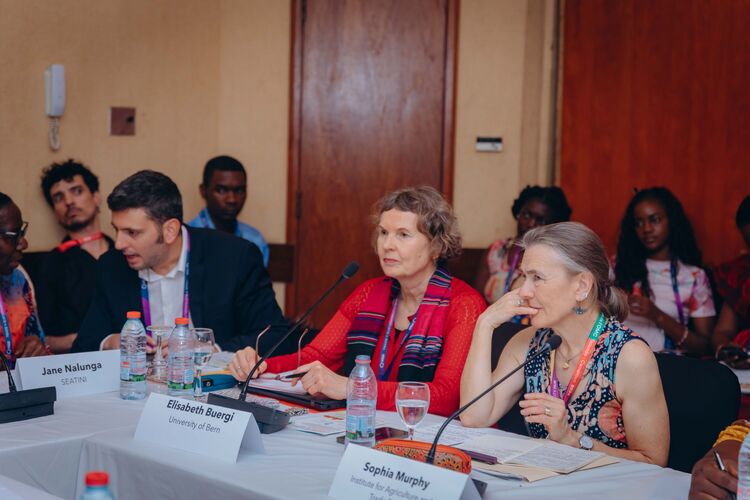
Photo credit: International Institute for Sustainable Development
While WTO negotiations stall, civil society events take a step forward
Fortunately, there were other far more constructive places to find discussion and content during MC14. In particular, the Trade and Sustainability Hub (organized by the International Institute for Sustainable Development) offered two days of workshops, with research findings, policy proposals, and opportunities for debate. This was a space for people engaged in using trade rules, sharing their ideas on how to do things better, and how to work with and improve the systems and institutions now in place.
I joined a colleague, Dr. Elisabeth Bürgi Bonanomi, to introduce the Agreement on Agriculture Re-Imagined (AoA R) project in a joint session with Transform Trade, who invited small-scale African farmers to speak about the challenges they face and their priorities for trade reform. We got lots of interest and engagement from the audience, and in the following days had many informal discussions with a variety of trade officials, legislators, and commentators who were curious to understand the model treaty and how they might use it.
La Via Campesina (LVC) was in Yaoundé, too, to launch their proposed new treaty for agricultural trade at a meeting of social movements hosted by the Cameroonian peasant organization PROPAC (see the LVC declaration here). While continuing to reject the WTO as a forum for trade negotiations, LVC and its allies are proposing a new forum for trade rules as well as a new basis for the rules. Much of their critique and some of their proposals align with the AoA R model treaty outcomes, including the call to anchor trade rules in existing international commitments to human rights and the environment.
Despite the bleakness of the MC14 negotiations, there is plenty of useful work to be done:
- Renewed widely shared recognition that trade rules matter and that the rules we have need to change have created momentum for change. Those rules may need to be developed elsewhere than the WTO, in multilateral institutions where governments are considering new measures of our wellbeing, such as the UN’s Beyond GDP, which could prompt significant economic transformations around the world.
- Everywhere we took the discussion of the AoA R draft model treaty for food systems and trade, we were met with curiosity, questions, and suggestions for how to improve it. Despite the circumstances, cynicism was at a welcome low.
- The fight has changed, but nevertheless it goes on. Governments no longer offer unquestioning support for globalization. We need to weave together the new economic thinking coming from proposals for just and green transitions with new thinking on how we will structure international cooperation and multilateralism. New structures will need to deal with the inequalities that have degraded trust and blocked progress in trade negotiations for more than a decade. The current U.S. administration is not so minded, but they are not as powerful as they think. The U.S. may be left behind as more pragmatic and forward-facing governments begin to forge ahead.