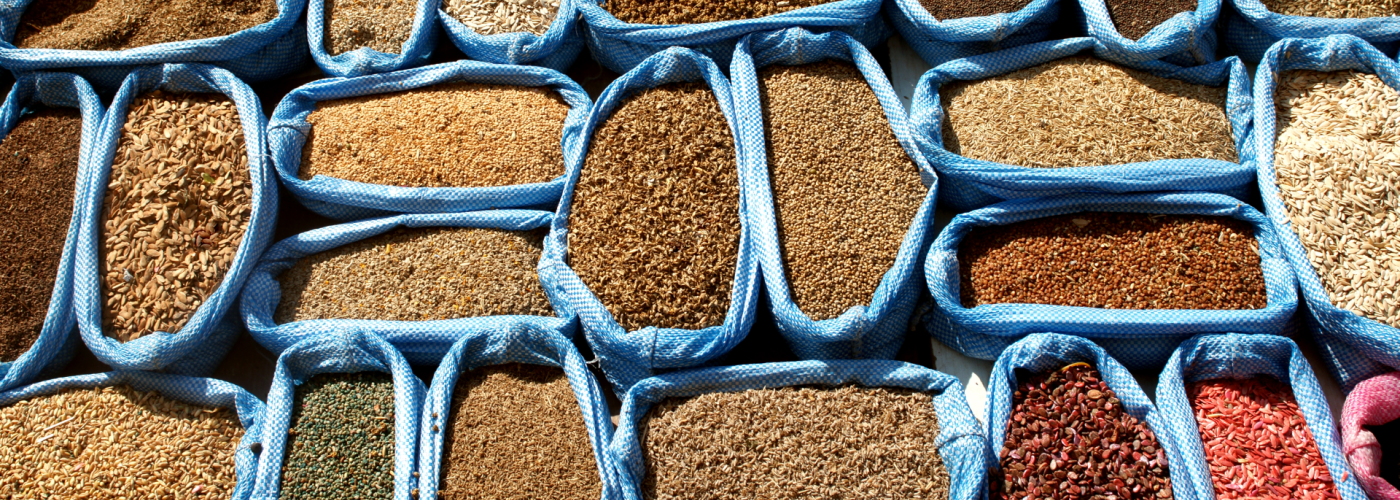
Central to the survival of small and mid-scale farmers is their right to save, use, exchange and sell their own seeds — that is, what agroecology advocates have come to recognize as their seed sovereignty. Such Farmers' Seed Systems often prioritize developing and maintaining seed varieties that are specifically adapted to local micro-climates, soil types and the diverse cultural needs of farming communities. Thus, guaranteeing farmers’ seed sovereignty has emerged as a central tenet to crop-genetic diversity and agroecological transitions, along with farmers’ control of land and other agricultural inputs more broadly, which are needed to adapt to rapid climate change.
However, this genetic diversity of plants, so essential in the fight against poverty and climate change, is at risk today. The diversity of domesticated plant varieties is disappearing at an alarming rate while private sector interest in the commercial use of genetic resources has increased in line with modern biotechnologies and accompanying demands for intellectual property rights of plant breeders.
In a series of meetings organized by IATP on the public policies needed to support agroecological transitions, colleagues in the Global South noted the threat posed by provisions in trade agreements that require governments to ratify UPOV 91, a restrictive international treaty that protects patented seeds to the detriment of traditional or even hybrid systems of seed governance that have emerged in local and national contexts. The result has been an expanded dependence on imported seeds, increasing demand for foreign exchange and increasing reliance on the agrochemical inputs that such seeds usually require — all the while missing an important opportunity to invest in rural development and agroecological transitions in support of local food sovereignty. These demands have been the subject of campaigns and advocacy in many countries in the Global South.
IATP’s new policy brief, “Battling for Farmers Seeds Systems: UPOV 91 and Trade Agreements,” focuses on the requirement in trade agreements that countries ratify the restrictive UPOV 91 treaty. It proceeds in three parts:
- First, it shows how two sets of agreements— the UPOV conventions and the Trade and Intellectual Property Rights (TRIPs) rules at the WTO — have systematically reduced policy space, undermining Farmers’ Seed Systems. UPOV 91 prohibits even small-scale farmers from saving or sharing protected seeds. Those policies have consolidated the hold of industrial agriculture and threatened agroecological transitions.
- Second, it shows how better rules on seeds could potentially be shored up through three initiatives — the Convention on Biological Diversity (CBD) and its Nagoya Protocol, the International Treaty on Plant Genetic Resources for Food and Agriculture (ITPGRFA), and two UN initiatives: The United Nations Declaration on the Rights of Indigenous Peoples (UNDRIP) and the United Nations Declaration on the Rights of Peasants and Other People Working in Rural Areas (UNDROP).
- Third, it briefly explores the current context, where many developing countries that have not joined UPOV 91 are facing multi-pronged pressure to do so by countries such as the U.S. Some countries have already developed their own approaches to seed protection that meet their specific conditions. The United States-Mexico-Canada Agreement (USMCA) and all U.S. trade deals negotiated since then require countries to ratify and implement UPOV 91. Many are resisting, but the pressure continues.
A planned review of the USMCA is expected to begin in the fall of 2025, culminating in a decision in July 2026 to either ratify a possibly revised version, or to enter into a 10-year process of annual reviews and possibly repeal the trade agreement altogether. It is noteworthy that the North American Free Trade Agreement (NAFTA, the precursor to the USMCA) required Mexico to join either UPOV 91 or the 1978 version, which allows for exceptions for smallholder farmers. Mexico ratified UPOV 78 but now is under pressure to join the more restrictive 1991 version of UPOV. The upcoming review of USMCA creates an important opportunity for the three countries to remove the requirement for UPOV 91 and instead advance more flexible rules in support of farmers seed systems that ensure biodiversity and honor seed sovereignty.
Read our full policy brief, “Battling for Farmers Seeds Systems: UPOV 91 and Trade Agreements,” to learn more.