On New Year’s Eve, the U.S. Department of Agriculture (USDA) announced the details for $11 billion of a $12 billion farm bailout plan. While the Trump administration’s trade fights with countries have raised costs and affected markets for nearly all farmers, the initial payout goes exclusively to commodity crop farmers. The aid is described as bridge assistance to help farmers access loans for next year. But without addressing the deeper problems in the farm economy, USDA and Congress will likely have to continue a cycle of yearly farmer bailouts.
USDA’s Farmers Bridge Assistance Program sends one-time payments to commodity crop farmers, expected to be distributed by the end of February. While providing some temporary relief, for most farmers the payments will go toward paying down debt, then to seeds, fertilizer, and inputs for this planting season, according to a farmer survey earlier this month. In fact, the largest beneficiary of the ad hoc farmer bailout during the first Trump administration was an alternative farm lender, where farmers directed their government payments to pay down their loans.
The payments were calculated by USDA using a model of estimated losses, which includes an average cost of production per crop acre and the market price paid to farmers. But by using national averages, USDA does not account for regional differences in cost of production (use of inputs and yields vary considerably) or market prices. Per acre, corn will receive $44.36, soybeans $30.88, wheat $39.35, rice $132.89, cotton $117.35, oats $81.75, peanuts $55.65, and sorghum $48.11. The program includes a payment limit of $155,000 per active farmer.
Farmers excluded from the program include those raising livestock and poultry and organic producers. While there is $1 billion left for fruit, vegetable, and sugar farmers, it’s not clear how or when that money will be distributed. The specialty crop industry, which includes fruits and vegetables, says $1 billion is not enough money, and $4 or $5 billion is what is needed to cover losses associated with higher costs tied to tariffs and workforce challenges related to immigration raids.
Farmers are facing multiple years of losing money. The gap between farmers’ costs and what they are paid is the largest in a decade.
Higher costs tied to the Trump administration’s use of tariffs affect all farmers and include costs for inputs, buildings, and equipment. Despite the administration’s decision to walk back many of its initial tariffs and offer a slew of exemptions, North Dakota State University reported in December that tariffs on agriculture inputs are still at 9%, hitting herbicides, pesticides, and tractors the most.
The loss of exports due to trade fights, particularly with China, has lowered prices for many commodity crops. While the Trump administration announced a trade deal with China in October, no text of the agreement has been made public. The administration has claimed China has promised to make purchases of soybeans, but China has not confirmed those numbers. Even if fulfilled, the soy purchases that the administration claims China has agreed to are lower than previous years.
Crop prices frequently drop below farmers’ costs due to market gluts driven by Farm Bill programs that incentivize over-production of a handful of commodity crops. A small handful of companies control nearly all sectors of agriculture, from inputs to grains and meat production. A recent report by More Perfect Union explains how farmers continue to lose money, digging into the role of corporate concentration in the farm debt crisis and how government payments to farmers are often passed on directly to input suppliers and farm creditors.
Now that USDA has announced the details, the payments still have to reach commodity crop farmers. A December USDA Inspector General report documented dramatic staff cuts in the first half of 2025, including cuts to the Farm Service Agency (FSA) responsible for handling the bridge payments. The National Sustainable Agriculture Coalition estimates FSA has lost an estimated 1,200 staff since January 2025.
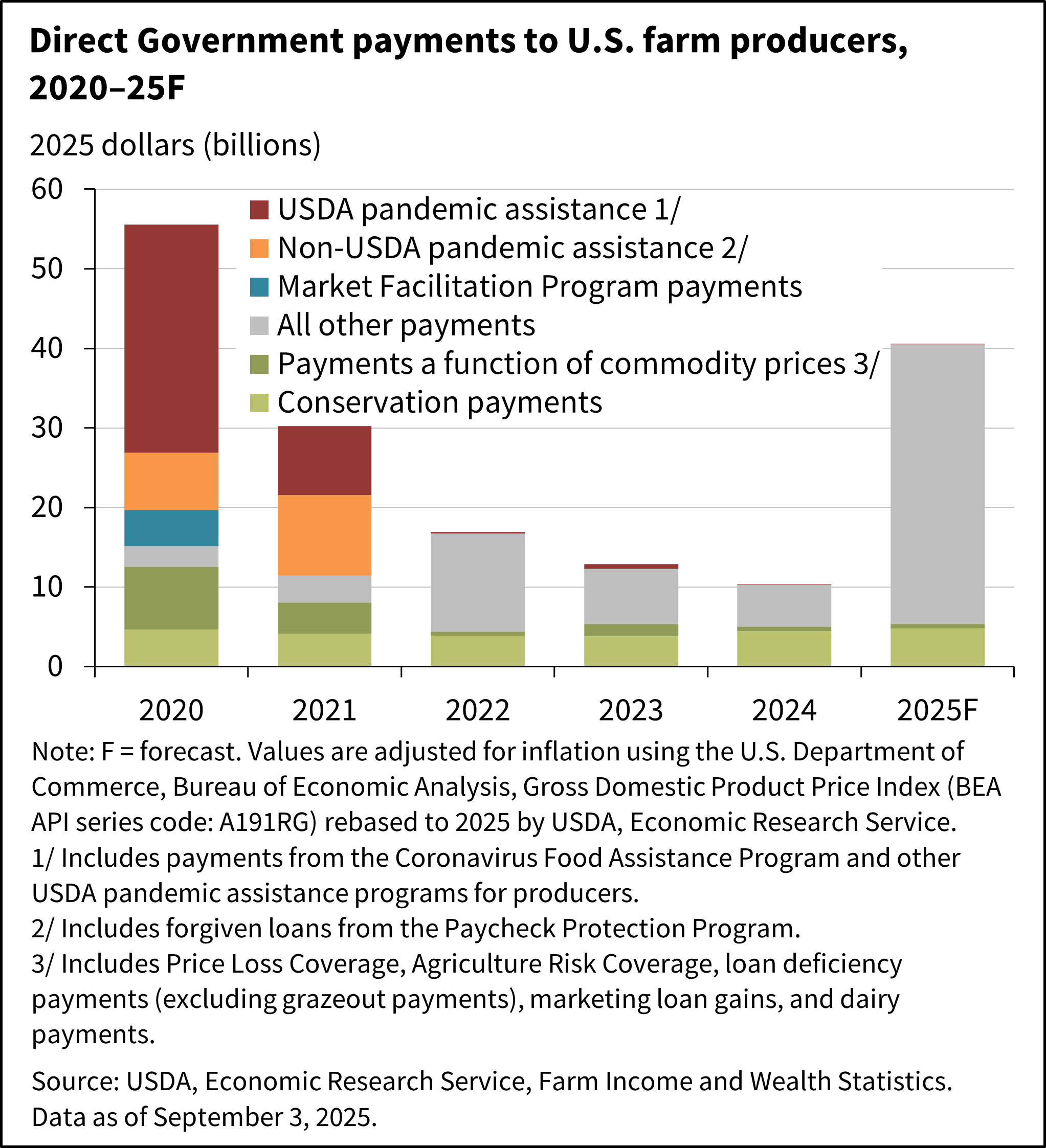
Payments under the first Trump administration in 2020 and the second term in 2025 ballooned compared to previous years, establishing what seems to be an official farm policy of throwing money at the problem — without any strategy to address the market fundamentals. Secretary of Agriculture Brooke Rollins promises the golden age of agriculture is just around the corner and that these payments won’t be needed in the future. But farm groups are already asking for more farmer aid in 2026.
Lost in the push for more ad hoc aid is that Congress has yet to pass a Farm Bill (now more than two years late), which would allow Congress to design a more comprehensive strategy to address the drivers of this punishing farm economy. Instead, USDA seems content to throw significant amounts of public money at the emerging farm crisis without a plan to end it.